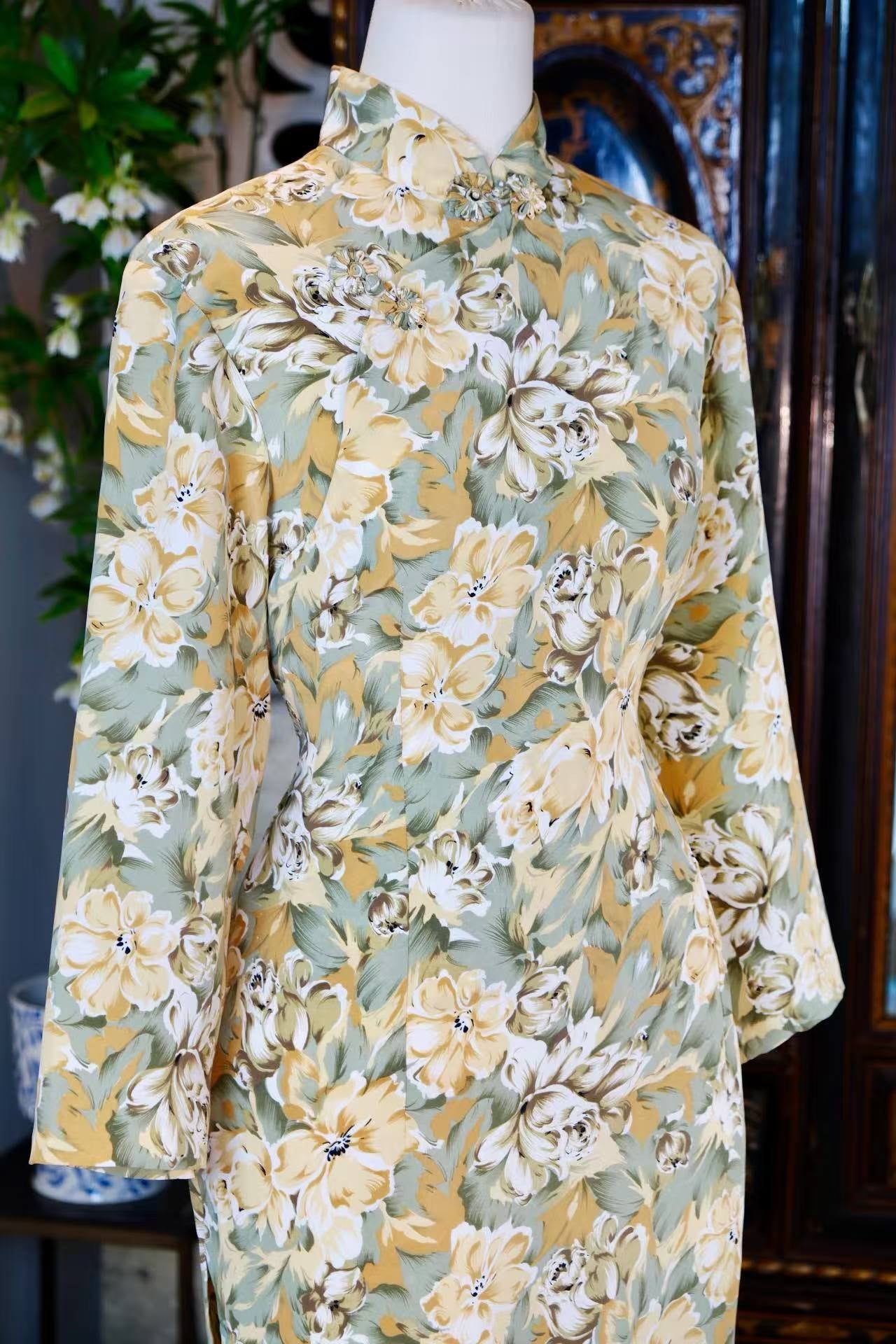
"Green branches adorned with golden blossoms; emerald leaves weaving shimmering light."
Against a delicate pale-yellow backdrop, white peonies and camellias with golden hearts bloom in succession. The petals are outlined using a sophisticated bleeding technique, as vivid and nimble as a Gongbi (fine-brush) nature sketch. Ink-green foliage intertwines between the blossoms, creating a lush imagery of "spring revealed in every flower." This printing craftsmanship inherits the elegant aura of Song and Yuan Dynasty bird-and-flower paintings while integrating the vibrant colors of early 20th-century Shanghai "calendar girl" posters—a perfect aesthetic epitome of Taiwan’s 1960s textile philosophy: "Refining Chinese essence with Western techniques."
This Qipao is particularly renowned for its "Live Pleat" (Huo Zhe) tailoring. Hidden tucks and pleats are concealed near the side slits, allowing the hem to sway gracefully with every step, creating a play of light and shadow like dancing flower reflections. Such a technique demands that the pattern maker possess a deep understanding of ergonomics and requires the weaver to master the tension of silk. Consequently, surviving examples are exceedingly rare; perhaps less than one in ten remains today.
The 1960s was a period of technical innovation for Taiwan’s textile industry. The printed silk used in this robe retains the smooth texture of traditional Hangzhou silk while innovatively employing mineral pigment immersion dyeing. This ensures that the floral colors remain as brilliant as new even after sixty years, serving as an industrial witness to "ancient roots finding new life." As a unique piece in a private collection, it carries not only the hidden threads of cross-strait textile history but also the eternal poetic sentiments of a generation of master craftsmen.