深圳溯源
Couldn't load pickup availability
如果说那件香芋紫羊绒旗袍是Woo女士在温哥华雪季里的“
这不仅仅是一件旗袍,更是一束被定格的光。在那个没有暖气、
一、视觉的盛宴:意大利织金与极简的碰撞
这件旗袍最令人屏息的,
- 面料溯源:这并非寻常的苏杭织锦,
- 极简剪裁:
- 无袖设计:大胆采用了无袖剪裁,
- 隐形门襟:最引人注目的是,这件旗袍摒弃了传统的盘扣设计。
二、衣以载道:弥敦道644号的“总统”威仪
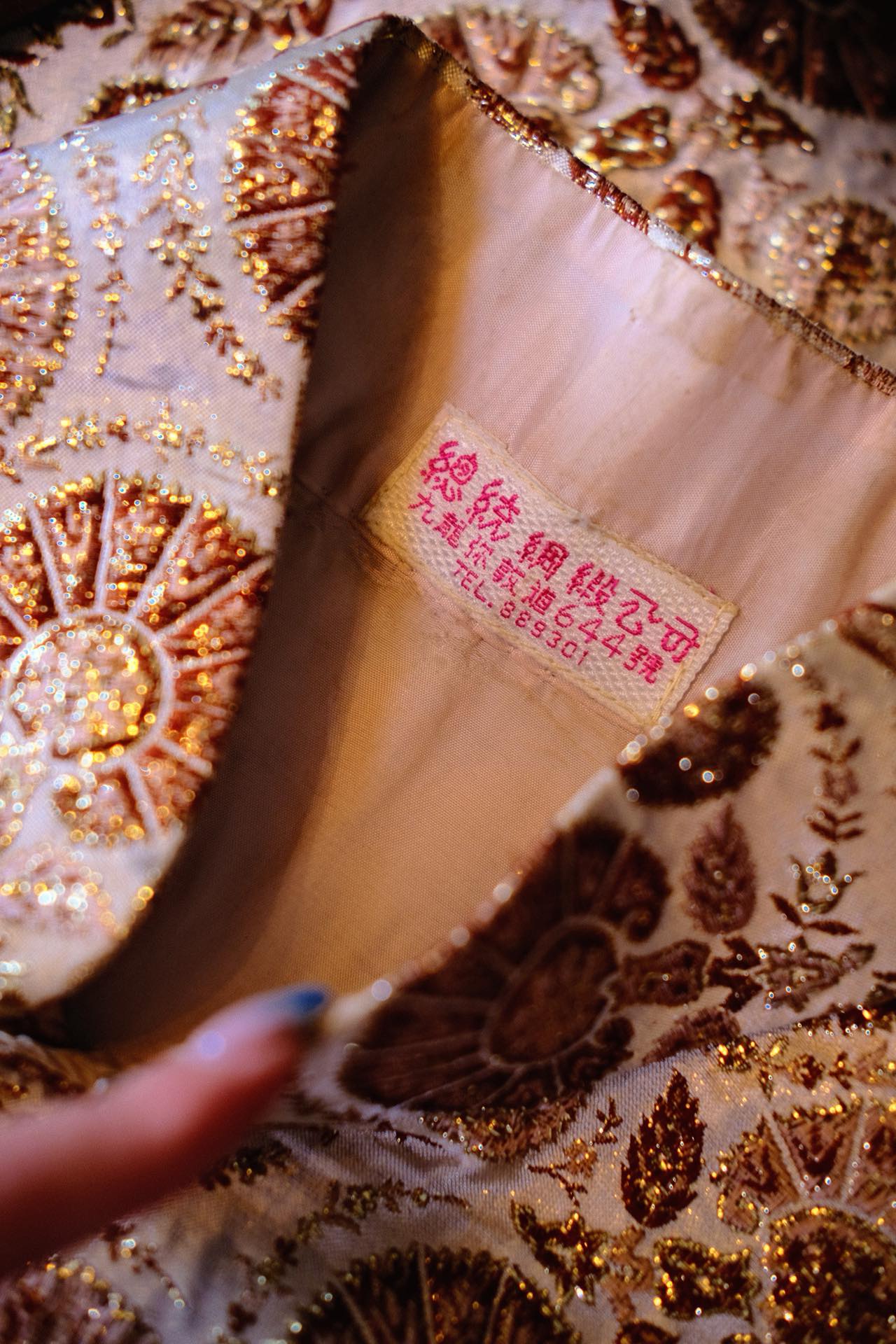
内衬那枚红色的标签——“總統綢緞公司,九龍弥敦道644號”,
“总统”二字,在六十年代的香港商界,代表着一种霸气与权威。
我们可以想象这样一个场景:Woo女士从温哥华飞抵香港,
于是,东方的剪裁骨架,遇上了西方的面料工艺,
If the taro-purple cashmere qipao served as Ms. Woo’s "gentle soliloquy" amid Vancouver’s snow season, then this gold-woven piece—crafted by the prestigious "President Silk Company" (總統綢緞公司) in Hong Kong—is her silent "power manifesto" for defining moments.
This is more than a garment; it is a ray of light captured in perpetuity. In an era when architectural heating was limited and formal indoor dress was strictly mandated, this fluid, undulating gold acted as the most radiant winter sun on Ms. Woo's shoulders.
The most breathtaking quality of this qipao is the sculpted, near-monumental luxury of its textile, paired with a non-traditional, ultra-modern silhouette:
The Textile Provenance: This is no ordinary Suzhou or Hangzhou brocade, but a rare yardage of imported Italian gold-woven jacquard that crossed oceans to reach her archive. Renowned for their precision mechanical milling, Italian textile houses engineered this fabric so that the gold threads are not merely laid flat; instead, through a complex jacquard technique, they form relief patterns resembling a "Golden Corona" (Rimian) or vintage medallions. Woven into an ivory-white canvas, the metallic threads flash with a crisp, aristocratic luster, bridging Eastern opulence with European courtly solemnity.
The Minimalist Silhouette:
The Sleeveless Cut: The garment boldly adopts a sleeveless profile—a highly progressive and contemporary choice for a formal evening qipao in the 1960s. It unreservedly showcases the wearer’s sharp, toned arm lines, projecting executive capability and confidence while shedding the fragile delicacy of traditional iterations.
The Hidden Placket: Most remarkably, this qipao entirely discards traditional frog buttons. The placket uses an entirely concealed side-zipper or hidden snap closure, allowing the architectural lines of the torso to flow seamlessly like liquid metal without any visual interruption. This "de-ornamented" approach represents the rise of mid-century minimalism, illustrating Ms. Woo’s forward-thinking aesthetic—she required no external frog buttons to prove this was a qipao; her presence alone was the definitive statement.
Stitched inside the lining is a vibrant red label: "President Silk Co., 644 NATHAN RD. KOWLOON."
The word "President" in 1960s Hong Kong commerce carried an unmistakable aura of authority and peak luxury. Ms. Woo’s decision to commission this piece from this specific establishment beautifully mirrors her status as a pioneering founder in the Canadian supermarket industry.
One can easily envision the scene: Ms. Woo landing in Hong Kong from Vancouver, carrying this elite Italian-loomed yardage, and stepping into this grand textile house on Nathan Road. Her instructions to the master tailor would have been precise: "I want something completely unique. Strip away the archaic closures; keep the lines as sharp and clean as a European evening gown."
Thus, the structural spine of Eastern tailoring met the mechanical brilliance of Western textile arts, bound together by the skilled hands of a Hong Kong master. This qipao stands as the ultimate material record of Ms. Woo's trans-Pacific commercial empire and her peerless design literacy. It rests in quiet repose, still emitting the brilliant, blinding light of an Eastern woman who carved out a legendary legacy across the Western world.