深圳溯源
Couldn't load pickup availability
衣服尺寸:
胸围/腰围/臀围:106/102/112 厘米
衣长:108 厘米
细节描述:
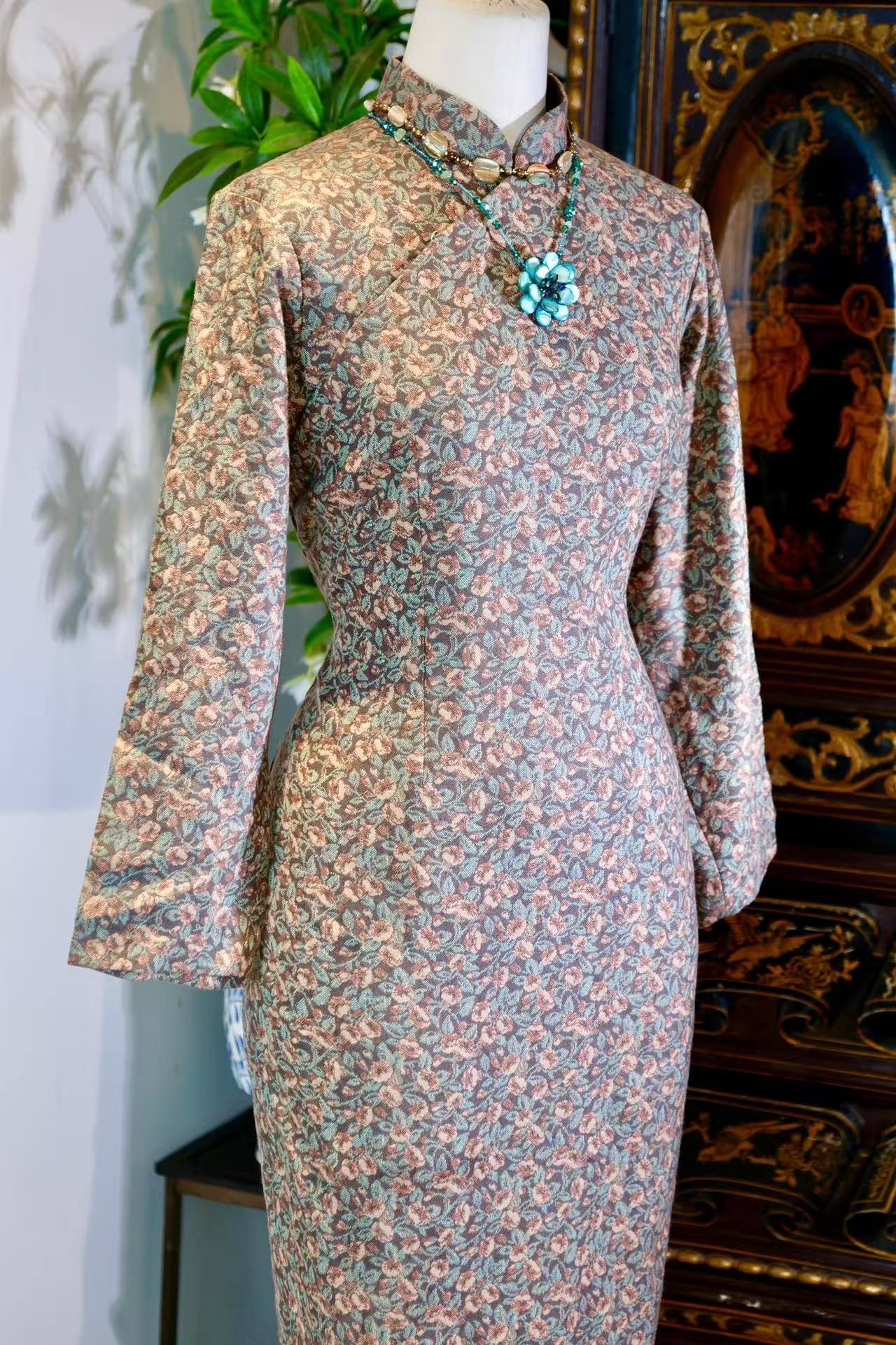
当指尖抚过这件六十年代台湾针织旗袍的肌理,仿佛触到了时光的褶皱。灰褐底布上,浅粉与淡蓝的碎花如星子散落,细密如织的提花工艺让每一朵花都在经纬间呼吸。这让我想起沈从文先生在《中国古代服饰研究》中所述:“旗袍之美,在剪裁之简约,更在纹样之精微。”彼时台湾纺织业初兴,针织面料取代传统丝绸,既承袭了旗袍的古典轮廓,又以现代材质回应着战后社会对实用与美学的双重渴求。
一、图案:锦灰堆中的春意
此旗袍的纹样,堪称“锦灰堆”美学的现代演绎。锦灰堆,原指元代画家以残破古籍、断简残篇入画,于破碎中见完整的艺术手法。而这件旗袍上的碎花,恰似将春日落英碾作尘,又以匠心重组为锦绣——灰褐底色如旧宣纸,浅粉花瓣似褪色的胭脂笺,淡蓝叶片若泛黄的竹纸,三者交织成“残缺的圆满”。正如明代计成在《园冶》中所言:“虽由人作,宛自天开”,这种“不完美”的纹样,反而成就了东方美学中“枯山水”般的留白意境。
二、故事:海岛上的衣香鬓影
六十年代的台湾,正处于传统与现代的十字路口。彼时旗袍不再是上海滩名媛的专属,而成为海岛女性日常着装的“新传统”。这件针织旗袍,或许曾属于一位在台北牯岭街旧书摊前驻足的女教师,或是高雄港口边等待归人的妻子——针织面料的弹性与透气,让她们在亚热带气候中既能保持端庄,又不失行动的便利。
尤为珍贵的是其“台湾产”身份。据《台湾纺织业发展史》记载,六十年代台湾针织业刚引进日本技术,能将传统旗袍纹样转化为针织提花者,不过寥寥数家作坊。此旗袍领口、袖口的暗纹与主体图案浑然一体,无接缝痕迹,足见当年工匠“以针代笔”的功力。正如梁实秋在《雅舍谈吃》中写台北的“旧时风味”,这件旗袍亦是“旧时衣风”的活化石,见证着海岛在文化断裂与重构中的温柔坚守。
三、稀缺:针织旗袍的“孤本”价值
在古董旗袍收藏界,六十年代台湾针织款堪称“稀有物种”。相较于丝绸旗袍的华丽易损,针织面料虽更耐穿,却因材质特性难以保存——纤维老化、弹性流失,能留存至今且纹样清晰者,百不存一。
从艺术风格而言,它打破了传统旗袍“重工刺绣”的范式,以“素花浅草”的简约,预示了七十年代极简主义的先声。这种“传统纹样+现代材质+简约设计”的三重变奏,使其成为研究二十世纪中叶东亚服饰转型的“标准器”。正如巫鸿在《中国绘画中的“女性空间”》中所言:“衣饰是身体的延伸,更是时代的镜像。”这件旗袍,正是六十年代台湾社会“传统未远,现代已至”的最佳注脚。
四、结语:穿在身上的历史诗学
当我们将这件旗袍置于当代语境,它不再仅是一件衣物,而是一部“穿在身上的历史诗学”。它让我们想起张爱玲笔下“生命是一袭华美的袍”,而这袭“灰褐碎花”的袍,虽无昔日华彩,却因承载了时代的风霜与个体的温度,而拥有了超越物质本身的精神重量。正如宋人林逋所咏:“疏影横斜水清浅,暗香浮动月黄昏”——这件旗袍的美,正在于那份“暗香浮动”的含蓄与悠长,在时光的长河中,静静诉说着属于六十年代海岛的衣香鬓影。
Measurements / Size Guide:
Bust / Waist / Hips: 106/102/112 cm
Total Length: 108 cm
Detailed Description:
Touching the texture of this 1960s Taiwanese knitted cheongsam (qipao) is like feeling the folds of time. Against a taupe backdrop, tiny blossoms of pale pink and light blue are scattered like stars, their intricate jacquard patterns breathing within the warp and weft. It recalls the words of Mr. Shen Congwen in Researches on Ancient Chinese Costumes: "The beauty of the qipao lies in its minimalist tailoring, but even more so in the subtlety of its motifs." At that time, Taiwan's textile industry was in its infancy; knitted fabrics replaced traditional silk, inheriting the classical silhouette of the qipao while responding to the post-war demand for both utility and aesthetics.
The motif of this qipao is a modern interpretation of the "Jin Hui Dui" (Ashes of Splendor) aesthetic—an art form where Yuan Dynasty painters created complete compositions from fragments of ancient scrolls and broken manuscripts. The scattered flowers on this garment are like spring petals crushed into dust and reassembled with ingenuity. The taupe base resembles aged rice paper, the pink petals evoke faded rouge stationery, and the blue leaves suggest yellowed bamboo paper—together, they form a "perfection found in fragmentation." As Ji Cheng noted in The Craft of Gardens: "Though made by human hands, it appears as if crafted by Heaven." This "imperfection" achieves a Zen-like "Karesansui" (dry landscape) void within Eastern aesthetics.
1960s Taiwan stood at a crossroad between tradition and modernity. The qipao was no longer exclusive to Shanghai socialites but became a "new tradition" for the island's women. This knitted piece might have belonged to a female teacher browsing old books on Guling Street, or a wife waiting for a traveler at Kaohsiung Harbor. The elasticity and breathability of knitwear allowed them to remain dignified in a subtropical climate while maintaining freedom of movement.
Its "Made in Taiwan" identity is particularly precious. According to the History of the Development of the Taiwan Textile Industry, the 1960s saw the introduction of Japanese technology, yet only a few workshops could translate traditional motifs into knitted jacquard. The seamless integration of the collar and cuff patterns with the main body showcases the artisans' mastery of "using needles as brushes." Much like Liang Shiqiu’s descriptions of "old-time flavors" in Taipei, this qipao is a living fossil of vintage style, witnessing the island's gentle persistence amidst cultural rupture and reconstruction.
In the world of antique qipao collection, 1960s Taiwanese knitted versions are a "rare species." While silk qipaos are glamorous yet fragile, knitted fabrics—though durable—are difficult to preserve over time. Fiber aging and loss of elasticity mean that fewer than one in a hundred have survived with clear patterns. Artistically, it breaks the paradigm of "heavy embroidery," its minimalist "pale grass and simple flowers" foreshadowing the minimalism of the 1970s. This triple variation of "traditional motif + modern material + minimalist design" makes it a "standard specimen" for studying mid-20th-century East Asian fashion transitions. As Wu Hung wrote in The Double Screen: "Clothing is an extension of the body and, more importantly, a mirror of the era." This qipao is the perfect footnote to a society where "tradition has not yet faded, and modernity has arrived."
In a contemporary context, this qipao is no longer just a garment; it is a "wearable historical poetics." It reminds us of Eileen Chang’s famous line: "Life is a beautiful gown." This taupe-blossomed gown, though lacking the luster of the past, possesses a spiritual weight that transcends the material world because it carries the frost of an era and the warmth of an individual. Like the Song dynasty poet Lin Bu sang: "Sparse shadows slant across clear shallow water; a hidden fragrance floats in the moonlit twilight." The beauty of this qipao lies in that lingering, subtle "hidden fragrance," quietly recounting the elegance of the island in the 1960s.