深圳溯源
Couldn't load pickup availability
衣服尺寸:
胸围/腰围/臀围:92/78/100 厘米
衣长:100 厘米
细节描述:
这件静默于人体模型之上的玫红色旗袍,宛如一位从旧时光中走来的“海上花”,带着六十年代香港独有的摩登气息与东方韵味,向我们低语着那个时代的繁华与风雅。它不仅是一件衣物,更是一段凝固的历史,一种流动的艺术,一份稀缺的文化记忆。
图案的诗意:从领口到裙摆的东方叙事
这件旗袍的图案之美,首先体现在其“画龙点睛”的镶边工艺上。它并非通体繁复的印花,而是以一种极为克制而精致的方式,将图案的诗意点缀于关键之处。
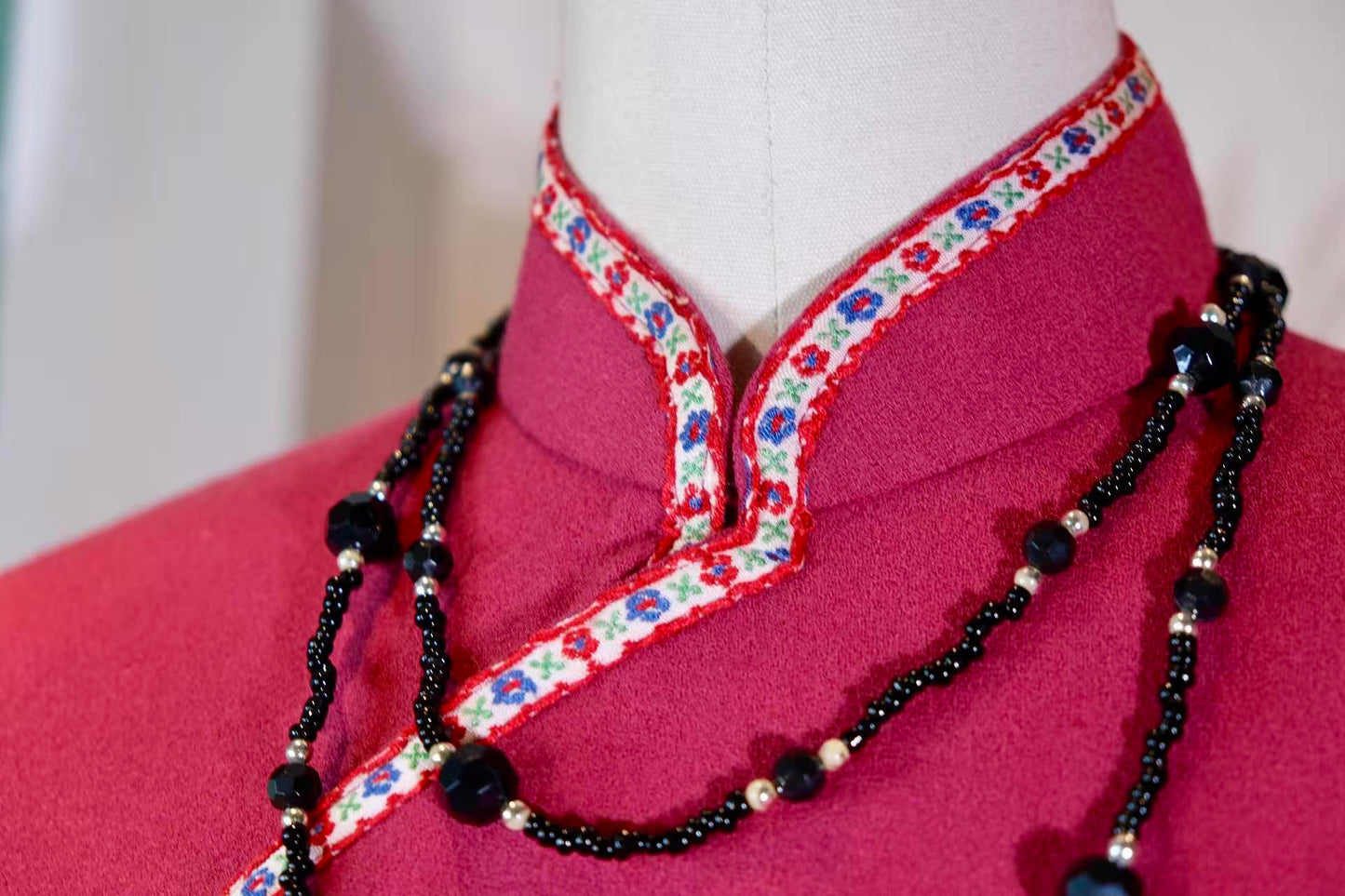
- 立领与斜襟的锦绣边缘:旗袍的立领与大襟处,镶嵌着一条宽约0.5cm的织锦花边。细观之,这花边以白色为底,其上以红、蓝、绿、黄等彩丝,绣出连续的、几何化的花卉纹样。这些小花或为梅花,或为宝相花,形态简练而富有装饰性,边缘以红色丝线勾勒,更显立体与鲜活。这种纹样,既有中国传统吉祥图案的寓意,又带有一丝现代设计的几何感,是六十年代香港东西方文化交融的视觉体现。
- 袖口与开衩的呼应之美:长袖的袖口与裙摆两侧的高开衩边缘,同样以同款织锦花边收束。袖口的一圈,如腕间绽放的繁花;开衩的两道,则如行走间若隐若现的风景。这种首尾呼应、上下贯通的设计,使得整件旗袍在视觉上形成一个完整的闭环,既统一了风格,又巧妙地勾勒出女性的曼妙曲线。
- 主体面料的素雅与肌理:旗袍的主体面料为纯色玫红,看似素净,实则暗藏玄机。面料并非光滑的丝绸,而是带有细微肌理感的混纺材质。这种材质的选择,在六十年代的香港颇为流行,它既保留了旗袍的优雅廓形,又增加了衣物的挺括度与保暖性,适应了香港亚热带气候下空调房或秋冬季节的穿着需求,体现了当时成衣设计的实用主义考量。
故事的回响:六十年代香港的摩登剪影
这件旗袍的故事,要追溯到上世纪六十年代的香港。那是一个“东方好莱坞”的黄金时代,经济腾飞,文化多元。旗袍,作为当时都市女性的日常着装,正经历着从传统到现代的华丽转身。
- 剪裁的革新:此件旗袍的剪裁,已完全摆脱了清代旗装的宽大与平直,而是采用了西式立体剪裁。胸省、腰省的巧妙运用,使得衣身能够完美贴合女性的身体曲线,呈现出“S”型的玲珑身段。这种剪裁方式,深受当时好莱坞电影的影响,是香港女性追求独立、自信与摩登的体现。
- 长度的演变:裙长及踝,开衩高至膝上,这是六十年代旗袍的典型特征。相较于三十年代旗袍的拖地长裙,这种长度更为干练、利落,方便女性参与社会活动与日常工作,是女性社会角色转变的服饰见证。
- 色彩的宣言:这抹浓郁而热烈的玫红色,在六十年代是时尚与大胆的象征。它不同于传统中国红的庄重,也不同于粉色的娇嫩,它更具现代感与视觉冲击力,是都市女性在人群中彰显个性与魅力的宣言。
艺术的风格与稀缺的价值
从艺术风格上看,这件旗袍是“海派旗袍”在香港的延续与变奏。它继承了上海旗袍的精致与考究,又融入了香港本土的务实与开放。其艺术价值体现在:
- 工艺之美:手工缝制的滚边、精准的省道处理、平整的接缝,无不体现着那个时代“慢工出细活”的工匠精神。
- 设计之美:在极简的主体上,以精致的花边作为点睛之笔,这种“少即是多”的设计理念,至今仍不过时。
- 时代之美:它凝固了六十年代香港的社会风貌、审美趣味与生活方式,是研究那个时代物质文化史的珍贵实物。
其稀缺性则源于:
- 存世量稀少:历经半个多世纪的风霜,保存如此完好、品相如此崭新的六十年代成衣旗袍,实属凤毛麟角。
- 材质特殊:毛呢或混纺材质的旗袍,相较于丝绸旗袍更易保存,但因其非传统材质,在当时产量本就不多,如今更难寻觅。
- 文化符号:它不仅是衣物,更是六十年代香港“东方之珠”辉煌岁月的一个文化符号,承载着无数人的集体记忆与怀旧情感。
这件玫红色旗袍,如同一首写在布料上的诗,一首关于六十年代香港的摩登叙事诗。它静默无声,却以其独特的图案、剪裁与色彩,向我们讲述着一个时代的优雅、自信与风华。它是一件值得被珍藏、被研究、被传承的“可穿戴的艺术品”。
Measurements / Size Guide:
Bust / Waist / Hips: 92/78/100 cm
Total Length: 110 cm
Detailed Description:
This rose-red cheongsam (qipao), standing silently upon the mannequin, is like a "Flower of Shanghai" stepping out of the past. Carrying the unique modern flair and Eastern charm of 1960s Hong Kong, it whispers of the era's prosperity and elegance. It is not merely a garment, but a segment of frozen history, a fluid form of art, and a scarce cultural memory.
The beauty of this qipao’s pattern lies in its "finishing touch" edging craft (Xiangbian). Instead of all-over prints, it employs a restrained and exquisite method to dot the poetics of pattern upon key areas.
The Brocade Edging of the Standing Collar and Diagonal Lapel: Along the high collar and the large lapel, a fine brocade ribbon approximately 0.5 cm wide is inlaid. Upon closer inspection, this border features a white base embroidered with colorful silks in red, blue, green, and yellow, forming continuous, geometric floral motifs. These tiny blossoms—perhaps plum or Baoxiang flowers—are concise yet decorative, outlined with red thread to appear three-dimensional. This motif bridges traditional Chinese auspicious meanings with a sense of modern geometric design, a visual manifestation of the East-meets-West fusion in 1960s Hong Kong.
The Correspondence of Cuffs and Slits: The cuffs of the long sleeves and the high side slits of the skirt are finished with the same brocade ribbon. The circles at the cuffs resemble flowers blooming at the wrists, while the lines along the slits act as flickering scenery during movement. This design forms a visual closed loop, unifying the style while subtly outlining the wearer's graceful curves.
The Elegance and Texture of the Main Fabric: The body of the qipao is a solid rose-red, seemingly plain but rich in detail. Rather than smooth silk, it uses a blended material with a subtle texture. This choice was highly popular in 1960s Hong Kong; it preserved the elegant silhouette while adding structure and warmth—an adaptation to air-conditioned rooms or the autumn/winter seasons, reflecting the utilitarian considerations of contemporary garment design.
This qipao’s story traces back to the "Golden Age" of Hong Kong, the "Hollywood of the East." As a daily attire for urban women, the qipao was undergoing a magnificent transformation from tradition to modernity.
Innovations in Tailoring: The cut has completely shed the looseness of the Qing Dynasty's Qizhuang, adopting Western three-dimensional tailoring. The clever use of bust and waist darts allows the garment to fit the female form perfectly, presenting the "S-curve." Influenced by Hollywood cinema, this style embodies the Hong Kong woman’s pursuit of independence, confidence, and modernity.
The Evolution of Length: Ankle-length with slits rising above the knee is a hallmark of the 1960s. Compared to the floor-sweeping lengths of the 1930s, this cut is more brisk and efficient, facilitating a woman’s participation in social activities and professional work—a vestiary witness to the changing social roles of women.
A Declaration of Color: This intense and passionate rose-red was a symbol of fashion and boldness in the 1960s. It differs from the solemnity of traditional "Chinese Red" or the daintiness of pastel pink; it is more modern and visually impactful—a declaration of individuality for the urban woman.
Artistically, this piece is a "variation" of the Shanghai Style continued in Hong Kong. It inherits the sophistication of Shanghai while absorbing the pragmatism and openness of Hong Kong.
Craftsmanship: Hand-sewn piping, precise darting, and flat seams all embody the "slow work produces fine results" artisan spirit of that era.
Design Aesthetic: On a minimalist body, the exquisite edging serves as the soul. This "Less is More" philosophy remains timeless.
Period Value: It freezes the social landscape and aesthetic tastes of 1960s Hong Kong, serving as a precious artifact for the study of material cultural history.
Its scarcity stems from:
Rare Survival: After half a century, finding a 1960s ready-to-wear qipao in such pristine condition is an extreme rarity.
Special Material: Woolen or blended qipaos are easier to preserve than silk ones, but because they were non-traditional materials, their production volume was limited.
Cultural Symbol: It is a symbol of the "Pearl of the Orient" in its prime, carrying collective memories and nostalgic emotions.
This fuchsia qipao is like a poem written on fabric — a modern narrative poem about 1960s Hong Kong. Silent yet eloquent, it speaks through its distinctive patterns, its tailored lines, and its vivid colors, telling us of an era’s elegance, confidence, and radiance. It is a “wearable work of art,” worthy of being treasured, studied, and passed on.