深圳溯源
Couldn't load pickup availability
衣服尺寸:
胸围/腰围/臀围:98/82/102 厘米
衣长:108 厘米
细节描述:
在服装史的浩瀚星空中,总有一些衣物如恒星般闪耀,它们不仅是蔽体的织物,更是凝固的时代诗篇。这件上世纪六十年代台湾产的浮雕立体机绣旗袍,便是这样一件承载着历史温度与艺术灵魂的“可穿戴文物”。它以巧克力色的沉稳为底,以浮雕般的立体绣纹为笔,书写了一段关于东方美学、工艺革新与时代风华的传奇。
一、图案:浮雕绣纹的视觉盛宴
旗袍上的图案,是整件作品的灵魂所在。设计师摒弃了传统旗袍常见的平面印花或平绣,大胆采用了“浮雕立体机绣”工艺——这一在上世纪六十年代台湾纺织业革新中诞生的技术,堪称当时“科技与艺术”的完美联姻。
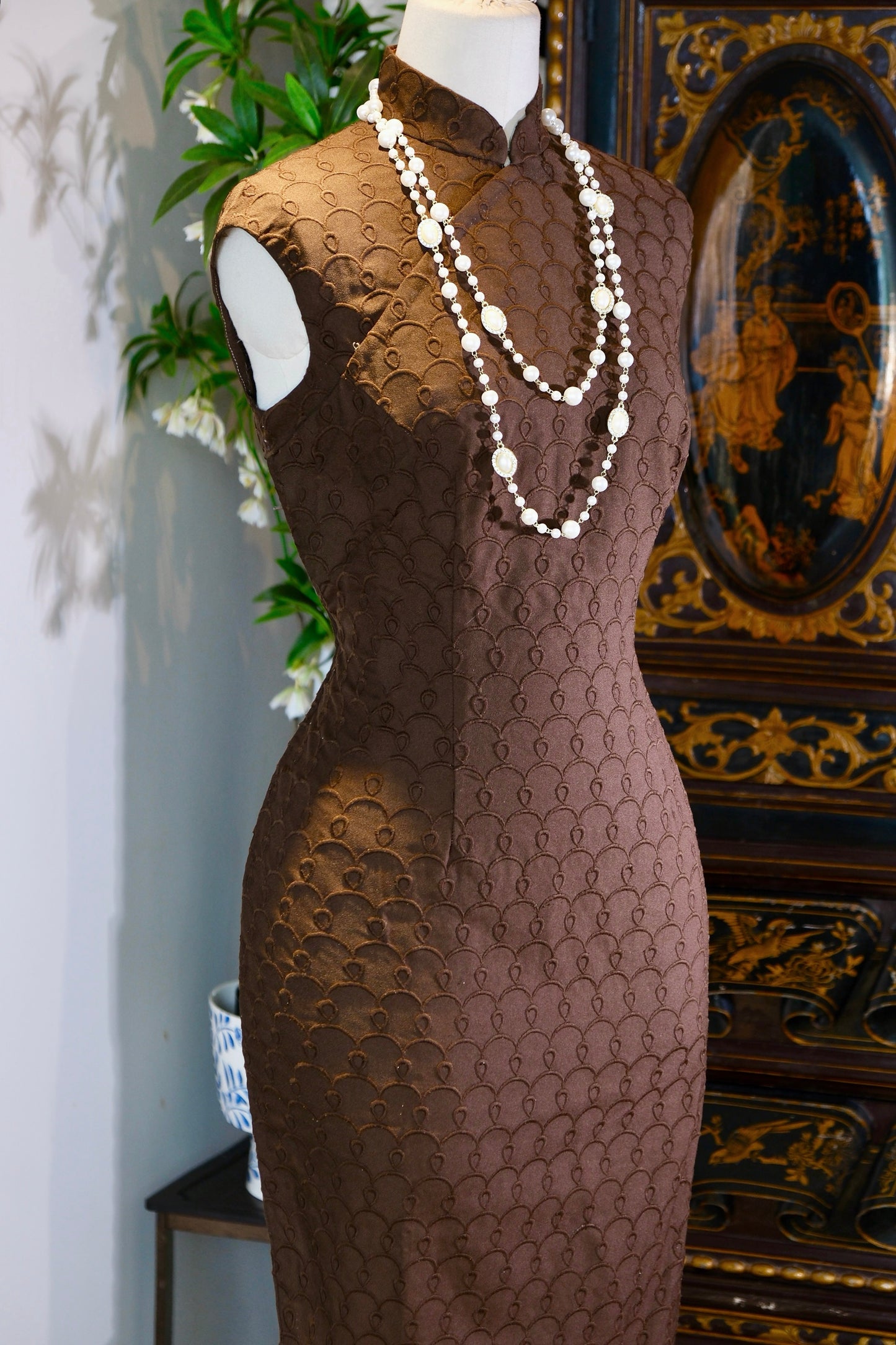
从视觉上看,图案以“鱼鳞纹”为基本单元,层层叠叠,如鱼游浅底,又似水波荡漾。每一片“鱼鳞”皆由立体绣线勾勒,边缘微微隆起,形成细腻的浮雕质感。这种纹样并非简单的几何重复,而是暗合了中国传统“鳞介纹”的吉祥寓意。《诗经·小雅》有云:“鱼在在藻,有颁其首”,鱼鳞纹自古便是富足、自由的象征,而在旗袍上,它更添了一份灵动与柔美。
更令人惊叹的是,绣线在光线下会呈现出微妙的明暗变化,如同古籍中描述的“云想衣裳花想容”,行走间,光影流转,旗袍仿佛有了生命。这种立体绣纹的工艺,不仅提升了视觉层次,更在触感上赋予衣物“温润如玉”的质感,正如《考工记》所言:“天有时,地有气,材有美,工有巧,合此四者,然后可以为良。”
二、故事:六十年代台湾的旗袍风华
这件旗袍的诞生,与上世纪六十年代台湾的社会文化背景密不可分。彼时,台湾正处于经济起飞的前夜,纺织业作为支柱产业,正经历从“代工生产”到“自主创新”的转型。浮雕立体机绣技术的引入,正是这一转型的缩影——它既保留了传统刺绣的精致,又通过机械化的效率,让高端工艺得以“飞入寻常百姓家”。
旗袍的主人,或许是一位台湾名媛,或是一位旅居海外的华人女性。在那个“西风东渐”的年代,旗袍既是身份的象征,也是文化自信的表达。六十年代的台湾旗袍,逐渐摆脱了四十年代上海旗袍的繁复装饰,转向更简约、更注重线条美的设计。这件旗袍的无袖剪裁、修身版型,正是这一趋势的体现。它既保留了传统旗袍的立领、斜襟等经典元素,又通过立体绣纹的现代感,展现出“新中式”的审美觉醒。
三、艺术风格:传统与现代的交响
从艺术风格上看,这件旗袍堪称“中西合璧”的典范。其色彩选择——巧克力色,是一种极具现代感的“中性色”,既不同于传统旗袍的明艳,也不同于西方礼服的冷峻,而是一种“温润的克制”,暗合了六十年代全球流行的“大地色系”风潮。
而浮雕绣纹的设计,则在传统纹样的基础上,融入了现代构成主义的几何美感。每一片“鱼鳞”的大小、间距、弧度,都经过精密计算,形成一种“秩序中的灵动”。这种设计思路,与同时期西方艺术家如埃舍尔的“平面镶嵌画”有异曲同工之妙,却又扎根于东方美学的土壤。
更值得一提的是,旗袍搭配的珍珠项链,并非简单的配饰,而是整体造型的“点睛之笔”。珍珠的圆润与绣纹的立体形成对比,白色的冷光与巧克力色的暖调相互映衬,正如《红楼梦》中形容薛宝钗的“唇不点而红,眉不画而翠”,低调中见奢华,简约中藏精致。
四、稀缺性:不可复制的时代印记
这件旗袍的稀缺性,体现在三个方面:
- 工艺的绝版:浮雕立体机绣技术在六十年代后逐渐被更高效的印花技术取代,如今已鲜少有人掌握。每一件存世的浮雕绣旗袍,都是“机器与手工”共同完成的孤品。
- 时代的孤本:六十年代台湾的旗袍,正处于“传统与现代”的过渡期,其设计风格既保留了民国旗袍的余韵,又开启了现代中式服装的先河。这种“承前启后”的特质,使其在服装史上具有不可替代的研究价值。
- 保存的奇迹:历经半个多世纪,这件旗袍仍能保持绣纹的立体感与面料的完整性,实属难得。正如《长物志》所言:“物之存者,必有其神”,它的存在,本身就是一段历史的见证。
五、结语:穿在身上的历史,绣在衣上的诗
这件六十年代台湾浮雕立体机绣旗袍,不仅是一件衣物,更是一部“可穿戴的历史书”。它以针为笔,以线为墨,书写了东方美学的永恒魅力;它以形为骨,以色为魂,展现了时代变革中的文化自信。
在今天这个“快时尚”盛行的时代,它提醒我们:真正的奢侈品,从来不是流水线的复制品,而是时间沉淀下的独一无二。正如诗人叶芝所言:“教育不是注满一桶水,而是点燃一把火。”这件旗袍,便是那把点燃我们对传统工艺、对历史记忆、对东方美学之火的“火种”。
若你有幸拥有它,便拥有了半世纪前的风华;若你有幸凝视它,便读懂了东方女性的温婉与坚韧。它是锦瑟华年的见证,是浮雕绣韵的绝唱,更是值得我们永远珍藏的“时光之衣”。
Measurements / Size Guide:
Bust / Waist / Hips: 98/82/102 cm
Total Length: 108 cm
Detailed Description:
In the vast galaxy of costume history, some garments shine like fixed stars; they are not merely textiles to cover the body, but frozen poems of an era. This 1960s Taiwanese-made relief-textured machine-embroidered cheongsam (qipao) is such a "wearable artifact." With a steady chocolate-brown base and sculptural embroidered motifs as its brush, it writes a legend of Eastern aesthetics, industrial innovation, and era-specific grace.
The pattern is the soul of this piece. The designer discarded common flat prints or satin stitching in favor of "Relief-Textured Machine Embroidery"—a technology born from the innovation of Taiwan’s textile industry in the 1960s, representing a perfect marriage of technology and art.
Visually, the pattern uses the "fish scale" as its basic unit, layered like waves. Each "scale" is outlined with three-dimensional thread, the edges slightly raised to create a delicate relief texture. This aligns with the auspicious meaning of the traditional Chinese "Scale Motif." As the Classic of Poetry mentions: "The fish are among the weeds, showing their large heads." Fish scales have long symbolized abundance and freedom; on a qipao, they add a sense of fluid elegance.
Under varying light, the embroidery presents subtle shifts in brightness, creating a "living" garment. This technique grants the fabric a texture as "gentle as jade," echoing the Artificers' Record: "When the season of Heaven, the vitality of Earth, the beauty of materials, and the ingenuity of craft converge, only then can a fine work be made."
This garment's birth is inseparable from the socio-cultural background of 1960s Taiwan. At the dawn of its economic takeoff, the textile industry was transitioning from "OEM production" to "independent innovation." Relief machine embroidery was a microcosm of this shift—retaining the delicacy of traditional embroidery while using mechanical efficiency to bring high-end craft to a wider audience.
The owner might have been a Taiwanese socialite or a woman from the overseas Chinese diaspora. In an era of "Western influence spreading East," the qipao was both a status symbol and an expression of cultural confidence. Taiwanese qipaos of the 60s moved away from the complex decorations of 40s Shanghai, shifting toward minimalist designs that emphasized line and form. The sleeveless cut and slim fit of this piece perfectly embody this "New Chinese" aesthetic awakening.
Artistically, this qipao is a paragon of "Sino-Western Fusion." Its color—chocolate brown—is a modern neutral, offering a "warm restraint" that aligned with the global "Earth Tone" trend of the 1960s.
The relief motifs integrate modern constructivist geometry into traditional patterns. The size, spacing, and curvature of each "scale" are precisely calculated to form "agility within order." This design logic shares an affinity with the tessellation art of M.C. Escher, yet remains rooted in Eastern aesthetic soil.
The paired pearl necklace is the "finishing touch." The roundness of the pearls contrasts with the three-dimensionality of the embroidery, creating a "low-profile luxury" that echoes the description of Xue Baochai in Dream of the Red Chamber: "Lips red without rouge, eyebrows green without charcoal."
The scarcity of this piece is manifested in three aspects:
Extinct Craftsmanship: Relief machine embroidery was gradually replaced by high-speed printing after the 60s. Each surviving piece is a unique specimen created by the harmony of machine and hand.
Epochal Transition: As a bridge between the Republican era and modern Chinese fashion, its "transitional" nature gives it irreplaceable research value in costume history.
A Miracle of Preservation: To maintain such sculptural integrity and fabric wholeness after half a century is a rarity. As the Treatise on Superfluous Things says: "That which survives must possess its own spirit."
This 1960s Taiwanese relief-embroidered cheongsam is a "wearable history book." It uses the needle as a pen and thread as ink to write the eternal charm of Eastern aesthetics. In an age of "fast fashion," it reminds us that true luxury is never a mass-produced replica, but a unique soul tempered by time.
To own it is to possess the splendor of half a century ago; to gaze upon it is to understand the tenderness and resilience of the Eastern woman. It is the swan song of relief embroidery and a "garment of time" worthy of eternal preservation.