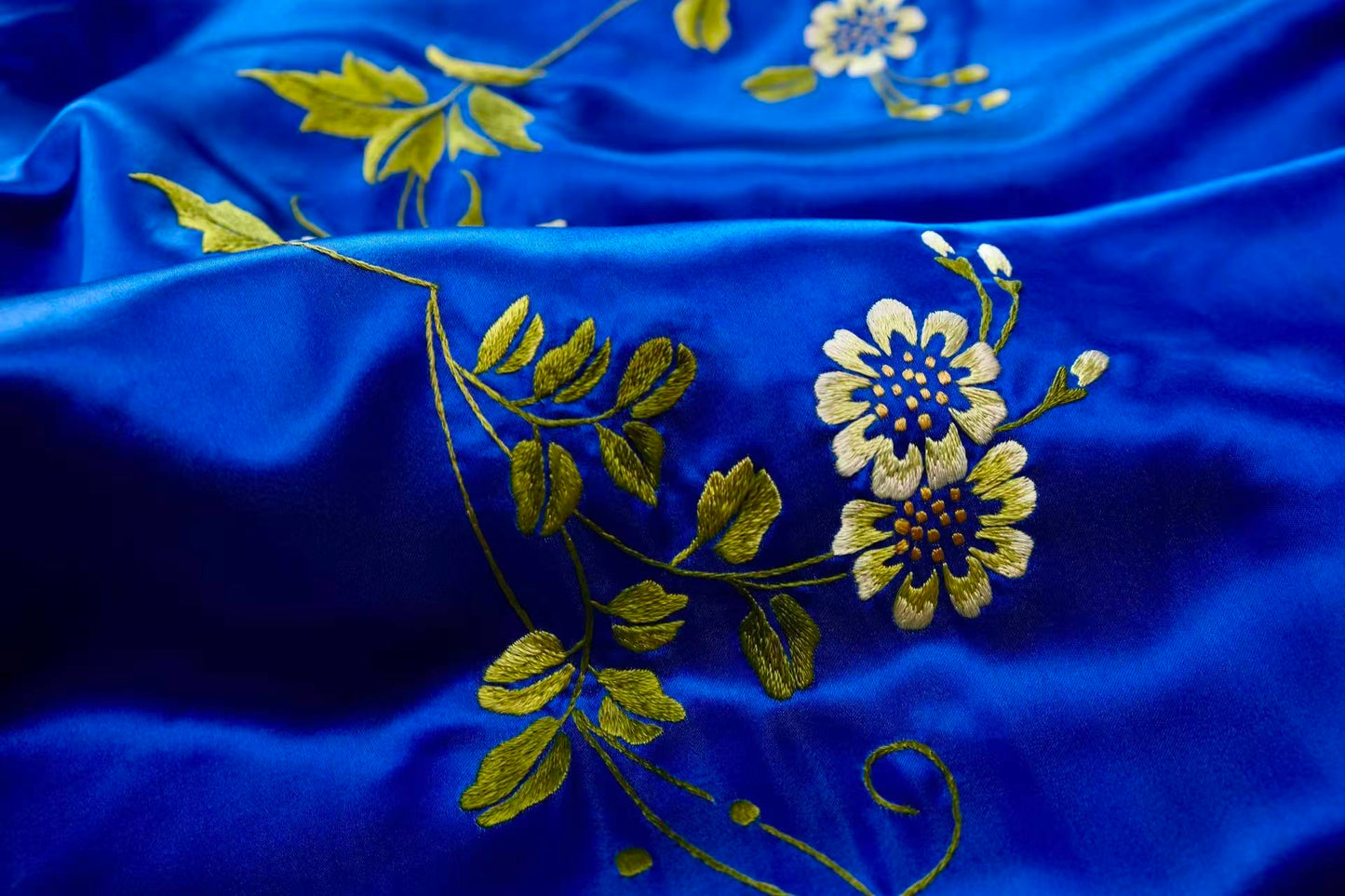
香江绮梦:上世纪六十年代香港产苏绣真丝花扣旗袍
这是一件极为珍贵的上世纪六十年代中期香港产古董旗袍,它集苏绣之精工、真丝之华美、花扣之雅致于一身,是那个特定年代中西文化交融下东方女性服饰美学的巅峰代表。其艺术价值与稀缺性,不仅在于材质与工艺的极致,更在于它承载了一段关于流亡、记忆与身份认同的复杂历史。
旗袍主体纹样为苏绣“折枝花卉”与“缠枝纹”的诗意重构。自领口沿襟线蜿蜒而下,以白色与浅黄丝线绣出的牡丹与小花,配以黄绿渐变的叶片,线条细如发丝,针脚密如繁星。这种“一枝数花、藤蔓相连”的构图,既符合传统“生生不息”的吉祥寓意,又巧妙地顺应了旗袍修身剪裁的曲线,达到“衣即人形,花即人意”的审美境界。
在《红楼梦》第六十三回中,薛宝琴所穿“洋绉银鼠褂”,虽非旗袍,却也暗示了清代至民国时期贵族女子对“绣花贴身衣裳”的偏爱。而此件六十年代旗袍,正是这一传统的延续与升华——它不再只是礼服,而是身体与艺术的合一。
此袍之苏绣,非机器印染可比,乃纯手工完成。上世纪五十年代末至六十年代初,因政治变动,大批苏杭绣娘南迁香港,将江南刺绣的精髓带入这个东方之珠。她们在狭窄的唐楼中,以针为笔、以丝为墨,为香港的裁缝店(如“鸿翔”、“丽华”)提供高端绣工,成就了“香港旗袍”在国际上的美誉。
这件旗袍的绣工细腻度、配色雅致度,均属当时“高级订制”级别。其针法之多变、丝线之光泽,显示出绣娘深厚的功底,极有可能出自当时香港知名绣坊之手。而“花扣”——即盘扣,亦非普通布扣,而是以真丝织带手工盘制,形如蝴蝶或蔓草,与绣花图案呼应,是“扣中有画,画中有扣”的绝妙设计。
面料采用重磅真丝素绉缎,光泽温润如月华,触感柔滑似凝脂。六十年代的真丝工艺尚未受化学纤维冲击,蚕丝品质极高,经纬密度紧密,至今仍保持良好的挺括性与垂坠感。这种面料在灯光下会呈现出深浅不一的宝蓝色调,宛如明代青花瓷中的“苏麻离青”,幽深而神秘。
此件宝蓝色苏绣真丝花扣旗袍,正如张爱玲在《更衣记》中所言:“……旗袍的花色虽繁,却始终带着一种静穆的气韵。”它不只是一件古董,更是一首穿在身上的诗,一幅流动的画,一段凝固的历史。在当今快时尚泛滥的时代,它提醒我们:真正的美,是时间沉淀后的从容,是手艺传承中的灵魂。
收藏此袍,不仅是收藏一件衣裳,更是收藏一个时代——那个在维多利亚港畔,旗袍与霓虹共舞的六十年代香港。
The Splendor of Fragrant River: A Mid-1960s Hong Kong Antique Su-Style Embroidered Silk Qipao
A Pinnacle of Transcultural Aesthetics This exceptionally precious mid-1960s Hong Kong-made antique qipao is a masterpiece that harmonizes the meticulous precision of Su embroidery (Su Xiu), the opulence of pure silk, and the elegance of hand-crafted frog buttons. It stands as a peak representative of Eastern feminine aesthetics during a unique era of East-West cultural convergence. Its artistic value and scarcity stem not only from its exquisite materials and craftsmanship but also from the complex history of migration, memory, and identity it carries.
The Poetics of "Folding Branches" and Scrolling Vines The primary motif is a poetic reconstruction of Su embroidery’s "Folding Branches" (Zhezhi) and "Scrolling Vines" (Chanzhi). Meandering from the collar down the lapel, peonies and small blossoms are rendered in white and pale yellow silk threads, accented by leaves in a yellow-green gradient. The lines are as fine as hair, and the stitches as dense as a starry sky. This composition—where multiple flowers bloom from a single vine—aligns with traditional auspicious meanings of "endless vitality" while cleverly following the curves of the qipao’s tailored silhouette, achieving the aesthetic ideal of "The garment is the form; the flowers are the soul."
The Legacy of the Southbound Embroiderers The embroidery on this piece is incomparable to machine-made prints. In the late 1950s and early 1960s, a large number of master embroiderers from Suzhou and Hangzhou migrated south to Hong Kong due to political shifts, bringing the essence of Jiangnan needlework to the "Pearl of the Orient." In the narrow tenements (Tong Lau), they used needles as brushes and silk as ink, providing high-end handwork for legendary Hong Kong tailor shops like "Hung Heung" and "Lin Va," cementing Hong Kong’s international reputation for couture qipaos.
Exquisite Details: "A Painting Within a Button" The technical mastery of this qipao belongs to the realm of Haute Couture. The varied stitching techniques and the enduring luster of the silk threads suggest it was likely produced by a renowned embroidery workshop of the time. The "Flower Buttons" (Pankou) are not mere closures; they are hand-coiled from silk ribbons into shapes of butterflies or vines, echoing the embroidery patterns. This creates a brilliant design where "there is a painting within the button, and a button within the painting."
The Luster of "Sumali Blue" The fabric is heavy-weight silk crepe satin, with a luster as gentle as moonlight and a touch as smooth as jade. In the 1960s, silk production was yet to be impacted by synthetic fibers; the quality of the mulberry silk was exceptionally high, maintaining its structure and drape even today. Under the light, the sapphire blue fabric reveals shifting depths, reminiscent of the "Sumali Blue" (Su Ma Li Qing) glaze found in Ming Dynasty blue-and-white porcelain—profound, mysterious, and serene.
A Frozen Fragment of History As Eileen Chang wrote in A Chronicle of Changing Clothes: "...the patterns of the qipao may be elaborate, yet they always carry an air of serene solemnity." This is more than an antique; it is a poem worn on the body, a moving painting, and a frozen fragment of history. To collect this qipao is to preserve an era—that 1960s Hong Kong where the qipao and the neon lights danced together by Victoria Harbour.