深圳溯源
Couldn't load pickup availability
衣服尺寸:
胸围/腰围/臀围:94/84/104 厘米
衣长:108 厘米
细节描述:
一、纹样解码:云间凤舞的吉祥密码
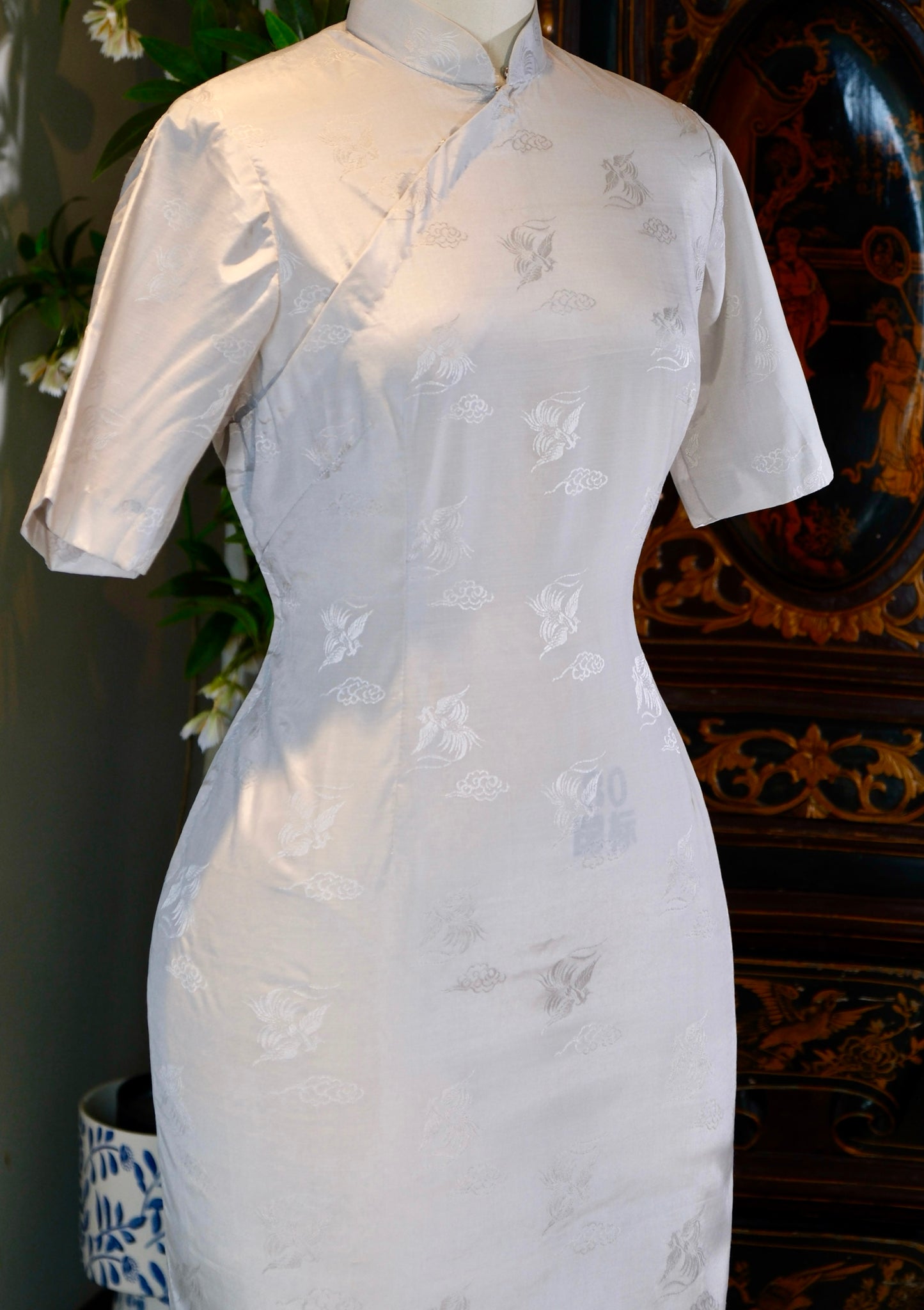
这件旗袍的提花面料,是传统吉祥纹样的精妙演绎。主体纹样为“云凤纹”——凤凰展翅于祥云之间,凤鸟造型灵动飘逸,羽翼舒展,尾羽修长,呈现出“凤舞九天”的昂扬姿态;祥云纹则以卷曲流畅的线条构成,如丝如缕,环绕凤鸟,形成“云托凤翔”的视觉效果。
在中国传统文化语境中,凤凰为“百鸟之王”,象征祥瑞、高贵与和谐,《山海经》载其“见则天下安宁”;祥云则是“天降祥瑞”的具象化表达,寓意福运绵长。二者结合,构成“凤翔云瑞”的经典吉祥图案,既承载着对美好生活的祈愿,也暗含着穿着者对身份与品味的追求。提花工艺使纹样在素色底料上若隐若现,光线下流转出低调的华贵,恰如《长物志》所言“贵精不贵丽,贵新奇大雅,不贵纤巧烂漫”。
二、时代叙事:六十年代香港旗袍的黄金剪影
这件旗袍诞生于上世纪六十年代的香港,彼时正是“海派旗袍”南传后与本土文化交融的黄金时期。香港作为东西方文化交汇的港口,旗袍在此既保留了传统工艺的精髓,又融入了现代审美:修身剪裁贴合女性曲线,短袖设计呼应热带气候,立领与斜襟的经典结构则延续着东方服饰的含蓄韵味。
提花面料的选择,更彰显着那个时代的“体面”与“讲究”。六十年代的香港,纺织业初兴,进口面料与本土织造并存,而如此精细的云凤提花,需耗费大量工时与技艺,非寻常人家可得。它或许曾属于一位出入中环写字楼的职场女性,或是一位参加宴会的名媛,在香江的霓虹与海风中,见证过殖民时期的繁华与市井烟火的交融。
三、艺术风格:传统与现代的平衡美学
从艺术风格而言,这件旗袍是“新古典主义”在服饰上的体现:
- 纹样上:延续明清以来吉祥图案的程式化表达,却通过提花工艺的“隐花”效果,弱化了传统纹样的繁复,更显简约雅致;
- 剪裁上:采用六十年代流行的“港式旗袍”版型——腰身收束利落,下摆微收,既保留传统旗袍的“S型”曲线美,又避免了过于夸张的束缚感,符合现代女性的活动需求;
- 色彩上:素色底料(推测为米白或浅灰)与同色系提花的搭配,摒弃了浓墨重彩,以“素以为绚”的东方美学,展现出“淡极始知花更艳”的高级感。
这种风格,恰如艺术史家贡布里希所言“传统的力量在于不断的再创造”——它既非对古制的亦步亦趋,也非对西化的全盘接受,而是在传统与现代之间,找到了一种优雅的平衡。
四、稀缺性:时光淬炼的孤品价值
作为古董旗袍,其稀缺性体现在三重维度:
- 工艺稀缺:提花织机在上世纪六十年代已逐渐被平纹织物取代,如此精细的云凤提花面料,如今已难觅踪影,更遑论保存完好的成衣;
- 时代稀缺:六十年代香港旗袍虽有一定存世量,但多为素色或简单印花,提花面料且纹样完整、剪裁精良者,凤毛麟角;
- 文化稀缺:它是“海派旗袍”南传后的地域化产物,承载着香港特定的历史记忆与文化认同,是研究二十世纪中叶华人服饰变迁的实物标本。
结语
这件祥云凤凰提花旗袍,不仅是一件衣物,更是一段凝固的时光。它以纹样诉说吉祥,以剪裁记录时代,以工艺彰显匠心。正如服装史学家瓦莱丽·斯蒂尔所言“服装是身体的延伸,也是文化的容器”——穿上它,仿佛能触摸到六十年代香江的温度,听见凤翔云间的古老祝福,在时光的流转中,续写着东方美学的永恒魅力。
Measurements / Size Guide:
Bust / Waist / Hips: 94/84/104 cm
Total Length: 108 cm
Detailed Description:
The jacquard fabric of this qipao is a masterful interpretation of traditional auspicious motifs. The primary pattern features the "Cloud and Phoenix"—a phoenix spreading its wings among auspicious clouds. The bird’s form is agile and ethereal, with outstretched wings and elegant tail feathers, presenting the spirited posture of a "Phoenix Dancing in the Nine Heavens." The auspicious clouds are composed of fluid, curling lines that encircle the bird, creating the visual harmony of "Clouds Cradling the Soaring Phoenix."
In traditional Chinese culture, the phoenix is the "King of Birds," symbolizing grace, nobility, and harmony; the Classic of Mountains and Seas notes that its appearance brings "peace to all under heaven." Auspicious clouds are the concrete expression of "Heaven-sent luck," signifying everlasting fortune. Together, they form the classic "Auspicious Phoenix" motif, carrying prayers for a beautiful life and reflecting the wearer’s pursuit of status and taste. The jacquard technique allows the pattern to shimmer subtly against the solid base, revealing a low-key opulence that echoes the Treatise on Superfluous Things: "Value refinement over gaudiness; value the novel and elegant over the delicate and rambling."
This qipao was born in 1960s Hong Kong, a golden era when the "Shanghai-style" (Haipai) qipao migrated south and merged with local culture. As a port where East met West, Hong Kong’s qipao retained the essence of traditional craft while integrating modern aesthetics: sleek tailoring contoured the feminine silhouette, short sleeves responded to the tropical climate, and the classic structure of the standing collar and diagonal closure maintained the reserved charm of Oriental dress.
The choice of jacquard fabric further highlights the "decency" and "refinement" of that era. In 1960s Hong Kong, the textile industry was just beginning to flourish, with imported fabrics coexisting with local weaves. Such intricate Cloud-Phoenix jacquard required immense labor and skill, making it inaccessible to ordinary households. It may have belonged to a professional woman in a Central office or a socialite at a gala, witnessing both colonial prosperity and the vibrant life of the city amidst the neon lights and sea breezes of old Hong Kong.
Artistically, this qipao is an embodiment of "Neoclassicism" in fashion:
In Pattern: It continues the stylized expression of auspicious motifs from the Ming and Qing dynasties but uses the "hidden floral" effect of jacquard to soften the complexity, appearing more minimalist and elegant.
In Tailoring: It adopts the popular "Hong Kong-style" silhouette of the 1960s—a crisp, cinched waist and a slightly tapered hem. It preserves the "S-curve" of traditional qipaos while avoiding excessive restriction, suiting the mobility of modern women.
In Color: The pairing of a solid base (likely ivory or pale gray) with tonal jacquard discards heavy colors for the Oriental aesthetic of "plainness as brilliance," revealing a high-end sophistication where "flowers seem more vivid in their pale simplicity."
The scarcity of this antique qipao is reflected in three dimensions:
Craft Scarcity: Jacquard looms were gradually replaced by plain-weave fabrics in the 1960s; such fine Cloud-Phoenix jacquard is now nearly impossible to find, let alone as a perfectly preserved garment.
Era Scarcity: While 1960s Hong Kong qipaos exist, most are solid colors or simple prints. Pieces with intact jacquard patterns and superior tailoring are exceptionally rare.
Cultural Scarcity: As a localized product of the southern migration of "Haipai" fashion, it carries specific historical memories and cultural identity of Hong Kong, serving as a physical specimen for studying the evolution of Chinese dress in the mid-20th century.
Conclusion This Cloud-Phoenix jacquard qipao is more than a garment; it is a frozen fragment of time. It speaks of luck through its patterns, records an era through its cut, and showcases craftsmanship through its technique. As fashion historian Valerie Steele remarked: "Clothing is an extension of the body and a vessel for culture." To wear it is to touch the temperature of 1960s Hong Kong and hear the ancient blessings of the soaring phoenix, continuing the eternal charm of Oriental aesthetics.