深圳溯源
Couldn't load pickup availability
这是一件承载着时光韵味的稀世珍宝——
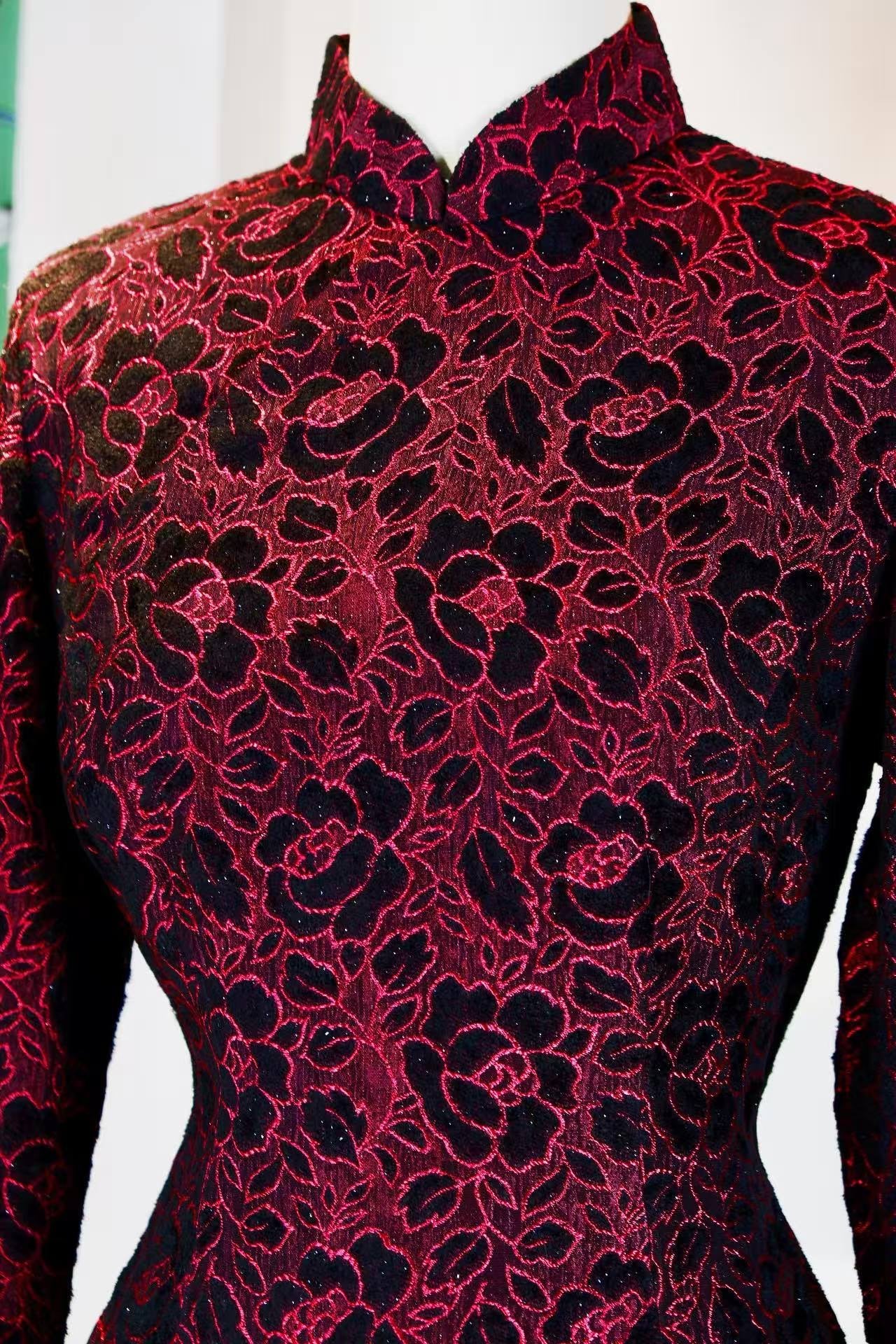
旗袍通体以玫瑰纹样为灵魂,其花型饱满、层叠舒展,
此袍面料堪称“指尖上的艺术”。其采用提花织金工艺,
此袍之艺术风格,恰是六十年香港黄金时代的缩影。
此类六十年代玫瑰提花织金旗袍,存世者如凤毛麟角。
当指尖抚过这袭旗袍,织金线纹理的微凉触感,
This rare treasure, a vintage Hong Kong cheongsam from the 1960s, is imbued with the charm of time. Through its exquisite craftsmanship and elegant, opulent pattern, it fuses Eastern and Western aesthetics into a single garment, much like a silent epic narrating the brilliance and grace of a golden age.
The cheongsam's soul lies in its rose motif: the flowers are full-bodied and layered, the branches and vines winding and entwining, suggesting a subtle, floating fragrance. Though the rose was not a mainstream traditional Chinese pattern, it had, amidst the tide of Western influence, become a symbol of "love" and "opulence." The ingenuity of this robe lies in its foundation of jacquard weaving, further enhanced by black zhījīn (gold brocade) silk threads filling the floral shapes. This renders the rose outlines like ink lines, causing them to leap out in three-dimensional relief from the wine-red silk surface. The petals are interwoven with varying depths, creating an interplay of solid and void, akin to the ancient method of "layered gauze making a rose color" recorded in the Ziren Yizhi, and aligning with the luxurious paradigm of "pale silk brocade with gold brocade ornamentation" found in the Tianshui Bingshanlu. The black gold threads, as light flows over them, shimmer like a river of stars running through the blossoms in the dark night. This inherits the essence of "gold and color shining together" from Yuan Dynasty Nasij (gold-woven brocade) while adding a layer of mysterious, profound modern intrigue. Every inch of the pattern is crystallized by the artisan's fingers; every stitch and line is the ultimate pursuit of aesthetics.
The fabric of this robe is truly "art on the fingertips." It employs the jacquard gold brocade technique, which requires a complex jacquard loom to perfectly integrate the rose pattern and the gold threads. Marco Polo’s travels in the Yuan Dynasty recorded the gold brocade of Nanjing and Suzhou as "extending for miles, dazzling with golden light." While the gold thread in this robe is subdued within the dark color, its skillful subtlety is more apparent. Although Hong Kong had entered the industrial era at the time, this kind of high-precision gold brocade jacquard remained scarce, taking artisans several months to complete a single bolt. The robe's tailoring also integrates East and West: the stand collar is crisp, the waist is cinched and fitted, and the slit is modest, retaining the classic elegance of the cheongsam while displaying the modernity of Hong Kong style. Every stitch is ruler-straight, and the manual traces reveal the artisan's obsession with perfection, making it a masterpiece of "weaving spring into the fabric" craftsmanship.
The artistic style of this robe is a microcosm of the Golden Age of 1960s Hong Kong. The rose motif carries the soul of Western romance, and the gold brocade technique carries the bone of Oriental opulence. Their fusion is like the phrase in the Classic of Poetry: "There is a beautiful one, so lovely and charming," blooming with a unique allure amidst heterogeneous collision. The design eschews complex embellishment, using simple lines to delineate the female curve, aligning with the societal pursuit of the "new woman's" independent and elegant image at the time. The wine-red base is like aged fine wine, sedimenting the richness of time; the black gold threads are like ink dots bringing a piece to life, lending modern tension to classicism. A single robe is half a history of cultural fusion: it once swayed under the neon lights of Central and paused in places of tea and literature, carrying the boundless imagination of that era toward beauty, identity, and the future.
Such 1960s rose jacquard gold brocade cheongsams are exceedingly rare. Their scarcity stems from three dimensions: the difficulty of the craft, which required artisans to master both jacquard and gold brocade techniques simultaneously, feasible only for masters; the limitation of the era, as the Hong Kong textile industry was transitioning and traditional handcrafts were being replaced by machines, leading to meager output of such bespoke works; and the difficulty of preservation, as silk is fragile, and those surviving in perfect condition after six decades are few. Therefore, this robe, seen today, is not merely an item of clothing but a solidified fragment of time, a "living fossil" of the artisan spirit and aesthetic fashion of the Golden Age.
As one's fingertips caress the robe, the cool touch of the gold brocade texture seems to transport one back to that golden era when roses bloomed. It is not only a masterpiece of fabric and craftsmanship but also a witness to cultural fusion and a carrier of the era's spirit. Just as the poem Magnolia Flower: A Letter to a Friend laments: "If life were only like the first meeting," this robe maintains the astonishment and elegance of its creation in the long river of time. To collect it is a tribute to aesthetics; to appreciate it is a gaze into history. It stands silent, yet every inch of its warp and weft narrates an eternal grace.