深圳溯源
Couldn't load pickup availability
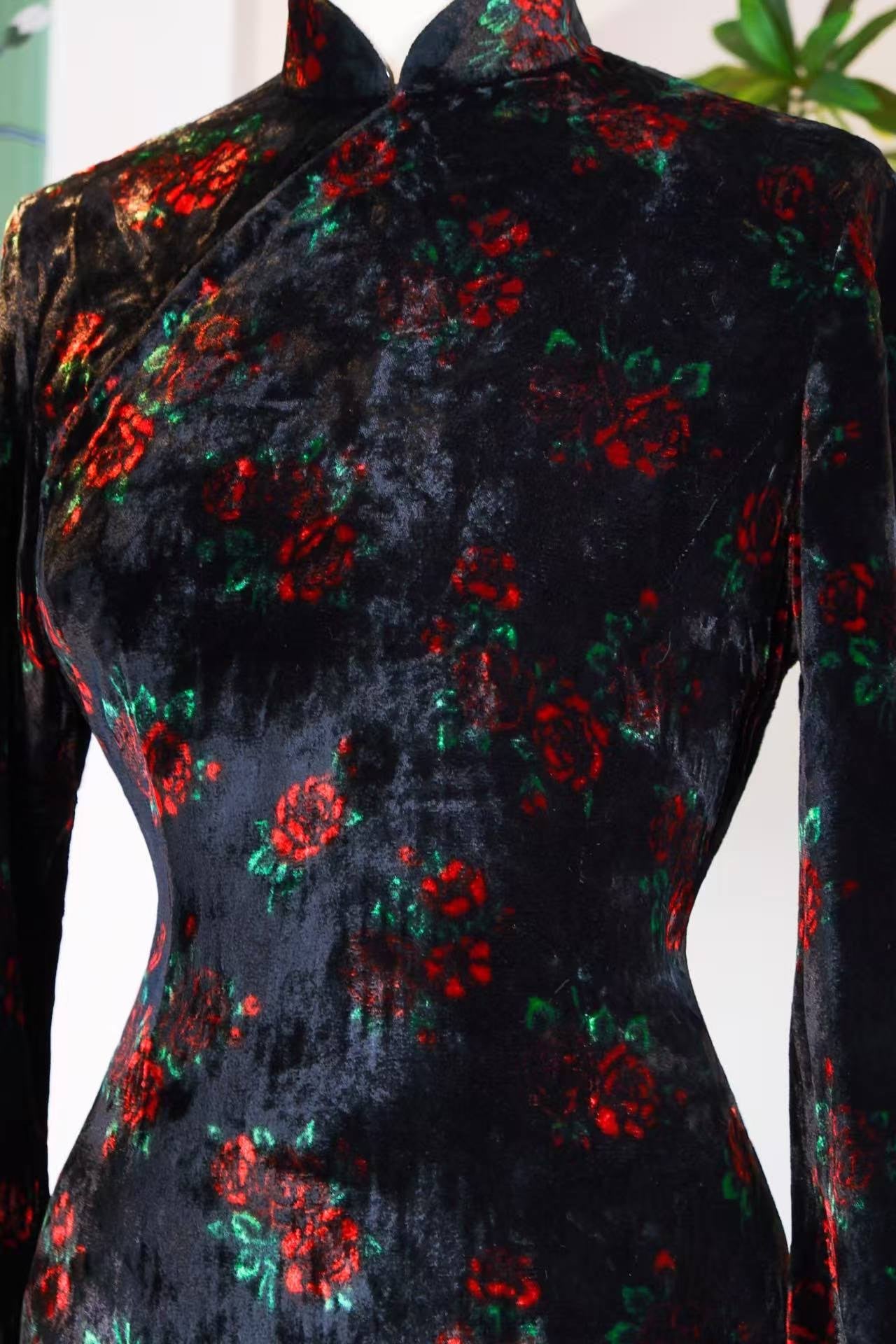
分享一件上世纪六十年代香港产黑天鹅绒古董玫瑰旗袍:
当黑色天鹅绒邂逅油画玫瑰,一件藏于时光褶皱里的香港旗袍,
旗袍面料选用顶级天鹅绒,深邃如维多利亚港的夜色,
六十年代的香港,正处于战后经济腾飞与文化身份重构的十字路口。
当我们在谈论古董旗袍时,实则在打捞一段凝固的文化记忆。
When black velvet meets oil-painted roses, a Hong Kong cheongsam, hidden in the folds of time, narrates the secret anxieties of a modern metropolis through its tangible form. This vintage robe, produced in 1960s Hong Kong, uses velvet as its paper and roses as its ink, growing a unique artistic texture and scarcity within the interstice of Eastern and Western aesthetics that belonged only to that era.
The cheongsam is made from top-grade velvet, deep as the night sky over Victoria Harbour. The fabric's luster shifts with the light, presenting a subtle variation like "fireflies glimmering in the dark night" (暗夜流萤). Clusters of roses are rendered upon it using the silk screen printing technique. The coloring of red petals and green leaves is bold yet restrained—the passion of the red roses aligns with the glamour and zeal of 1960s Hong Kong as the "Oriental Hollywood"; the somberness of the dark green leaves conceals the continuous vitality imagery of "flourishing branches and leaves" (枝叶扶疏) in traditional Chinese culture. The form of the roses is not meticulous realism (gongbi) but an slightly abstract, blended effect. The color gradation at the petal edges resembles ink diffusing in water, a perfect microcosm of the fusion of Chinese and Western art: one sees the deconstruction of traditional floral patterns by Western modern printing technology, yet it subtly aligns with the Chinese classical aesthetic ideal of the "space between similarity and dissimilarity" (似与不似之间).
Hong Kong in the 1960s was at a crossroads of post-war economic boom and cultural identity reconstruction. The cheongsam, as a "modern classic" of women's daily attire, exhibited a unique "hybrid" characteristic during this period: it retained traditional forms like the stand collar, diagonal closure, and cinched waist while integrating the three-dimensional cutting of Western garments. The body-hugging silhouette of this cheongsam confirms the "1960s modernization trend" described in the History of the Hong Kong Cheongsam—"The waistline was cinched to the extreme, the hip curves fully revealed, just as Eileen Chang wrote, 'wrapping the body's curves, like a piece of silk wound around a piece of silk'" (Rondeau of Clothes). The choice of velvet also conceals an era's code: this luxurious material, originally for Western aristocratic clothing, was given new life in local Hong Kong workshops, becoming the "battle robe" for modern women in social settings like dance halls and cocktail parties. As scholar Leo Ou-fan Lee remarked: "The evolution of the cheongsam is the Hong Kong people's embodiment of modernity."
When we discuss vintage cheongsams, we are, in fact, retrieving a solidified cultural memory. This black velvet rose cheongsam is not only an aesthetic declaration by the metropolitan women of 1960s Hong Kong but also a material text carrying technology, art, and identity. Its scarcity lies not in the preciousness of the fabric or the complexity of the craft, but in its ability to reflect, in its modest form, an era's self-shaping amidst the collision of Eastern and Western cultures—just as the poet Yu Guangzhong wrote: "When you wear a cheongsam, you wear the entirety of Chinese modernity." And this cheongsam is the most concentrated stroke of that modernity.