深圳溯源
Couldn't load pickup availability
衣服尺寸:
胸围/腰围/臀围:92/84/94 厘米
衣长:112 厘米
细节描述:
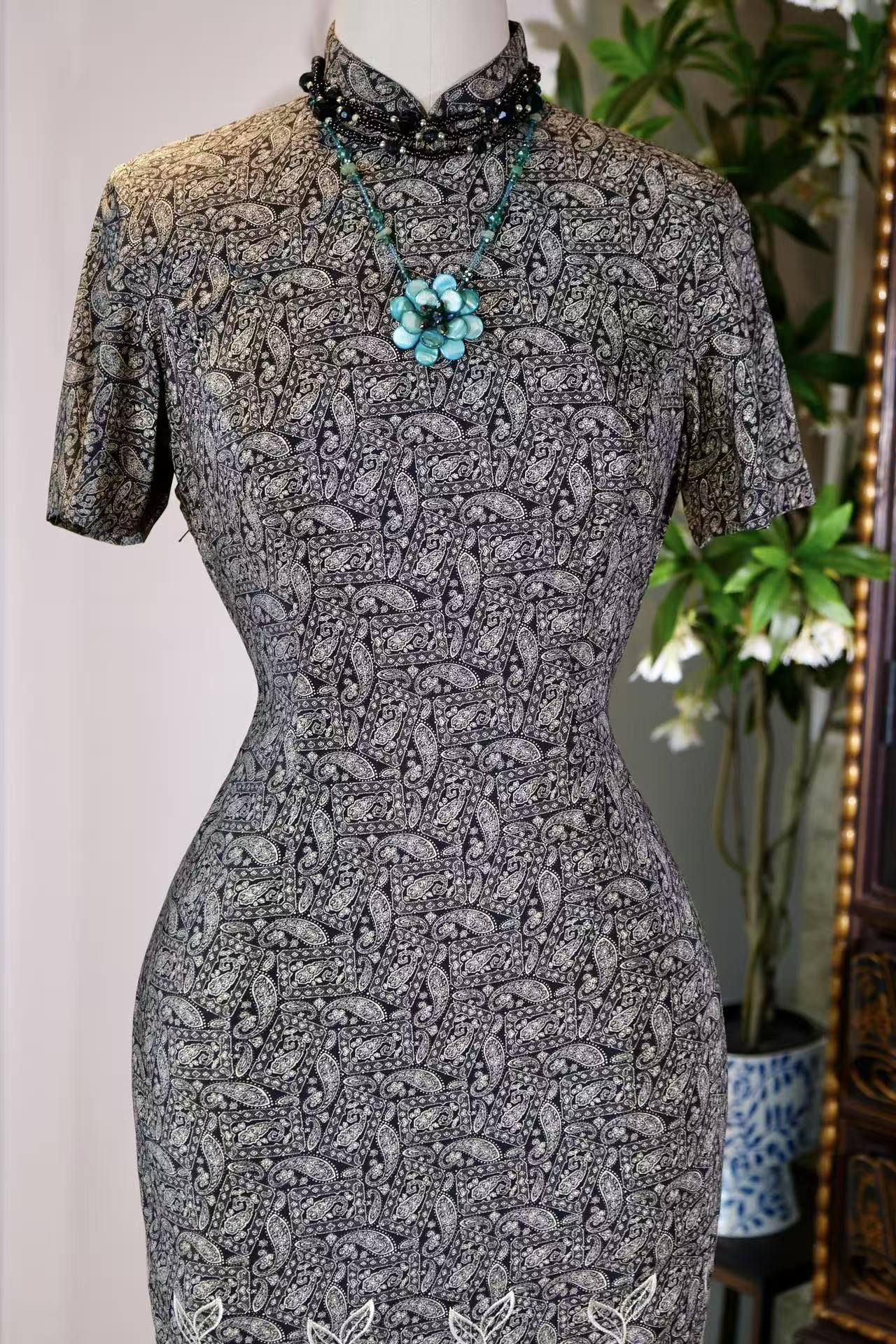
当目光触及这件上世纪六十年代的台湾产古董旗袍,仿佛推开了一扇通往旧时光的门扉。它以经典的立领、收腰、开衩剪裁,勾勒出东方女性独有的温婉曲线,而通体密布的佩斯利花纹,则如同一部微缩的纺织史诗,在黛色底布上徐徐展开。
一、纹样解码:佩斯利的东西方交融之美
旗袍主体纹样为典型的佩斯利涡旋纹,这种源自古波斯、兴盛于印度克什米尔的“生命之树”图案,经由丝绸之路传入东方后,与中国传统缠枝纹产生奇妙共鸣。细观其纹:涡旋状的“腰果花”以银灰丝线织就,在深黛色底布上流转如云,每个单元纹样皆由细密的几何线条与卷草纹构成,既有伊斯兰艺术的繁复精密,又暗合中国“曲水流觞”的灵动意趣。
下摆处的机器刺绣花卉则是点睛之笔——不同于传统苏绣的写实风格,这些银白色丝线绣成的牡丹、菊花以抽象化的姿态层叠绽放,花瓣边缘的镂空针法让纹样在光影下若隐若现,恰似《长物志》所言“花影移墙,如诗如画”。机器刺绣的规整与手工织物的肌理形成微妙对比,恰是六十年代台湾纺织工业转型期的技术见证:彼时台湾作为亚洲“四小龙”之一,正将传统手工艺与现代机械结合,这件旗袍便是那个时代“中学为体,西学为用”的时尚注脚。
二、时光叙事:海岛上的旗袍黄金时代
上世纪六十年代的台湾,正值旗袍文化的“最后辉煌”。随着大陆移民带去的海派裁剪技艺与本地纺织业的崛起,台北迪化街的布庄里,这类融合异域纹样的旗袍成为知识女性的挚爱。佩斯利纹在当时的流行并非偶然:它既避开了政治语境下的传统纹样禁忌,又以国际化的视觉语言彰显着现代性——正如张爱玲在《更衣记》中所写:“时装的日新月异并不一定表现活泼的精神,但旗袍的演变,却始终是时代情绪的晴雨表。”
这件旗袍的稀缺性,更在于它保存了完整的时代肌理:机器刺绣的花卉未因岁月褪色,佩斯利纹的经纬仍清晰可辨。在手工定制逐渐被成衣取代的今天,这样一件兼具工业美学与传统剪裁的旗袍,恰似一枚凝固的时间胶囊,封存着六十年代台湾女性的优雅身姿与文化自信。
三、艺术价值:古典纹样的现代转译
从艺术史视角看,这件旗袍的价值在于它对传统纹样的创造性转化。佩斯利纹的“涡旋”与中国缠枝纹的“连绵”形成视觉复调,既非纯粹的东方复古,亦非简单的西方模仿,而是战后亚洲文化身份重构的微观体现。下摆的机器刺绣花卉则以工业化手法重释“岁朝清供”的吉祥寓意,银白色调的冷艳与底布的深沉形成张力,恰如六十年代台湾文学中“现代派”与“乡土派”的对话。
正如贡布里希在《秩序感》中所言:“装饰艺术的本质,在于人类对有序与变化的永恒追求。”这件旗袍以佩斯利纹的秩序感与刺绣花卉的变化性,完美诠释了这种追求。它不仅是件衣物,更是一件可穿着的艺术品,承载着六十年代台湾纺织工业的记忆、东西方文化的交融,以及东方女性对美的永恒诠释。
四、结语:穿越时空的优雅对话
如今,当我们凝视这件旗袍,仿佛能听见六十年代台北街头的自行车铃声,看见穿着它的女子走过迪化街布庄时的侧影。佩斯利纹的涡旋里,藏着丝绸之路的驼铃;机器刺绣的花瓣上,凝着海岛的阳光与海风。它提醒我们:真正的经典从不会被时光淹没,反而会在岁月的打磨中,愈发显现出跨越时空的艺术光芒。
这件旗袍,便是一场与六十年代的优雅对话,一次东西方美学的深情相拥,更是一份值得被珍藏的、会呼吸的历史。
Measurements / Size Guide:
Bust / Waist / Hips: 92/84/94 cm
Total Length: 112 cm
Detailed Description:
As your gaze touches this 1960s antique cheongsam (qipao) from Taiwan, it feels like opening a door to the past. With its classic standing collar, cinched waist, and side-slit silhouette, it outlines the unique, gentle curves of the Oriental woman. Meanwhile, the dense Paisley patterns covering the garment unfold like a miniature textile epic across the deep ink-colored fabric.
The primary motif of the cheongsam is the classic Paisley swirl. Originating in ancient Persia and flourishing in India’s Kashmir as the "Tree of Life" pattern, it traveled along the Silk Road to the East, finding a marvelous resonance with traditional Chinese intertwining vine motifs. Observing the pattern closely: the whorl-shaped "cashew flowers" are woven with silver-gray silk thread, drifting like clouds over the deep ink base. Each unit consists of intricate geometric lines and scrolling grass patterns, possessing both the precision of Islamic art and the fluid grace of the Chinese "winding water" aesthetic.
The machine-embroidered flowers at the hem are the crowning touch. Unlike the realistic style of traditional Su embroidery, these peonies and chrysanthemums—stitched in silver-white thread—bloom in abstracted layers. The hollowed-out needlework at the petal edges makes the patterns appear and disappear under shifting light, much like the poetic imagery described in Treatise on Superfluous Things: "Flower shadows moving on the wall, as picturesque as a poem." The regularity of the machine embroidery contrasts subtly with the texture of the hand-woven fabric, serving as a technical witness to the transition of Taiwan's textile industry in the 1960s. As one of the "Four Asian Tigers," Taiwan was then merging traditional craftsmanship with modern machinery; this cheongsam is a fashion footnote to that era's philosophy of "Chinese essence with Western application."
The 1960s in Taiwan represented the "final brilliance" of cheongsam culture. With the influx of Shanghainese tailoring techniques brought by mainland immigrants and the rise of the local textile industry, cheongsams blending exotic patterns became the favorites of intellectual women in Taipei’s Dihua Street fabric shops. The popularity of Paisley was no accident: it bypassed traditional symbolic taboos of the political context while manifesting modernity through a global visual language. As Eileen Chang wrote in A Chronicle of Changing Clothes: "The rapid changes in fashion do not necessarily express a lively spirit, but the evolution of the cheongsam has always been the barometer of the era's mood."
The scarcity of this piece lies in its perfectly preserved temporal texture: the machine-embroidered flowers have not faded, and the warp and weft of the Paisley remain clear. In an age where ready-to-wear has replaced bespoke tailoring, this cheongsam—balancing industrial aesthetics and traditional cutting—is like a frozen time capsule, sealing the elegance and cultural confidence of 1960s Taiwanese women.
From the perspective of art history, the value of this cheongsam lies in its creative transformation of traditional motifs. The "swirl" of the Paisley and the "continuity" of Chinese vines form a visual polyphony that is neither pure Oriental revivalism nor simple Western imitation, but a microscopic reflection of post-war Asian cultural identity reconstruction. The machine-embroidered flowers at the hem reinterpret auspicious meanings through industrial methods. The cold elegance of the silver-white tones creates a tension with the deep base fabric, echoing the dialogue between "Modernist" and "Nativist" schools in 1960s Taiwanese literature.
As E.H. Gombrich stated in The Sense of Order: "The essence of decorative art lies in the eternal human pursuit of order and variation." This cheongsam perfectly interprets this pursuit through the order of Paisley and the variation of embroidered flowers. It is not merely clothing, but a wearable work of art carrying memories of the 1960s Taiwanese textile industry and the fusion of East and West.
Today, gazing at this cheongsam, one can almost hear the bicycle bells on the streets of 1960s Taipei and see the silhouette of a woman walking past the fabric shops of Dihua Street. Hidden within the Paisley swirls are the camel bells of the Silk Road; on the machine-embroidered petals rests the sunlight and sea breeze of the island. It reminds us that true classics are never submerged by time but instead reveal an artistic brilliance that transcends eras through the polishing of years.
This cheongsam is an elegant dialogue with the 1960s, a soulful embrace of Eastern and Western aesthetics, and a piece of breathing history worthy of being cherished.