深圳溯源
Couldn't load pickup availability
衣服尺寸:
胸围/腰围/臀围:92/76/98 厘米
衣长:93 厘米
细节描述:
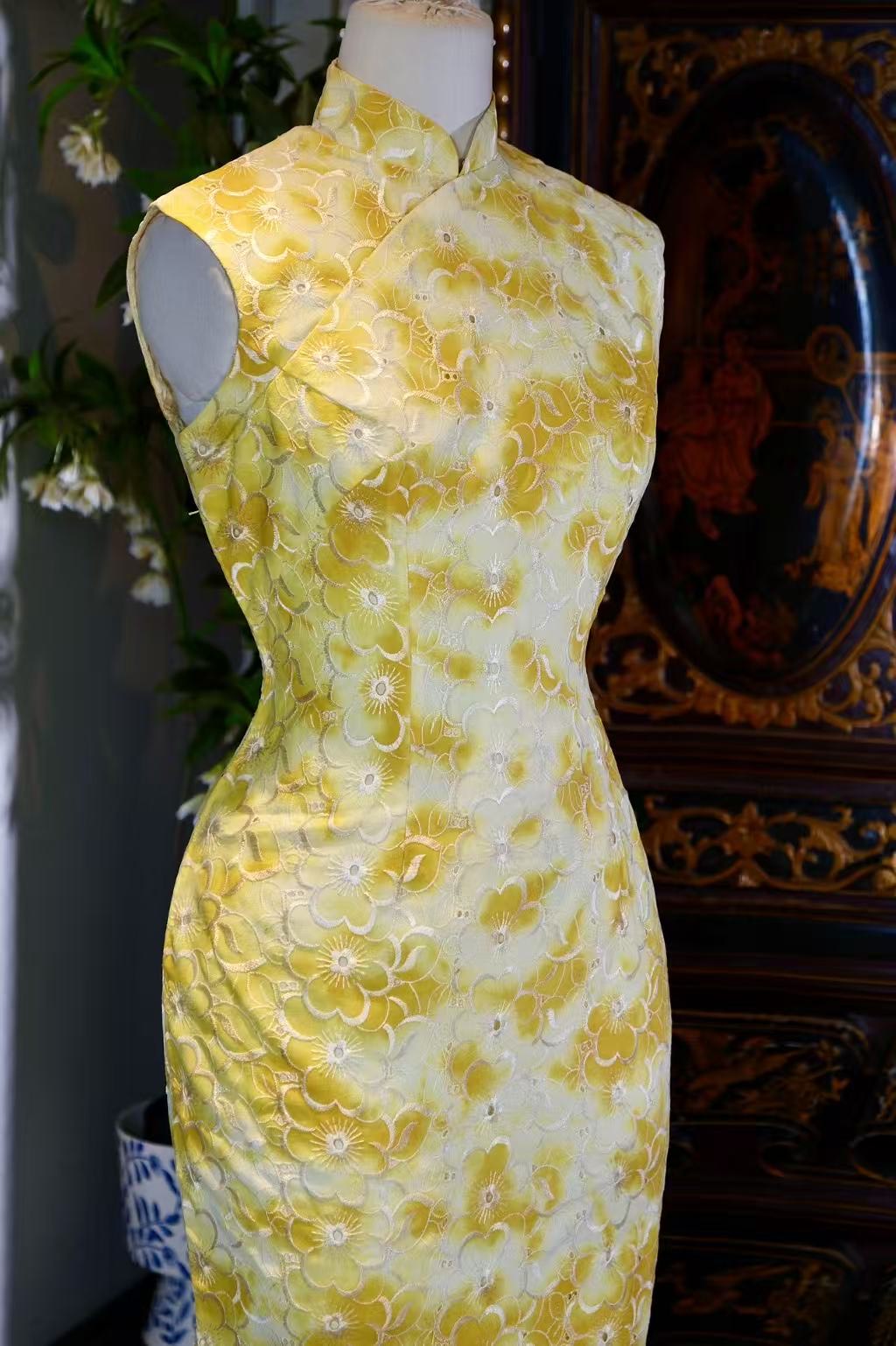
这件六十年代的香港机绣蕾丝旗袍,于我而言,不仅仅是一件衣物, 晕染天光,机绣繁花:视觉的诗意解构
若要细品其图案,需先入其境。这件旗袍最摄人心魄之处,
而其上的花卉图案,则是这件作品的灵魂所在。这是一种“ 锦瑟年华,香江遗梦:一段被遗忘的时尚史诗
若要追溯这件古董衣的故事,
这件旗袍,正是那个时代精神的完美注脚。它采用了当时最先进的“ 纸醉金迷,风华绝代:引经据典的美学诠释
这件旗袍的艺术风格,可以用“繁而不乱,艳而不俗”八字概括。
正如张爱玲在《更衣记》中所言:““对于不会说话的人,
它的稀缺性,不仅在于其年代的久远与工艺的精湛,
Measurements / Size Guide:
Bust / Waist / Hips: 92/76/98 cm
Total Length: 93 cm
Detailed Description:
To me, this 1960s Hong Kong machine-embroidered lace qipao is more than just a garment; it is a volume of flowing "Oriental Rococo" poetry wrapped in silk. Born during the golden age of Hong Kong, it represents the brilliant sparks struck between Oriental restraint and Western flamboyance within the warp and weft.
To truly appreciate its pattern, one must first enter its atmosphere. The most soul-stirring element of this qipao lies in the "breaking of boundaries" within its colors—this is no flat, gaudy yellow, but a "wash" of sunlight piercing through morning mist and blossoms. The palette transitions from a bright yellow at the collar to a milky white at the hem, interspersed with the warmth of goose-yellow and the vitality of pale green, as if the light and shadow of an entire spring have been sealed within this space. This gradient is not a simple dye but resembles the "Boneless" (Mogu) technique of Chinese painting—gentle, layered, and speaking silently of the "white space" and artistic conception of Oriental aesthetics.
The floral motifs are the soul of this work—a pinnacle of "machine-embroidered lace" craftsmanship. Distinct from the meticulous realism of Suzhou embroidery or the opulence of Cantonese embroidery, this technique—unique to 1960s Hong Kong—uses the machine as a pen and silk thread as ink. Upon the lightweight lace base, it embroiders three-dimensional "abstract blossoms." The petal outlines are traced in white silk with rounded, flowing lines, while the interiors are stacked with gradients of bright and goose-yellow, creating a relief-like visual effect. These flowers do not exist in isolation but follow a meticulously designed "scattered-point composition," varying in density and posture like stars twinkling in the night or swaying shadows of flowers in a breeze, full of movement and vitality.
To trace the story of this antique garment, we must rewind time to 1960s Hong Kong. It was an era of convergence—the end of the "magnificent yet desolate" world of Eileen Chang and the prologue to the rise of Hong Kong’s local fashion culture. During this time, socialites and master tailors from Shanghai migrated south, bringing the essence of the Shanghai-style qipao to the Pearl of the Orient, merging it with Western aesthetics and emerging textile technologies to give birth to the unique "Hong Kong-style Qipao."
This qipao is the perfect footnote to that era's spirit. It utilizes the most advanced machine-embroidered lace of the time—a fabric so light and translucent that it showcases the graceful curves of the female silhouette while adding a touch of Western sexiness and mystery. In its tailoring, it discards complex frog fasteners and high slits in favor of cleaner, more fluid lines. The mandarin collar remains a symbol of Oriental dignity, but the treatment of the shoulders and armholes clearly shows the influence of Western Modernism, emphasizing the beauty of the neck and the extension of the arms. This was not just an "improvement" but an "innovation," marking the moment Oriental women began to break free from traditional shackles and step onto the world stage with a more confident, modern posture.
The artistic style of this qipao can be summarized as "complex yet orderly, vibrant yet refined." Its "complexity" lies in the dense machine-embroidery, where every blossom is lifelike and every petal reflects the artisan's heart. Its "order" lies in the color gradients and pattern layout, which align with the Oriental principle of "rhythmic vitality." Its "vibrancy" is found in the bold contrast of bright yellow and milky white, while its "refinement" comes from the lightness of the lace, which neutralizes the intensity of the colors.
As Eileen Chang wrote in Chronicle of Changing Clothes: "To those who cannot speak, clothes are a language; what one carries with them is a pocket drama." This 1960s lace qipao is exactly such a "pocket drama." It tells a story of "fusion"—Oriental imagery and Western craft, traditional tailoring and modern aesthetics, feminine softness and the vigor of the era. It is a work of art and a "wearable history," recording the prosperity and dreams of a vanished Hong Kong and the unceasing pursuit of beauty and freedom by Oriental women.