深圳溯源
Couldn't load pickup availability
衣服尺寸:
胸围/腰围/臀围:96/82/102 厘米
衣长:104 厘米
细节描述:
一、图案解析:抽象印花的诗意重构
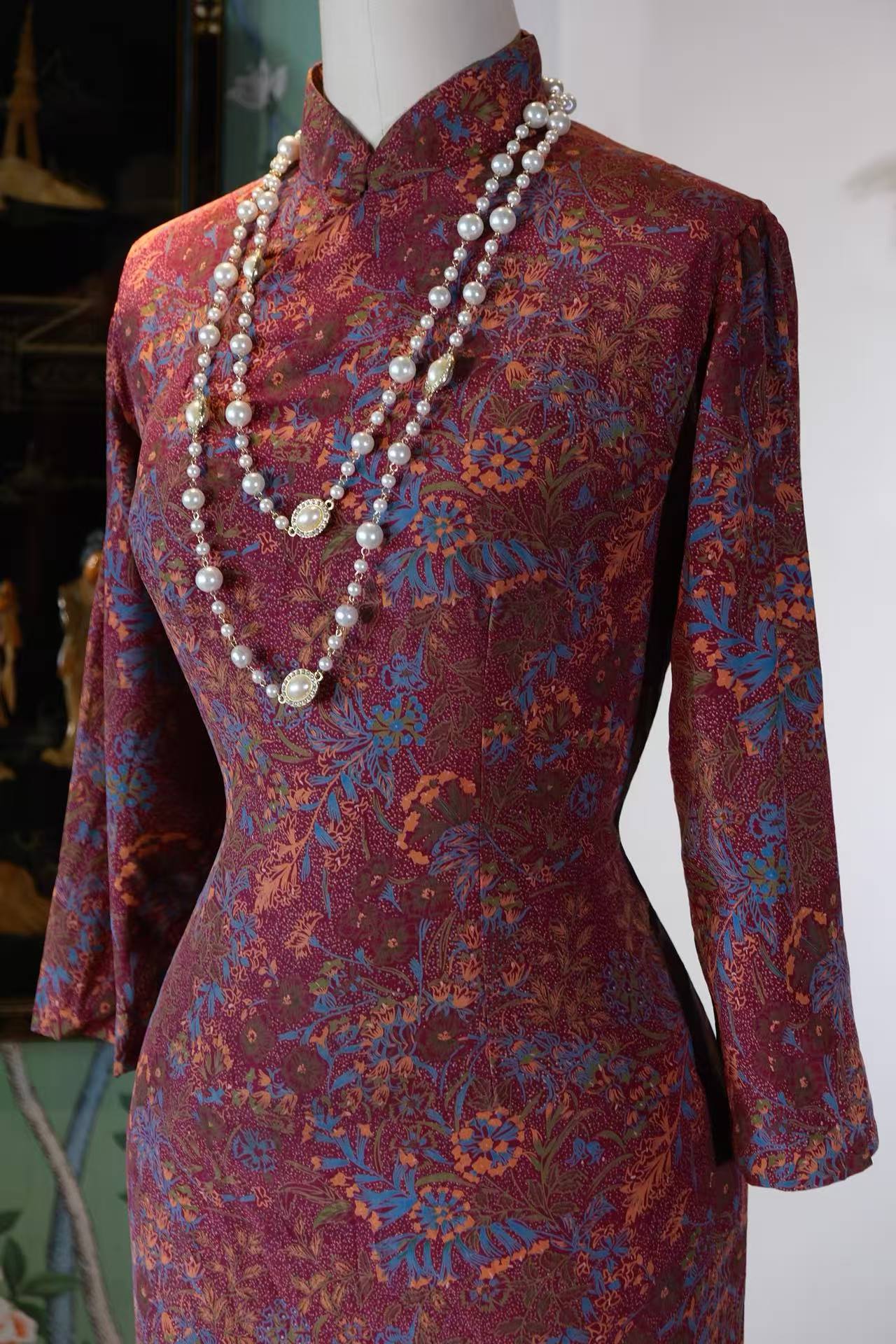
这件1960年代台湾产古董旗袍,以酒红色为底,缀以蓝、橙、绿交织的抽象花卉纹样,如《考工记》所言“杂四时五色之位以章之”,将传统花卉纹样解构重组。图案并非写实摹形,而是以流畅线条勾勒花叶轮廓,色块晕染似水墨留白,暗合六十年代现代主义思潮对东方美学的再诠释。其纹样布局疏密有致,如《文心雕龙》“云霞雕色,有逾画工之妙”,在秩序与自由间寻得平衡,既承袭宋锦“落花流水”的灵动,又融入西方抽象表现主义的张力,堪称东西方艺术对话的织物载体。
二、古董衣的故事:时代褶皱中的风华
上世纪六十年代,台湾正处于传统与现代的交汇点。这件旗袍诞生于台北迪化街的绸缎庄,彼时西方迷你裙风潮席卷亚洲,而东方女性仍以旗袍为身份符号。它或许曾见证过某位女学者在东海大学的讲堂风采,或某位名媛在圆山大饭店的晚宴流光。历经半世纪流转,面料因时光浸润泛出温润光泽,针脚间仍存当年绣娘的体温——正如本雅明所言“灵光”,这件衣物承载着不可复制的历史现场,每一道褶皱都是时代记忆的拓片。
三、艺术风格:新古典主义的织物宣言
其艺术风格可归为“东方新古典主义”:剪裁上遵循旗袍“十字平面结构”,却在腰省、臀围处暗藏西式立体剪裁,如梁思成论中国建筑“以结构为装饰”,将功能美学隐于无形。图案设计受六十年代欧普艺术启发,以几何化花卉营造视觉韵律,却又以传统“缠枝纹”的连续性消解现代主义的冷硬。面料选用台湾本土织造的提花绸,经纬交织间闪烁丝光,恰似《长物志》所赞“吴中绝技”之精微。这种“中学为体,西学为用”的创作逻辑,使其成为六十年代亚洲现代性探索的物质见证。
四、稀缺性:不可再生的文化标本
存世的六十年代台湾产旗袍本就不多,而此类抽象印花款式更是凤毛麟角。彼时台湾纺织业虽兴盛,但高端定制旗袍多服务于本地精英阶层,产量有限。加之1970年代后成衣工业化冲击,手工旗袍逐渐式微。此件旗袍保存完好,面料无蛀无损,其稀缺性不仅在于物质层面的稀有,更在于它是“冷战时期东亚文化混血”的活化石——既非纯粹传统,亦非全盘西化,而是在地缘政治夹缝中生长出的独特美学。正如福柯所言“知识考古学”,这件衣物是解码六十年代台湾社会文化基因的珍贵密钥,其历史价值远超服饰本身。
Measurements / Size Guide:
Bust / Waist / Hips: 96/82/102 cm
Total Length: 104 cm
Detailed Description:
I. Pattern Analysis: Poetic Reconstruction of Abstract Prints This 1960s antique qipao from Taiwan features a wine-red base adorned with abstract floral motifs intertwined in blue, orange, and green. Much like the description in Kao Gong Ji—"mixing the positions of the four seasons and five colors to create brilliance"—the traditional floral patterns have been deconstructed and reorganized. The patterns are not realistic imitations; instead, they use fluid lines to sketch the silhouettes of flowers and leaves, with color blocks smudged like the "white space" in ink-wash painting. This subtly aligns with the reinterpretation of Oriental aesthetics by the Modernist trends of the 1960s. The layout is perfectly balanced between density and sparsity, echoing The Literary Mind and the Carving of Dragons: "Clouds and mist carve colors more marvelous than the work of any painter." It finds equilibrium between order and freedom, inheriting the agility of the Song Dynasty "falling flowers and flowing water" brocade while integrating the tension of Western Abstract Expressionism. It is a textile medium for a dialogue between Eastern and Western art.
II. The Story of the Antique Garment: Elegance within the Folds of Time In the 1960s, Taiwan sat at the crossroads of tradition and modernity. This qipao was born in a silk shop on Dihua Street in Taipei. During an era when the Western mini-skirt craze was sweeping across Asia, Oriental women still held the qipao as a symbol of identity. It may have witnessed the elegant presence of a female scholar in a lecture hall at Tunghai University, or the shimmering radiance of a socialite at a gala in the Grand Hotel. Having drifted through half a century, the fabric has developed a gentle luster tempered by time, and the stitches still carry the warmth of the seamstress from years ago. As Walter Benjamin spoke of the "aura," this garment carries an irreproducible historical scene—every fold is a rubbing of an era's memory.
III. Artistic Style: A Textile Manifesto of Neoclassicism Its artistic style can be categorized as "Oriental Neoclassicism." While the tailoring follows the traditional "cross-planar structure" of the qipao, it hides Western-style three-dimensional tailoring at the waist darts and hip circumference. Much like Liang Sicheng’s discourse on Chinese architecture—"using structure as decoration"—it conceals functional aesthetics within the invisible. The pattern design was inspired by 1960s Op Art, using geometric flowers to create visual rhythm, yet it dissolves the cold hardness of Modernism through the continuity of traditional "scrolling branch" motifs. The fabric is a locally woven Taiwanese jacquard silk, shimmering with a silken glow between the warp and weft, much like the exquisite "Suzhou mastery" praised in Treatise on Superfluous Things. This logic of "Chinese essence with Western utility" makes it a material witness to the exploration of Asian modernity in the 1960s.
IV. Scarcity: A Non-Renewable Cultural Specimen Surviving Taiwan-made qipaos from the 1960s are already rare, but abstract print styles like this one are truly far and few between. Although the Taiwanese textile industry was flourishing at the time, high-end custom qipaos primarily served the local elite, and production was limited. Furthermore, with the impact of the ready-to-wear industrialization in the 1970s, handmade qipaos gradually declined. This qipao is perfectly preserved, with the fabric free of moths or damage. Its scarcity lies not only in its physical rarity but in its status as a "living fossil of East Asian cultural hybridization during the Cold War." It is neither purely traditional nor entirely Westernized; rather, it is a unique aesthetic grown from the cracks of geopolitics. As Foucault described in "The Archaeology of Knowledge," this garment is a precious key to decoding the socio-cultural genes of 1960s Taiwan, and its historical value far exceeds that of the clothing itself.