深圳溯源
Couldn't load pickup availability
衣服尺寸:
胸围/腰围/臀围:84/74/92 厘米
衣长:107 厘米
细节描述:
1960年代的香港,是东西方文化碰撞的十字路口,
一、图案:黄玫瑰的诗意与隐喻
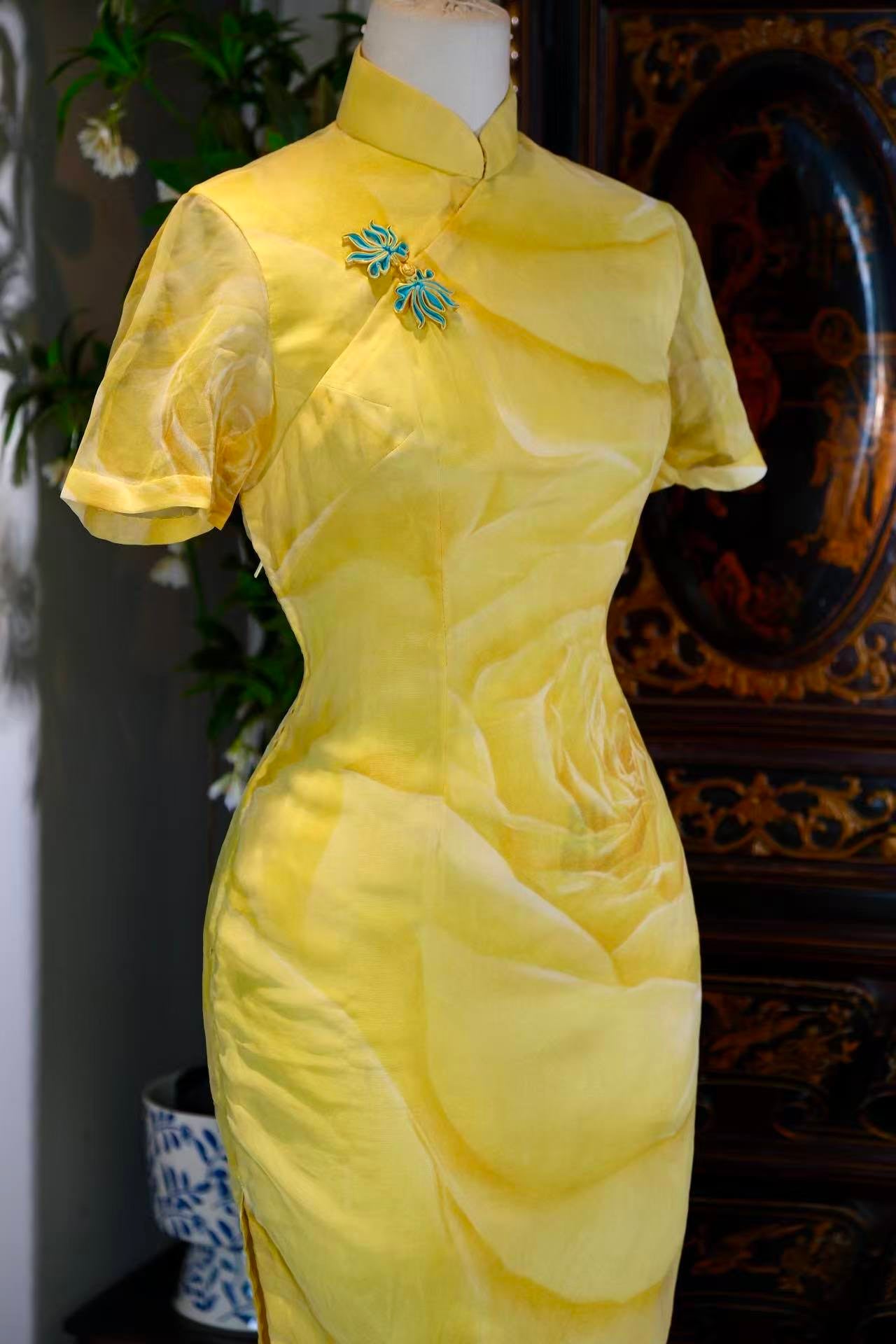
旗袍上的图案,是一朵朵盛开的黄玫瑰。黄玫瑰在传统文化中,
雪纺的轻盈与玫瑰的柔美相得益彰,薄纱的半透明质感,
二、故事:香港古董旗袍的海上花事
1960年代的香港,是旗袍的“最后辉煌”。
雪纺,这种源自西方的轻薄面料,
这件旗袍的主人,或许是一位香港的名媛,她在某个夜晚,
三、艺术风格与稀缺性
从艺术风格上看,这件旗袍是“中西合璧”的典范。它的剪裁,
从稀缺性上看,雪纺薄纱旗袍由于面料的脆弱性,
结语
这件1960年代的香港黄玫瑰雪纺薄纱旗袍,是旗袍艺术的“
Measurements / Size Guide:
Bust / Waist / Hips: 84/74/92 cm
Total Length: 107 cm
Detailed Description:
Hong Kong in the 1960s was the crossroads of Eastern and Western cultural collisions and the final golden age of qipao artistry. This yellow rose chiffon gauze qipao, produced in Hong Kong, is akin to a "Flower on the Sea" stepping out of Eileen Chang’s prose—solidifying the unique romance and elegance of that era upon ethereal gauze.
The patterns on the qipao are clusters of blooming yellow roses. While yellow roses are often viewed as symbols of "friendship" and "blessings" in traditional culture, on this garment, they represent an awakening of female self-consciousness. The petals layer upon each other, spreading across the chiffon with a gradient wash technique, appearing as delicate as morning dew and swaying as if caught in an evening breeze. This "impressionistic" rather than "realistic" approach embodies the "white space" aesthetic of traditional Chinese painting—seeking spirit and charm rather than mere physical likeness.
The lightness of the chiffon complements the softness of the roses perfectly. The translucent quality of the gauze allows the roses to appear almost flickering against the skin, possessing both the restraint of "holding a pipa to half-hide one's face" and the allure of "a single back-glance and a smile that breeds a hundred charms." This design is a quintessential feature of 1960s Hong Kong qipaos: infusing Western fashion's sensuality and freedom into the dignity of the traditional form.
The 1960s marked the "final brilliance" of the qipao in Hong Kong. With the influx of Western culture, the qipao gradually transitioned from daily wear into a "ceremonial" presence, becoming the "armor" for socialites at gala events. This yellow rose chiffon qipao likely originated from the hands of Hong Kong's most prestigious tailors. Many of them were "Red Gang" tailors who had migrated south from Shanghai, blending exquisite Shanghainese craftsmanship with Hong Kong fashion elements to create a unique "Hong Kong Style"—retaining classic elements like the mandarin collar, frog fasteners, and side slits, while boldly innovating in fabric, cut, and pattern to meet the aesthetics of the modern woman.
Chiffon, a lightweight Western fabric, saw widespread use in 1960s Hong Kong qipaos. It not only made the garment airy and flowing but also endowed it with a sense of "modernity." The yellow rose motif may have been influenced by the "Pop Art" movement of the time, combining natural elements with fashion design to form a unique visual language.
The owner of this qipao might have been a Hong Kong socialite, wearing this piece to a grand ball on a particular night. Under the lights, the yellow roses on the gauze would seem to sway gently with her every turn—a visual feast. She could have been Eileen Chang’s "Ge Weilong" or Yi Shu’s "Xi Bao," representative of the independent, confident, and freedom-seeking women of that era.
From an artistic perspective, this qipao is a paragon of "East meets West." Its tailoring follows the traditional "S" curve, emphasizing feminine softness and silhouette, while its fabric and pattern are imbued with the colors of Western Modernism. This collision of "traditional and modern" and "East and West" is precisely where the unique charm of 1960s Hong Kong qipaos lies.
In terms of scarcity, chiffon gauze qipaos are rarely preserved due to the fragility of the fabric. A piece with such a vivid yellow rose pattern is a rarity among rarities. It is more than a garment; it is a work of art carrying the memories and emotions of an era.
Conclusion: This 1960s Hong Kong yellow rose chiffon qipao is the "swan song" of qipao art and a "witness" to the awakening of female self-consciousness. It is like a silent poem narrating the stories of that decade, and a flowing painting showcasing the softness and strength of Oriental women. As Eileen Chang said: "Clothes are a language; what one carries with them is a pocket drama." This qipao is undoubtedly the most moving scene in that "pocket drama."