深圳溯源
Couldn't load pickup availability
衣服尺寸:
胸围/腰围/臀围:94/76/98 厘米
衣长:97 厘米
细节描述:
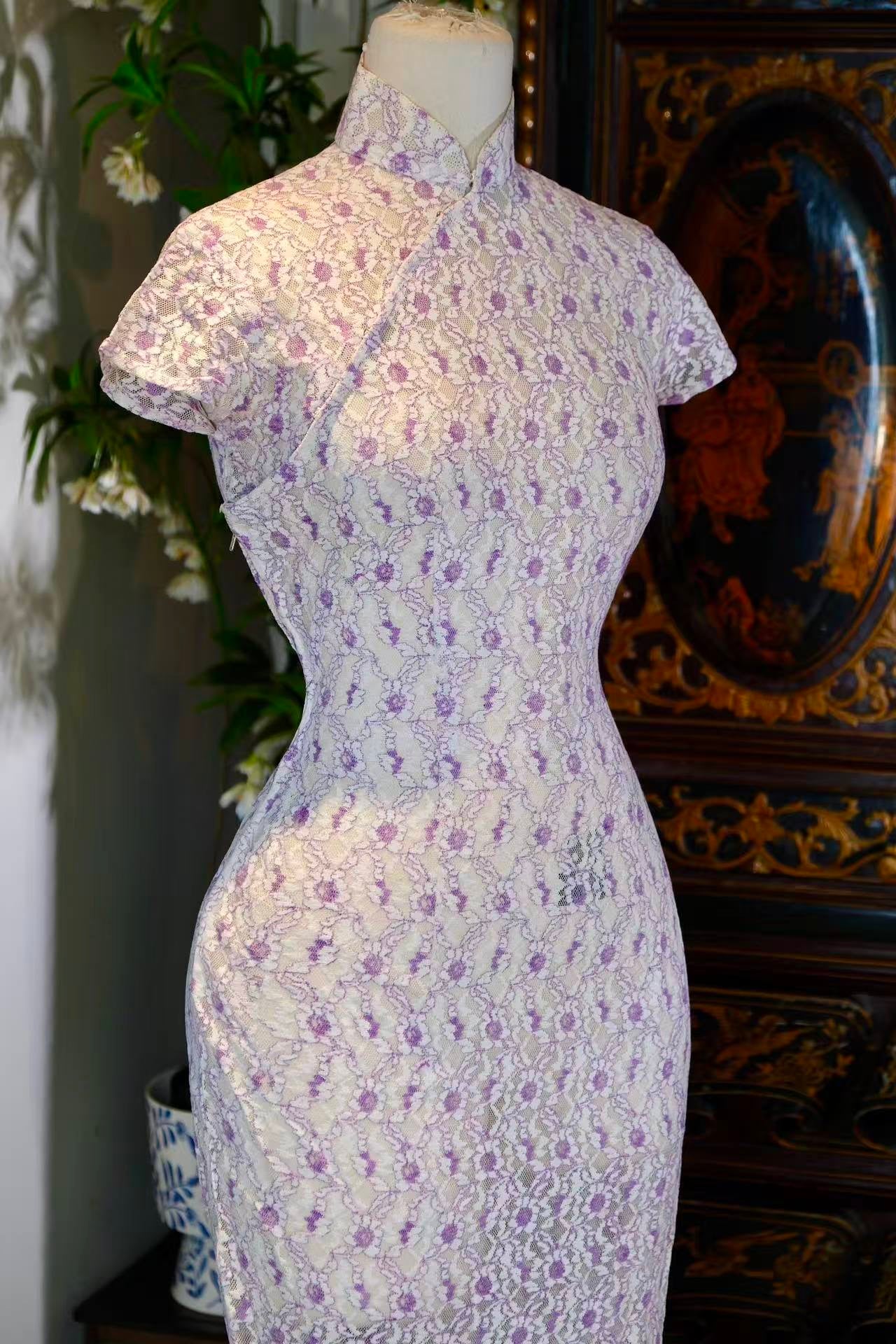
这件古董旗袍,堪称时光的杰作,
面料与图案:蕾丝上的“花间词”
这件旗袍的灵魂,在于那袭来自法国的顶级手工蕾丝。
仔细端详,蕾丝上的图案并非简单的重复堆砌,而是一种“
香港工艺:东方剪裁的“无声诗”
如果说法国蕾丝是“骨”,那么香港匠人的剪裁便是“肉”。
这件旗袍的剪裁堪称“量身定制”的典范:高领紧贴颈部,
时代故事:旗袍里的“香港记忆”
这件旗袍,不仅是一件衣物,更是一段历史的见证。
在那个年代,一件这样的旗袍,往往是女性最珍贵的嫁妆,
稀缺性与艺术价值:时光的“限量款”
如今,这样一件集法国顶级面料与香港精湛工艺于一身的古董旗袍,
它不仅是一件衣物,更是一件艺术品,是那个时代审美与工艺的“
结语
这件上世纪六十年代的法国进口手工蕾丝香港产古董旗袍,
Measurements / Size Guide:
Bust / Waist / Hips: 94/76/98 cm
Total Length: 97 cm
Detailed Description:
This antique qipao is a true masterpiece of time, serving as a paragon of the fusion between Eastern and Western aesthetics in the 1960s. With imported French handmade lace as its "bone" and the ingenious vision of Hong Kong artisans as its "soul," it narrates a fashion legend of "swallows from the halls of old nobility flying into the homes of ordinary people."
The soul of this qipao lies in its top-tier French handmade lace. In the 1960s, French lacemaking had reached a pinnacle of artistry, with every inch of fabric condensing the warmth of an artisan's fingertips. Against a cream-colored base, intricate and elegant floral motifs are sketched in pale purple, reminiscent of the Song Dynasty poet Yan Shu’s verses: "Helplessly the flowers fall; seemingly familiar the swallows return." The shadows of flowers sway, and a subtle fragrance seems to float in the air.
Upon close inspection, the patterns are not mere repetitive stackings but a continuous aesthetic expression: each tiny blossom is woven with meticulous stitching, with petal edges curling slightly as if moistened by morning dew. The pistils are accented with even finer silk threads, creating a subtle three-dimensional texture. This design of "fullness within transparency" preserves the magnificence of Western lace while aligning with the Oriental philosophy of "the interplay between void and solid," much like a living volume of Anthology from Amidst the Flowers whispering romance through light and shadow.
If the French lace is the "bone," the tailoring of Hong Kong artisans is the "flesh." Hong Kong in the 1960s was a melting pot of Eastern and Western cultures, where qipao craftsmanship reached its zenith—retaining classic elements like the high mandarin collar and diagonal closure while embracing the modern pursuit of silhouetted curves.
The tailoring of this piece is a textbook example of "bespoke excellence": the high collar fits snugly against the neck, outlining the specific dignity of the Oriental woman; the diagonal closure (Pianjin) winds down from the right shoulder in an elegant arc, poetic as a "winding path leading to a secluded spot." The cinched waist vividly portrays the grace of a woman’s curves. Most impressively, the artisan skillfully utilized the lace's transparency, using a slight tapering at the hem to avoid the awkwardness of being overly revealing while adding the restrained beauty of "holding a pipa to half-hide one's face."
This qipao is more than a garment; it is a witness to history. In 1960s Hong Kong, amidst economic takeoff and social change, the qipao served as daily attire, carrying the collective memory of an era. It witnessed Hong Kong’s transformation from a small fishing village into an international metropolis and recorded the footsteps of women moving from tradition toward modernity.
In those years, such a qipao was often a woman’s most precious dowry or her "armor" for significant occasions. It might have accompanied a Hong Kong socialite to a grand ball or been worn by an intellectual woman strolling through the streets of Central on a quiet afternoon. Every inch of its fabric is steeped in the atmosphere of that time—possessing both Western openness and Oriental elegance.
Today, an antique qipao that combines top-tier French fabric with exquisite Hong Kong craftsmanship is a rarity of rarities. The production of French handmade lace was inherently limited, and after decades of weathering, very few pieces remain in pristine condition. Furthermore, the specific 1960s Hong Kong qipao techniques have gradually faded with time, making them nearly impossible to find today.
It is a "living fossil" of the aesthetics and craftsmanship of its era. As Marcel Proust wrote in In Search of Lost Time: "The real voyage of discovery consists not in seeking new landscapes, but in having new eyes." This qipao is a window through which we look back at that elegant age, catching a glimpse of a fashion legend sealed by time.
Conclusion: This 1960s Hong Kong-made antique qipao in imported French handmade lace is the perfect fusion of East and West—an artistic treasure precipitated by time. It uses lace as its paper and tailoring as its pen to write a moving story of beauty, an era, and memory. Its beauty lies not in flamboyance, but in the composure and elegance following the baptism of years—this is the most touching charm of an antique garment.