深圳溯源
Couldn't load pickup availability
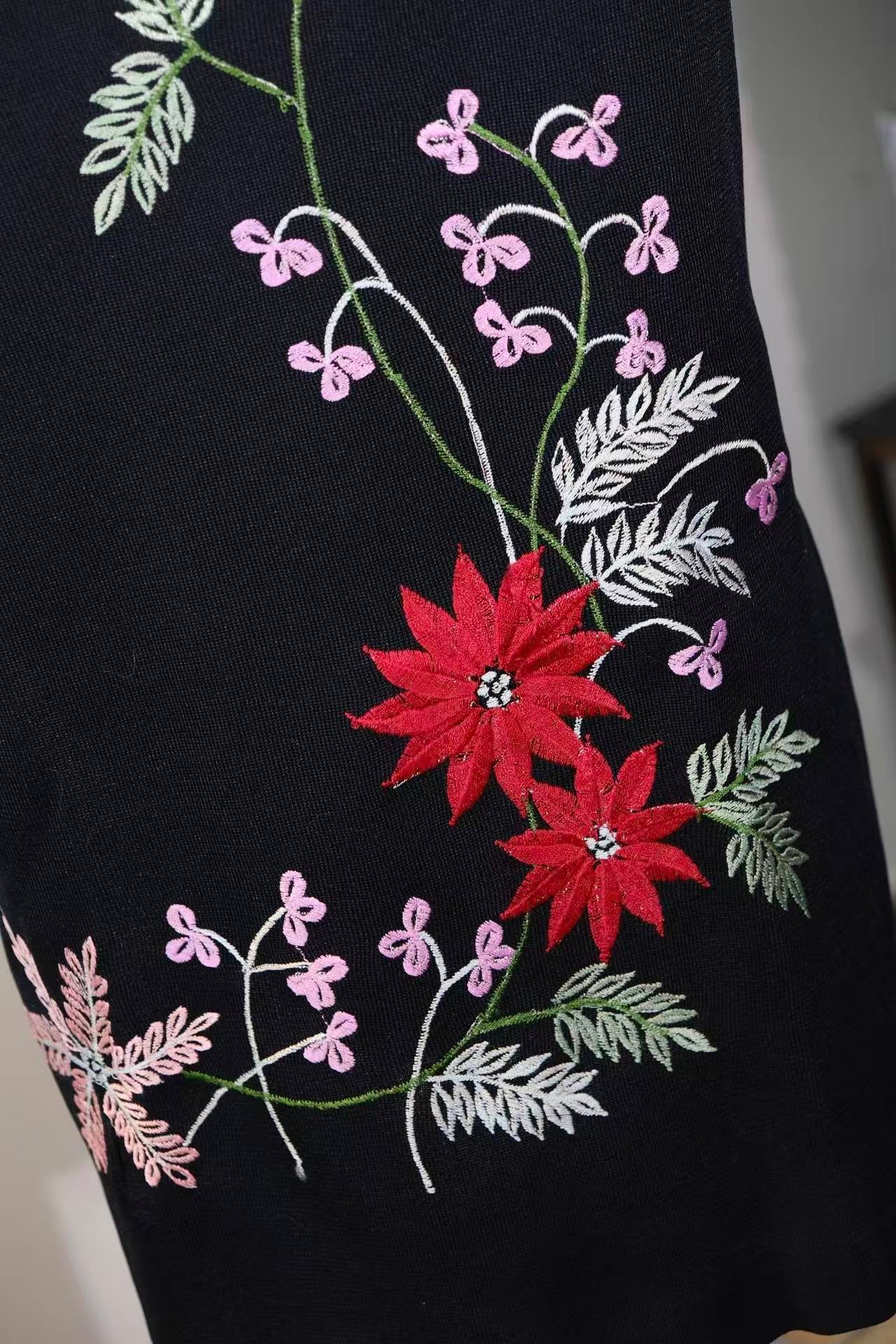
深黑色的底料如静夜,斜襟处淡粉滚边似月光流淌,
一、古董衣的“时代密码”:传统与现代的缝合
这件改良旗袍诞生于上世纪90年代,恰逢中国时尚界“新旧碰撞”
二、刺绣里的“文化隐喻”:从《诗经》到“新中式”
裙摆刺绣的花卉组合,暗藏多重文化密码。红花的热烈,呼应《
三、稀缺性与收藏价值:一件衣裳的“时代标本”
如今,这类90年代改良旗袍已成为“古董衣”中的珍品。
- 材质稀缺:当时的针织羊毛工艺尚未普及,这件旗袍的面料兼具“
- 工艺稀缺:手工刺绣的精细度与艺术性,远非现代机器刺绣可比,
- 时代稀缺:90年代是中国时尚“觉醒”的关键期,这件旗袍既是“
四、结语:穿在身上的“时代诗篇”
当你穿上这件旗袍,仿佛能听见90年代的风——
收藏这件旗袍,便是收藏一段“被针线缝合的时光”——
The deep black base fabric is like a quiet night, while the pale pink piping along the diagonal placket flows like moonlight. The embroidery nestled amidst the hem serves as the "soulful footnote" of the entire garment. Several red blossoms (resembling camellias or hollyhocks) bloom in vivid cinnabar, their petals layered like folding fans with delicate white threads at the center, appearing like morning dew yet undried. Clusters of pinkish-purple florets (akin to lilacs or hydrangeas) huddle between them, their stems and leaves outlined in tender green silk. With leaf veins as clear as if they were alive, the entire composition possesses the visual tension of "a splash of red amidst a sea of green," while subtly echoing the literati painting aesthetic of "sparse shadows reclining across clear, shallow water." The stitching is as fine as "gossamer" and the lines as fluid as "floating clouds," condensing the vitality and tenderness of flowers into a square inch—truly a "fine-brushwork painting (Gongbi) on the tip of a needle."
I. The "Epochal Code" of an Antique: Stitching Tradition to Modernity
This modified qipao was born in the 1990s, coinciding with a "golden age" of collision between the old and the new in Chinese fashion. At that time, the qipao was no longer merely a "relic of olden days" but a carrier of "modern aesthetics." Designers replaced traditional silk with knitted wool, preserving classic elements like the standing collar, diagonal placket, and cinched waist, while imbuing the garment with elasticity and warmth. This allowed the wearer to be "dignified and proper" while remaining "relaxed and comfortable." This "modification" was not a departure from tradition, but a fashion practice of the principle from the I Ching: "When at an impasse, change; through change, pass through; by passing through, endure." It is a paradigm of the perfect fusion between "traditional aesthetics" and "modern functionality."
II. Cultural Metaphors in Embroidery: From the Classic of Poetry to "New Chinese Style"
The floral combination embroidered on the hem hides multiple cultural codes. The passion of the red flowers echoes the celebration of life in the Classic of Poetry: "The peach tree is young and elegant; brilliant are its flowers." The reserve of the pinkish-purple florets aligns with the graceful sentiment of Song Dynasty lyrics: "In the small tower, listen to the spring rain all night; in the deep lane, apricot flowers are sold tomorrow morning." The embroidery craft itself is a microcosm of "Intangible Cultural Heritage" skills—from the "flat stitch" of Suzhou embroidery to the "stray hair stitch" of Hunan embroidery, every needle carries a thousand years of inherited ingenuity. By integrating these traditional elements into a modern qipao, 1990s designers used "needle and thread" as a pen to write a fashion manifesto for the "New Chinese Style": it does not merely replicate the past, yet it retains ancient charm; it is not avant-garde, yet it leads the new trend.
III. Scarcity and Collectible Value: An "Epochal Specimen" of a Garment
Today, this type of 1990s modified qipao has become a treasure among antique clothing. Its scarcity stems from three dimensions:
Material Scarcity: Knitted wool technology was not yet widespread at the time; this fabric possesses both the "luster of silk" and the "warmth of wool," symbolizing the "high-end bespoke" of the 90s.
Craftsmanship Scarcity: The precision and artistry of hand embroidery far exceed modern machine embroidery; every flower and leaf is the product of the artisan’s "heart and hand in harmony."
Epochal Scarcity: The 1990s was a critical period for the "awakening" of Chinese fashion. This qipao is a witness to the "awakening of female consciousness after the Reform and Opening-up" and a physical specimen of the fusion of tradition and modernity.
IV. Conclusion: An "Epochal Poem" Worn on the Body
When you wear this qipao, you can almost hear the wind of the 1990s—it blows through the plane trees of Shanghai, brushes past the hutongs of Beijing, and sweeps over the redefinition of "beauty" by countless women. The embroidery on the hem is both a "whisper among flowers" and an "echo of the era." It is not just a garment, but an "epochal poem worn on the body," telling a story of grace, ingenuity, and sentiment.
To collect this qipao is to preserve a "segment of time stitched together by thread"—it allows tradition to be reborn in modernity and history to continue through fashion.