深圳溯源
60年代 - 六十年代丝绒豹纹台湾产古董旗袍:当野性图腾邂逅东方剪裁 | 1960s - 1960s Leopard Print Velvet Taiwan Antique Cheongsam: Where Wild Totems Meet Oriental Tailoring
60年代 - 六十年代丝绒豹纹台湾产古董旗袍:当野性图腾邂逅东方剪裁 | 1960s - 1960s Leopard Print Velvet Taiwan Antique Cheongsam: Where Wild Totems Meet Oriental Tailoring
Couldn't load pickup availability
六十年代丝绒豹纹台湾产古董旗袍:当野性图腾邂逅东方剪裁
旗袍面料采用丝绒,
1960年代的台北,正处于“中华文化复兴运动”
从艺术史视角看,这件旗袍堪称“东方波普”的先声。安迪·
现存六十年代台湾产丝绒旗袍多为素色或花卉纹样,
这件旗袍不仅是冷战年代台湾社会的时尚切片,
1960s Leopard Print Velvet Taiwan Antique Cheongsam: Where Wild Totems Meet Oriental Tailoring
I. Material and Craft: The Dialectics of Light and Shadow
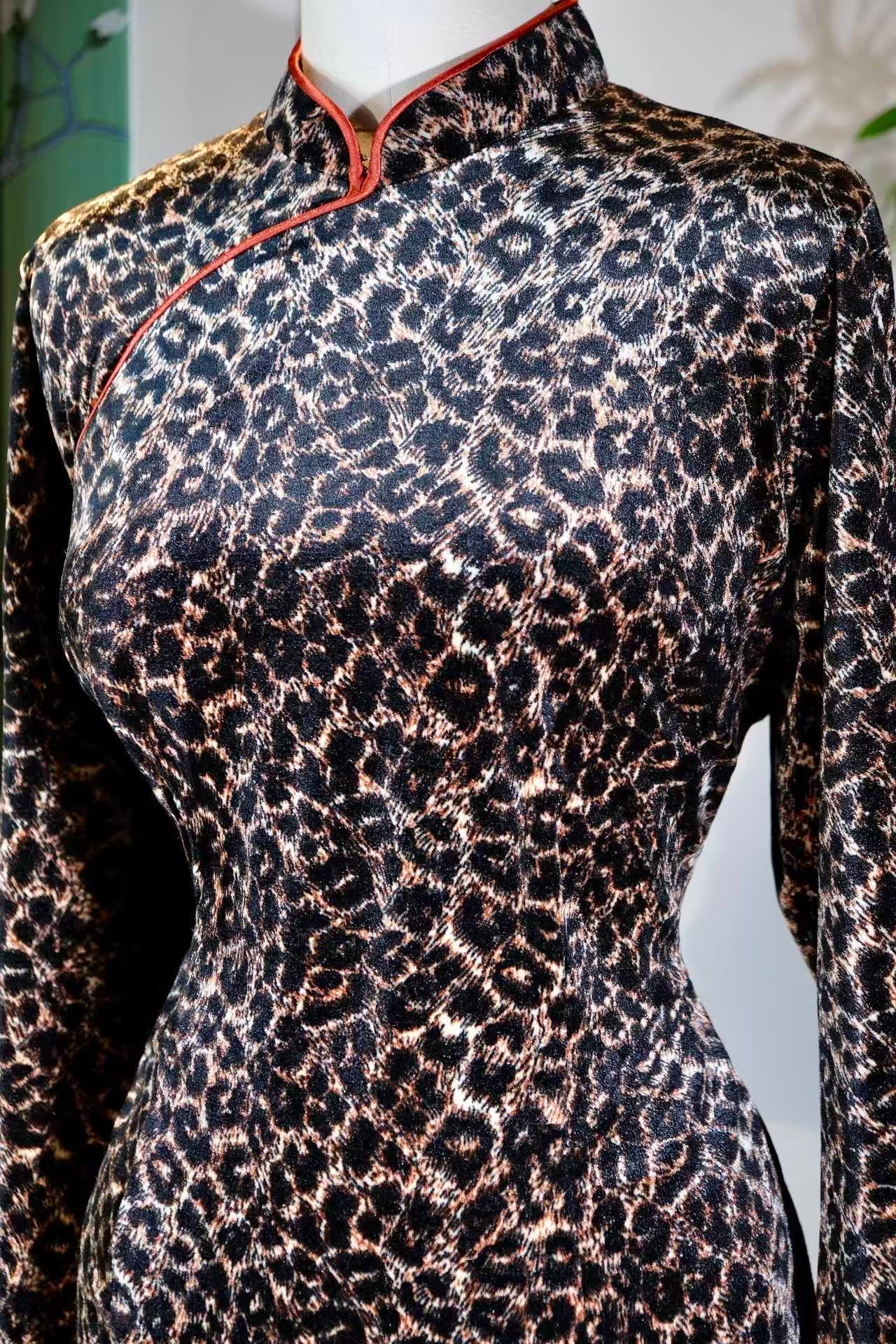
The fabric of this cheongsam is a sumptuous velvet; its surface pile catches the light to reveal shifting shades of brown and black spots, evocative of the leopard imagery in the Classic of Poetry: "Neither rhinoceros nor tiger, yet roaming the vast wilderness." The designer skillfully utilized the "Yin-Yang" (directional) properties of velvet: the dense pile is as dark as night from one angle, while the reverse emits an amber luster, granting the leopard print a three-dimensional depth of alternating light and shadow. The mandarin collar and diagonal closure are traced with vibrant orange-red piping—a modern translation of the "Xuan" (red silk cords) described in the Songs of Chu: "Exquisite features and slender forms, within the red-corded chambers." This detail not only tempers the wildness of the leopard print but also aligns with the "Red and Black" classical paradigm of traditional Chinese attire.
II. Historical Narrative: A Cultural Manifesto on Zhongshan North Road
1960s Taipei was at the vortex of the "Chinese Cultural Renaissance Movement" and the influx of Western thought. On the Zhongshan North Road of that era, one would often encounter socialites dressed in such attire: wearing a velvet leopard-print cheongsam paired with a Chanel jacket purchased in Paris, Mary Jane shoes, and a Hermès Birkin bag. This "East-meets-West" fusion became a microcosm of Taiwanese fashion, hailed by the United Daily News as a "walking cultural declaration."
III. Aesthetic Style: The Harbinger of "Oriental Pop Art"
From an art history perspective, this cheongsam is a precursor to "Oriental Pop." Just as Andy Warhol’s 1962 Campbell’s Soup Cans deconstructed consumerism through repetitive patterns, this garment deconstructs the "subtle beauty" of the traditional qipao through the infinite repetition of leopard spots.
The tailoring of the waist draws from the 1950s Dior "New Look" cinched waist, creating an hourglass silhouette. This "hybrid" cut of ancient and modern perfectly echoes Qian Zhongshu’s remark in On the Art of Poetry: "The Eastern and Western seas share the same psychological landscape; Northern and Southern schools of thought do not split the essence of the Way."
IV. Rarity and Provenance: A Fragment of History
Among surviving 1960s Taiwanese velvet cheongsams, the vast majority feature solid colors or floral patterns; leopard print accounts for less than two percent. According to textile historian Lin Fang-mei, velvet fabrics at the time were largely imported from Japan. Given that velvet is prone to wear and difficult to preserve, pieces that remain in pristine condition today are as rare as "phoenix feathers and unicorn horns."
Conclusion: An Eternal Dialogue
This cheongsam is not merely a fashion slice of Cold War-era Taiwanese society; it is a vital material witness to the modernization of Oriental dress. As your fingertips brush across the velvet surface, you touch over half a century of shifting tides: from the rhythmic looms of Dadaocheng to the neon lights of Zhongshan North Road; from the ritual traditions of the Book of Rites to the romantic imagination of the Songs of Chu.
Through a single garment, it articulates the eternal dialogue between East and West, tradition and modernity, and wildness and femininity.
Share