深圳溯源
Couldn't load pickup availability
“大音希声,大象无形;大美若夜,众星拱之。”
当这件黑色礼服静立于光影之间,它不仅仅是一件衣物,更是一封来自1960年代维多利亚港的情书。在那个东西方文化激烈碰撞的黄金年代,它以一种近乎奢侈的静默,诠释了什么是真正的“暗夜生花”。
一、 视觉解构:墨色上的星辰变奏
这件礼服的底色并非普通的黑,而是深邃如墨的重磅醋酸缎面黑。这种黑色如同午夜的深海,贪婪地吸收光线,只为让点缀其上的珠绣迸发出最耀眼的生命力。
- 散落的“星图”纹样:
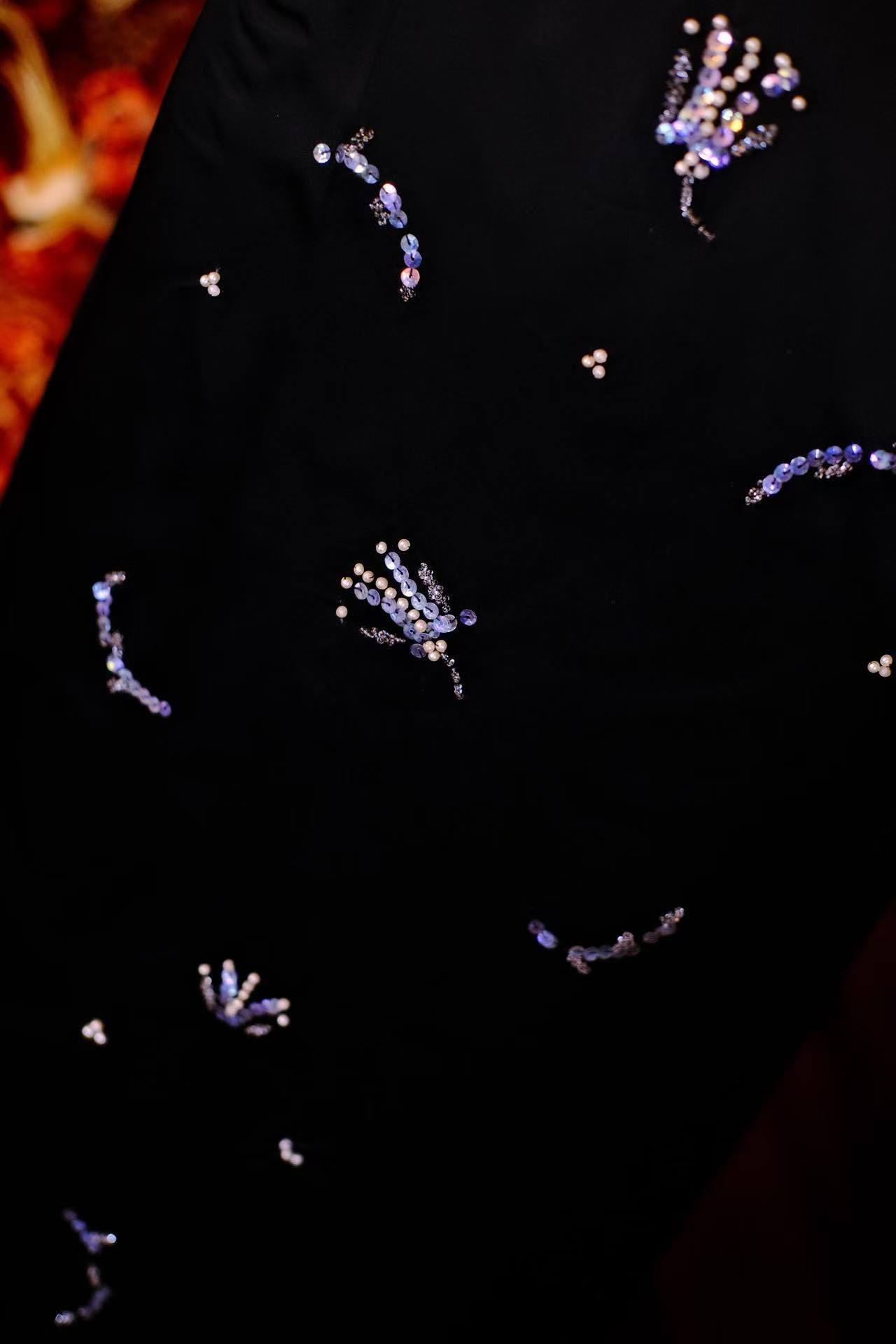
请看那些散落在黑色缎面上的珠绣,它们并非传统的中式团花,而是极具六十年代现代感的抽象花卉与星芒。匠人巧妙地利用了黑色底布的“虚空”属性,将珠绣设计得疏密有致。
- 胸前:珠绣最为密集,以幻彩珠片和莹润米珠组成了盛开的花簇,仿佛夜空中最亮的几颗星辰。
- 裙摆:随着视线下移,纹样逐渐稀疏,化作零星散落的花蕊与流苏。这种留白,恰如中国画中的“计白当黑”,在黑色的裙身上营造出一种流动的空气感。
- 光影的魔法:
在黑色的衬托下,每一颗手工缝制的珠片都成为了光的捕手。图片中可以看到,珠片呈现出极光般的幻彩,在暗处会折射出淡紫、银蓝的微光。这种“黑底银绣”的视觉效果,比彩色底布更具高级感,正如《红楼梦》中形容的“软烟罗”般,虽无艳色,却自有光华。
二、 时代回响:香江名媛的“战袍”
这件礼服诞生于上世纪60年代的香港。彼时,香港不仅是转口贸易港,更是亚洲的时尚中心之一。
- 中西合璧的剪裁:
它采用了经典的方领无袖设计,这是典型的西式晚礼服廓形,强调肩颈线条的优雅与锁骨的精致。然而,其灵魂却是东方的。这种在成衣上进行大面积重工珠绣的工艺,正是当时“香港制造”的金字招牌。
- 潮汕匠人的指尖史诗:
这件衣服是潮汕珠绣工艺的巅峰体现。在六十年代,没有电脑制版,没有机器钉珠。每一颗米粒大小的珠子,都是由潮汕绣娘在昏黄的灯光下,用比发丝还细的丝线,一针一线手工缝制。
- 稀缺性:这种高密度的重工珠绣,一位熟练绣娘可能需要耗时数月才能完成一件。在那个年代,这通常是电影明星或豪门名媛出席重要晚宴(如慈善舞会、赛马会)时的“战袍”。如今,这种纯手工技艺已濒临失传,这件衣服便成了那段“流金岁月”的活化石。
三、 艺术独白:引经据典的东方哲思
若要用一句诗来形容它,莫过于“黑云压城城欲摧,甲光向日金鳞开”的变奏——只不过这里的“甲光”化作了温柔的珠光,在黑色的“云”中静谧绽放。
它让我想起张爱玲笔下对于服饰的执着:“生命是一袭华美的袍。”而这件黑色的珠绣礼服,便是那袭袍子中最华丽、最神秘的一角。它不似大红大绿那般张扬,却以一种“由于懂得,所以慈悲”的低调奢华,诉说着关于时间、关于工艺、关于美的永恒故事。
收藏这件礼服,不仅是收藏一件可以穿着的艺术品,更是收藏了一段关于1960年代东方巴黎的绮丽旧梦。
"Great music is faint in sound; great imagery is invisible in form. Great beauty is like the night, with a multitude of stars surrounding it."
Standing silently between light and shadow, this black gala gown is more than a piece of clothing; it is a love letter from 1960s Victoria Harbour. In that golden age of intense collision between Eastern and Western cultures, it interprets true "blooming in the dark" with an almost extravagant silence.
The base color of this gown is not an ordinary black, but a deep, ink-like heavy acetate satin. This black is like the midnight deep sea, greedily absorbing light only to let the bead embroidery embellished upon it burst forth with the most dazzling vitality.
Scattered "Star Map" Motifs: Observe the beadwork scattered across the black satin; these are not traditional Chinese floral clusters but abstract blossoms and starlight brimming with 1960s modernity. The artisan skillfully utilized the "void" attribute of the black fabric, designing the embroidery with balanced density.
The Bust: The beadwork is most concentrated here, with iridescent sequins and lustrous seed beads forming blooming flower clusters, like the brightest stars in the night sky.
The Hem: As the gaze moves downward, the patterns gradually thin out, turning into sporadically scattered stamens and tassels. This use of negative space is exactly like the "treating white as black" (ji bai dang hei) principle in Chinese painting, creating a sense of flowing air across the black gown.
The Magic of Light and Shadow: Against the black backdrop, every hand-sewn sequin becomes a "light catcher." As seen in the images, the sequins present an aurora-like iridescence, reflecting faint glints of violet and silver-blue in the dark. This visual effect of "silver embroidery on a black base" carries a higher sense of luxury than colored fabrics, much like the "Soft Smoke Gauze" (Ruan Yan Luo) described in Dream of the Red Chamber—possessing its own radiance despite the absence of gaudy colors.
This gown was born in 1960s Hong Kong. At that time, Hong Kong was not only an entrepôt but also one of Asia’s fashion epicenters.
An East-Meets-West Silhouette: It features a classic square-neck sleeveless design—a typical Western evening gown silhouette that emphasizes the elegance of the neck and the delicacy of the collarbone. However, its soul is Eastern. The technique of performing large-scale, heavy-duty bead embroidery on ready-to-wear was the "Gold Standard" of Made in Hong Kong at the time.
A Fingertip Epic by Chaoshan Artisans: This garment is a pinnacle manifestation of Chaoshan bead embroidery. In the 1960s, there was no computer-aided design or machine-beading. Every bead the size of a grain of rice was hand-sewn by a Chaoshan embroideress under dim lamplight, using silk threads finer than a human hair.
Scarcity: Such high-density heavy beadwork could take a skilled embroideress several months to complete just one piece. In that era, these were typically the "battle armor" for film stars or socialites attending major banquets, charity balls, or race meetings. Today, this pure handicraft is on the brink of extinction, making this gown a "living fossil" of those golden years.
If one were to use a poem to describe it, it would be a variation of: "Dark clouds weigh down upon the city, threatening to crush it; the light on the armor shines toward the sun, like golden scales opening." Only here, the "armor light" has turned into a gentle pearlescent glow, blooming quietly within the black "clouds."
It reminds me of Eileen Chang’s obsession with attire: "Life is a gorgeous gown." And this black bead-embroidered gown is the most magnificent and mysterious corner of that gown. It is not as ostentatious as bright reds or greens, but with a low-key luxury of "Because I understand, I am compassionate," it tells an eternal story about time, craftsmanship, and beauty.
Collecting this gown is not just collecting a wearable work of art; it is collecting a splendid old dream of the "Paris of the East" in the 1960s.