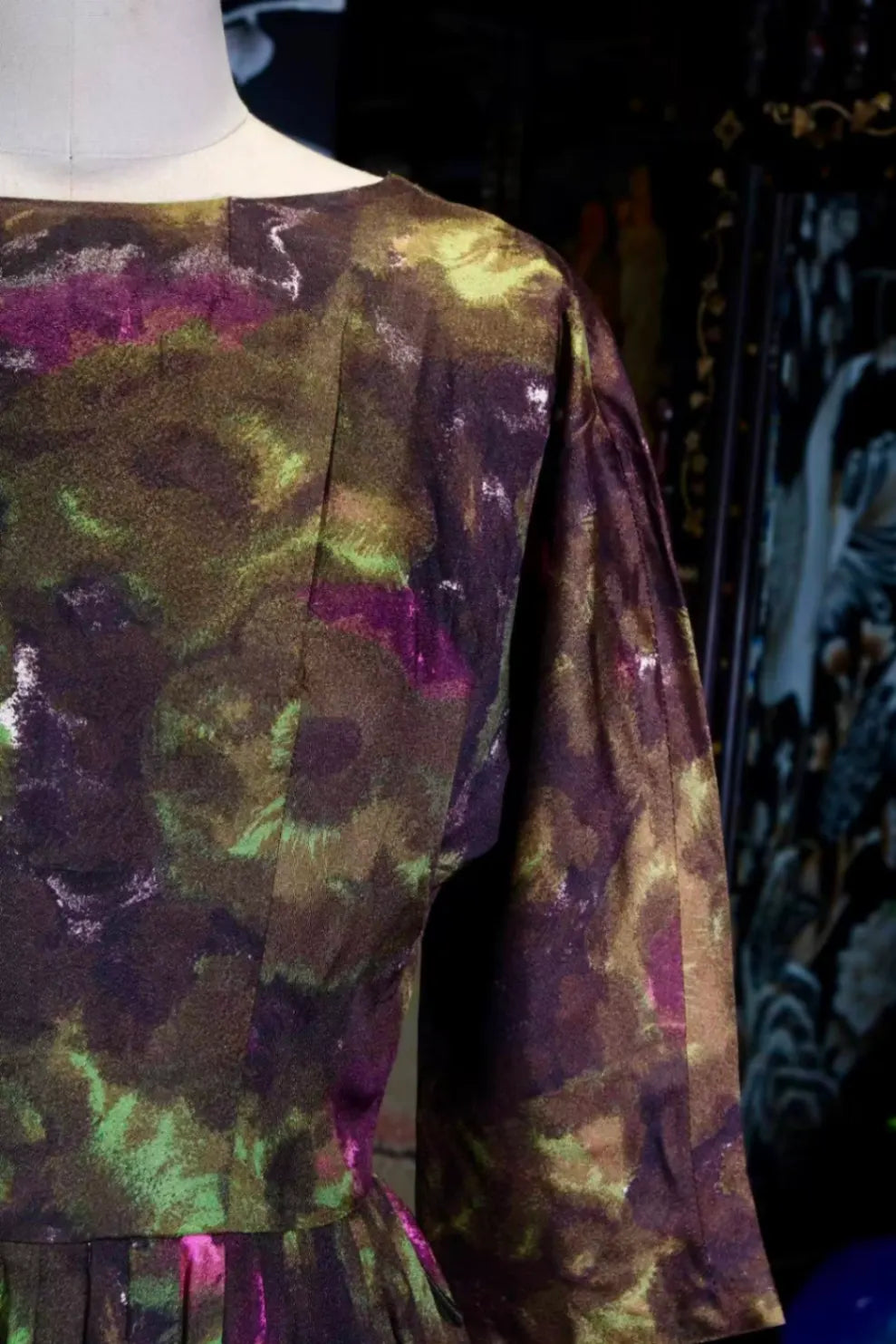
Old Dreams of Hong Kong: An Archival Record of a 1960s Painterly-Print Pleated Dress
Formal Origins: An Elegant Paradigm of East-West Synthesis
The cut of this dress deeply embodies the aesthetic essence of 1960s East-West convergence. Its neckline adopts the classic boat neck (Bateau Neckline), gracefully framing an elongated neck and collarbones—a visual sensibility echoing the traditional Chinese "straight-across collar" (Yizi Ling), poised and restrained. Tapered cleanly at the waist to meet an elevated waistline, the skirt flares into a bell-shaped silhouette (Bell Shape). Immensely favored in 1960s Hong Kong, this form preserves the gentle curves of the Eastern female figure while integrating the post-Dior "New Look" Western pursuit of voluminous, sweeping skirts. Finished with fine accordion knife pleats (Knife Pleats), the hem sways effortlessly in motion like willows in a breeze, projecting the classical grace of "swaying steps yielding timeless allure."
Textile & Motif: A Flowing Monet Garden
The most captivating aspect of this piece resides in its textile. Judging by its subtle, shifting sheen, it is crafted from the high-grade rayon or silk-blend fabrics that were the pride of Hong Kong’s textile industry during that era, possessing an exceptional, fluid drape.
Rather than utilizing conventional flat screen-printing, the motif achieves a blurred, painterly diffusion combining the organic fluidity of tie-dye with hand-painted oils. Chromatically, deep ink-greens and enigmatic magentas interweave, accented by bright yellows and dusty pinks—resembling Monet’s Water Lilies pond, dappled with shifting light and shadow where abstraction and reality merge. This "splashed-ink painting" tactility shatters the rigidity of standard prints, infusing the garment with the freehand expressive spirit of traditional Chinese ink-wash art. The collision of a dark ground with vivid bursts of color echoes the Song-dynasty verse "green lush, red thin," balancing the opulent richness of the late Tang and Five Dynasties with modernist abstract beauty.
Historical Lineage: The Golden Age of "Made in Hong Kong"
The 1960s marked the golden epoch of Hong Kong’s light industrial ascent. Serving as a nexus where mainland Chinese textile craftsmanship converged with Western fashion intelligence, the city produced countless dazzling "Hong Kong-made" masterpieces. This dress stands as an epitome of that era's supreme garment-making skill. Transcending mere apparel, it serves as tangible testimony to the cross-cultural dialogue unfolding along Victoria Harbour—chronicling the marriage of master Shanghai tailoring (Shanghai Tailors) with Western three-dimensional pattern-making, and recording the aesthetic journey of Eastern women balancing modern sophistication with traditional modesty.
Archival Epilogue
Years turn, neon lights shift. Resting quietly upon the display rack of time, this 1960s vintage dress is no longer simply a garment from the past, but a chapter of old Hong Kong stitched together thread by thread. Slipping into it feels akin to hearing the lapping tides of Victoria Harbour and catching the faint scent of vintage rouge lingering in bygone days. This represents far more than a collection of beauty; it is an affectionate gaze back into a golden age.