深圳溯源
Couldn't load pickup availability
衣服尺寸:
胸围/腰围/臀围:86/64/88 厘米
衣长:100 厘米
细节描述:
这件旗袍,是上世纪六十年代香港黄金时代的缩影。它不仅仅是一件衣物,更是一段被织物封存的历史,一种在东西方文化碰撞中诞生的独特美学。
图案描述:青花流韵与抽象写意的交响
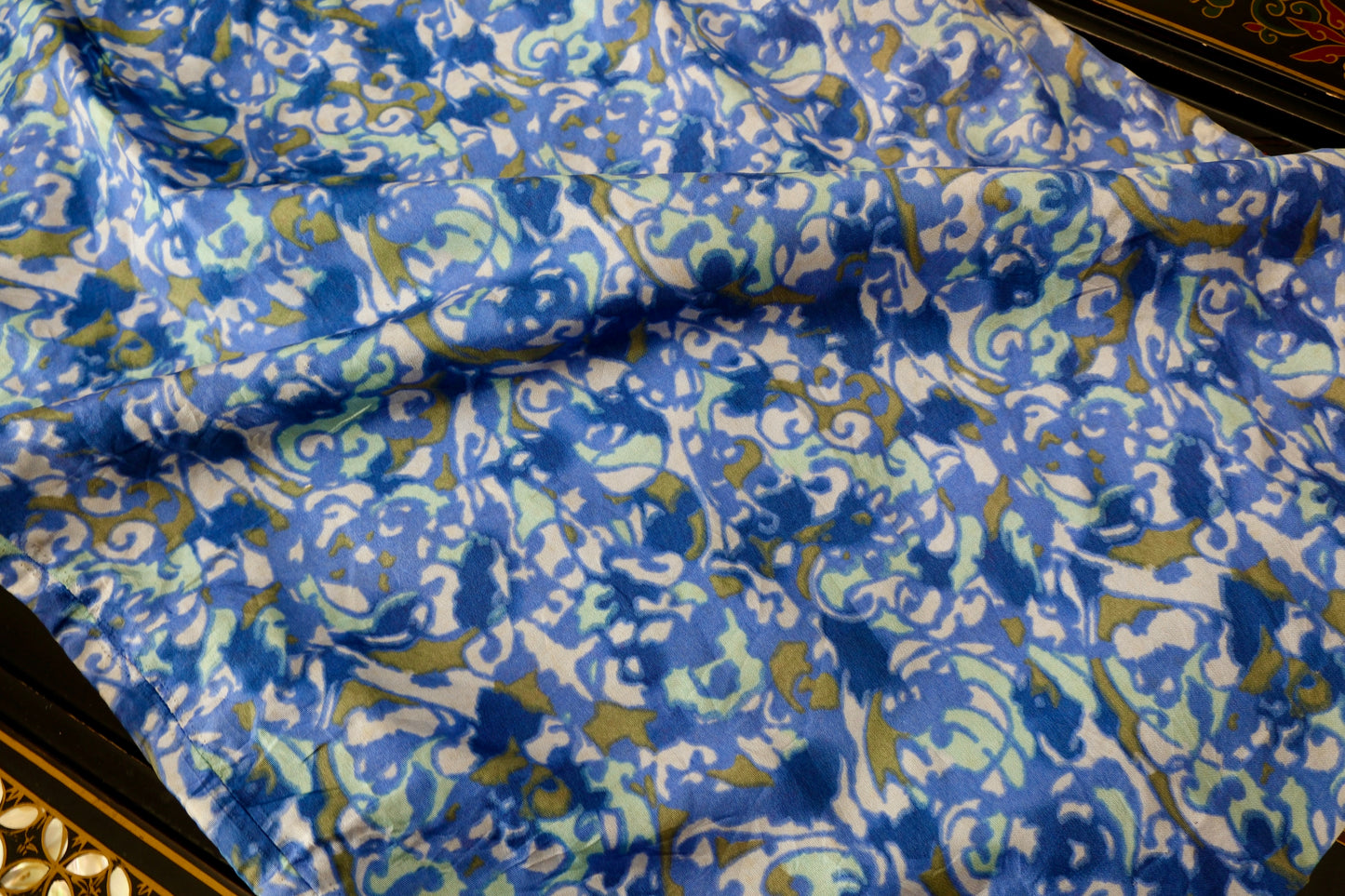
这件旗袍最引人注目的,莫过于其面料上繁复而灵动的纹样。这并非传统意义上工整对称的宫廷缠枝莲,而是一种更具现代感、甚至带有几分表现主义色彩的“抽象云雷与花卉”纹饰。
- 色彩美学: 整体色调以深邃的靛蓝(Indigo)为主基调,间杂着天青、月白以及点缀其中的赭石色线条。这种配色方案让人联想到中国传统的青花瓷,但又比青花瓷多了一份流动感和不确定性。
- 纹样形态: 图案看似杂乱无章,实则气韵贯通。深蓝色的团块如同泼墨山水中的远山,又似翻滚的云涛;浅色的线条则如游龙惊鸿,穿插其间。这种设计打破了传统旗袍纹样的具象束缚,更接近于一种“意象化”的表达——它不直接画花,却处处透着花的姿态;不直接画云,却满纸皆是云的流动。
- 工艺质感: 从细节看,面料具有明显的光泽感,极有可能是当时流行的人造丝或混纺丝绸。这种面料在当时被称为“的确良”的前身或高档仿真丝,它能极好地承载这种高饱和度的印花,使图案在光影下呈现出一种迷离的视觉效果。
古董衣的故事:香江旧梦与西风东渐
这件旗袍诞生于1960年代的香港,那是一个极其特殊的时空节点。
彼时的香港,正处于战后经济腾飞的前夜,也是中西文化交融最为剧烈的熔炉。张爱玲笔下的上海旗袍风韵并未随风而逝,而是随着移民潮南下,在维多利亚港的霓虹灯下完成了最后的华丽转身。
这件衣服的主人,或许是一位在写字楼里干练工作的职业女性,也或许是某位名伶在后台换装时的私服。那个年代的香港女性,开始追求更自由的身体表达。请注意观察它的剪裁:
- 立体省道: 不同于老式旗袍平面的剪裁,这件旗袍有着非常明显的西式立体剪裁痕迹。胸省、腰省的运用,精准地勾勒出女性的S型曲线,这是受好莱坞电影和西方时装影响的结果。
- 无袖设计: 大胆露出的肩部线条,在那个年代是一种摩登的象征,既保留了东方的含蓄(高领),又释放了现代的性感。
它见证了那个时代女性在传统礼教与现代自由之间的挣扎与平衡。每一处针脚,都缝进了那个时代特有的焦虑与希望。
艺术风格与稀缺性:绝版的东方现代主义
引用沈从文先生在《中国古代服饰研究》中的观点,服饰是“穿在身上的历史”。而这件旗袍,正是“海派文化”向“港式风情”过渡的活化石。
- 引经据典: 《长恨歌》里写杨贵妃“温泉水滑洗凝脂”,虽言唐风,但这件旗袍所追求的贴合肌肤的流畅感,与其有着异曲同工之妙。然而,它摒弃了繁复的刺绣与滚边,转而用平面构成的手法来处理面料,这恰恰符合包豪斯设计理念在东方的投射。它证明了六十年代的香港设计师已经开始尝试用国际化的视觉语言来重构中国传统符号。
- 稀缺性分析:
- 保存难度: 这类六十年代的人造丝或混纺面料,随着时间推移极易脆化、褪色。能像图中这样色泽依然鲜亮、结构依然完整的,实属凤毛麟角。
- 审美断层: 七十年代后,成衣工业爆发,这种需要极高手工技巧(特别是归拔工艺)的定制旗袍逐渐被流水线取代。这种介于“传统手工”与“现代工业”之间的 transitional piece(过渡时期作品),在收藏界具有极高的学术研究价值和审美价值。
这不仅是一件衣服,这是一首用蓝白两色写就的、关于六十年代香港的散文诗。它静默无言,却道尽了那个时代的万种风情。
Measurements / Size Guide:
Bust / Waist / Hips: 86/64/88 cm
Total Length: 100 cm
Detailed Description:
This qipao stands as a flawless microcosm of Hong Kong's golden era during the 1960s of the last century. It transcends its primary classification as a mere article of clothing to operate as a segment of history preserved within the weave—a highly singular aesthetic born directly from the collision of Eastern and Western cultures.
The most arresting element of this qipao resides indisputably in the intricate and highly fluid patterns dancing across the textile chassis. This completely rejects the tidy, symmetrical layout of traditional court-style continuous lotus vines, delivering instead a contemporary and almost expressionistic composition of "abstract cloud-and-thunder motifs mixed with florals."
Chromatic Aesthetics: The overall color palette relies on a deep, concentrated indigo as its primary grounding anchor, interspersed with celadon blue, moon white, and accented strokes of ochre lines. This specific coloration instantly evokes classical Chinese blue-and-white porcelain, yet it injects a layer of dynamic fluidity and organic uncertainty that porcelain cannot capture.
Pattern Morphology: While the pattern layout might appear chaotic at a glance, its vital energy and internal spirit (Qiyun) remain completely seamless and continuous. The deep blue clusters resemble distant mountains found within splashed-ink landscapes or rolling cloud billows; meanwhile, the lighter lines cut through the composition like startled dragons or flying swans. This design completely shatters the representational boundaries of traditional qipao motifs, leaning deep into an "ideational" expression—it avoids rendering flowers directly, yet the posture of blossoms breathes through every inch; it avoids painting clouds explicitly, yet the fluid motion of mist saturates the entire surface.
Textile Texture and Craftsmanship: Observing the finer details, the fabric displays a distinct, high-profile luster, indicating it is highly likely made of rayon or a silk blend that was intensely popular during that specific timeline. This material was celebrated in that era as a luxurious faux silk (or a precursor to Dacron), capable of beautifully holding highly saturated prints and causing the patterns to exhibit a dreamy, shifting visual effect under moving light and shadow.
This qipao was materialized during the 1960s in Hong Kong—a highly specific, extraordinary intersection of time and space.
Hong Kong during that timeline stood right on the eve of its postwar economic takeoff, functioning as a hyper-dynamic melting pot where Eastern and Western cultures fused with absolute intensity. The romantic charm of the Shanghai qipao popularized by author Eileen Chang did not simply vanish with the wind; rather, it migrated south alongside the waves of population movement, executing its definitive, magnificent evolution beneath the brilliant neon glow of Victoria Harbour.
The original custodian of this garment may have been a highly efficient professional woman commanding a modern corporate high-rise, or perhaps it served as the personal off-duty apparel of a celebrated actress changing inside a backstage greenroom. Hong Kong women of that era began aggressively pursuing a much freer expression of the physical form. One can trace this clearly within its pattern drafting:
Three-Dimensional Darting: Utterly distinct from the flat, two-dimensional drafting of old-school heritage qipaos, this piece bears unmistakable hallmarks of Western three-dimensional tailoring. The precise implementation of bust darts and waist darts sharply frames the female S-curve silhouette—a direct result of structural influences bleeding over from Hollywood cinema and Western fashion trends.
The Sleeveless Architecture: The bold exposure of the shoulder profiles operated during that specific generation as a supreme symbol of modernity. It perfectly preserved Eastern containment through its high standing collar while simultaneously releasing a clean, contemporary sensuality.
It stood as a silent physical witness to the generational negotiation and balance struck by women navigating between traditional moral decorum and modern liberation. Every single stitch holds the unique anxieties and burning hopes characteristic of that transformative decade.
Evoking the definitive perspective of scholar Shen Congwen in his seminal text Research on Ancient Chinese Clothing, apparel operates essentially as "history worn directly upon the body." This specific qipao stands as a genuine living fossil tracking the vital transition where "Shanghai culture" evolved into true "Hong Kong-style elegance."
Classical Allusions and Intertextuality: The historical masterpiece The Song of Everlasting Sorrow describes Yang Guifei as stepping into "the soothing waters of the hot springs to cleanse her smooth, jade-like skin." Though tracing Tang Dynasty aesthetics, the smooth, body-hugging fluid contour pursued by this qipao shares an identical artistic spirit. However, it completely throws off intricate embroidery and heavy edge piping, choosing instead to handle the fabric using two-dimensional planar composition—a design choice that perfectly mirrors the Eastern projection of Bauhaus design philosophies. It proves definitively that Hong Kong designers of the 1960s had already begun masterfully utilizing an internationalized visual language to completely deconstruct and rebuild traditional Chinese symbols.
Scarcity Analysis:
Conservation Defiance: Rayon or mixed-silk blend textiles from the 1960s are notoriously prone to embrittlement, structural breakdown, and severe color fading over a long timeline. For a specimen to retain its saturation as vibrantly and preserve its structural integrity as flawlessly as this one is exceptionally rare.
Aesthetic Discontinuity: Post-1970s, the explosion of mass-market ready-to-wear apparel took hold, and custom-tailored qipaos requiring elite manual mastery (specifically the complex heat-shaping stretching techniques known as Guiba) were steadily replaced by automated assembly lines. This transitional piece bridging "traditional handicraft" and "modern industrialization" carries immense academic research weight and profound aesthetic value within elite curation circles.
This transcends its definition as a functional garment; it stands as a prose poem written in blue and white, dedicated entirely to the 1960s of Hong Kong. It remains beautifully silent, yet speaks volumes regarding the infinite elegance of its era.