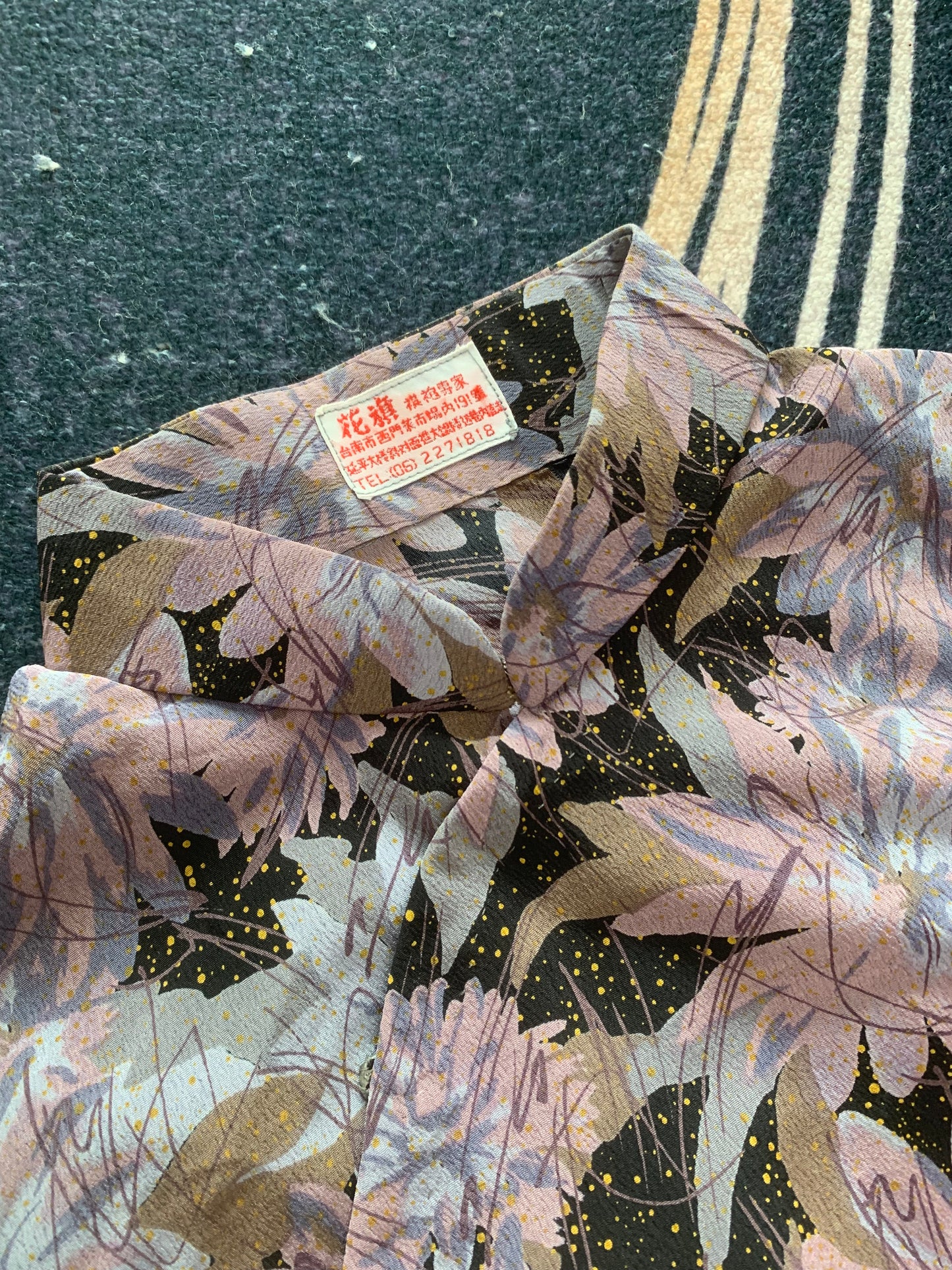
六十年代台湾产花旗旗袍专家古董旗袍文案
衣服尺寸:
胸围/腰围/臀围:100/84/106 厘米
衣长:109 厘米
细节描述:
一、图案描述:水墨与金粉的绮梦交织
这件旗袍的图案,是一幅流动的“花间词”。主色调为淡紫与藕粉的渐变,如暮春时节的烟霞,又似宣纸上晕染的水墨。花瓣以写意笔法勾勒,边缘略带飞白,似有风过花枝的灵动;花蕊处点缀细碎金粉,如星子散落,在光线下流转微芒,暗合《诗经》“桃之夭夭,灼灼其华”的诗意。底色为深褐与墨黑,如夜空般沉静,衬得花色愈发清丽,恰似“月移花影动,疑是玉人来”的朦胧意境。
二、古董衣的故事:六十年代台湾的旗袍风华
这件旗袍出自“花旗旗袍专家”——上世纪六十年代台湾知名的旗袍工坊。彼时,台湾经济渐兴,文化交融,旗袍作为“国服”,既是日常着装,亦是身份象征。花旗旗袍专家以“量体裁衣”为核,融合海派旗袍的精致与本土审美,成为当时名媛仕女的首选。
据考,六十年代台湾旗袍多采用进口丝绸与印花工艺,这件旗袍的面料细腻挺括,印花清晰,可见当时纺织技术之精。下摆微开衩,行走时裙裾轻摆,既有传统旗袍的含蓄,又添几分现代女性的洒脱。
三、艺术风格与稀缺性:时光淬炼的孤品
从艺术风格看,这件旗袍融合了“新古典主义”与“装饰艺术”(ArtDeco)的元素。图案的抽象花卉设计,打破了传统旗袍的写实花鸟纹样,更具现代感;而剪裁上保留了旗袍的修身廓形,强调女性曲线,符合六十年代“优雅而独立”的女性形象。
稀缺性方面,六十年代台湾产的旗袍存世量稀少。彼时,旗袍多为定制,工坊规模小,产量有限;加之岁月流转,保存完好的古董旗袍更是凤毛麟角。这件旗袍历经半世纪,面料未褪色,版型未变形,实属难得。
四、结语:穿在身上的历史
这件旗袍,不仅是一件衣物,更是一段历史的载体。它见证了六十年代台湾的社会变迁,承载了女性的优雅与自信。当你穿上它,仿佛能听见旧时光里的呢喃,看见那个穿着旗袍、步履轻盈的女子,在岁月的长河中,留下一抹永不褪色的芳华。
“衣以载道,物以传情。”这件花旗旗袍专家的古董旗袍,是时光的馈赠,亦是艺术的传承。愿它能遇见懂它的人,续写新的故事。
Oriental Dreams of Ink and Gold: An Analytical Study of a 1960s Taiwan "Huaqi Qipao Expert" Antique Qipao
Measurements / Size Guide:
Bust / Waist / Hips: 100/84/106 cm
Total Length: 109 cm
Detailed Description:
I. Pattern Description: A Dreamy Interplay of Ink and Gilded Dust
The pattern of this qipao is a flowing "Poem Among Flowers." The primary palette features a gradient of pale violet and lotus-root pink, resembling the misty clouds of late spring or ink washing over Xuan paper. The petals are sketched with "freehand" (Xieyi) brushstrokes, with slight "flying white" (Feibai) at the edges to evoke the movement of wind through blossoms. The stamens are dotted with fine gilded dust, shimmering like scattered stars under the light—a subtle nod to the Book of Songs: "The peach tree is young and elegant; brilliant are its flowers." The base tones of deep amber and ink-black are as tranquil as the night sky, making the floral colors appear exceptionally fresh, capturing the hazy mood of: "The moon shifts and the flower shadows move, suspecting the jade lady has come."
II. The Antique Story: The Qipao Elegance of 1960s Taiwan
This piece hails from "Huaqi Qipao Expert" (花旗旗袍专家)—a renowned Taiwanese qipao atelier of the 1960s. During this era, as Taiwan’s economy flourished and cultures converged, the qipao stood as the "National Dress," serving as both daily attire and a symbol of status. Huaqi focused on the core principle of "bespoke tailoring," blending the exquisite craftsmanship of Shanghainese (Haipai) styles with local Taiwanese aesthetics, making it the premier choice for socialites and refined ladies of the day.
Historical records indicate that 1960s Taiwanese qipaos frequently utilized imported silk and advanced printing techniques. The fabric of this piece is delicate yet structured with crisp prints, showcasing the textile prowess of the period. The slight side-slits allow the hem to sway gently with each step, preserving the traditional reserve while adding the spirited independence of the modern woman.
III. Artistic Style & Rarity: A Timeless Original
Artistically, this qipao fuses elements of Neoclassicism and Art Deco. The abstract floral design breaks away from traditional realistic bird-and-flower motifs, offering a more contemporary feel. However, the tailoring preserves the body-contouring silhouette that emphasizes feminine curves, perfectly aligning with the "elegant and independent" female archetype of the 1960s.
Regarding rarity, 1960s Taiwanese-made qipaos are increasingly scarce. At the time, they were primarily custom-made in small-scale ateliers with limited production. After half a century, finding an antique qipao that has neither faded in color nor lost its structural shape—as this one has—is truly finding a "phoenix feather or unicorn horn."
IV. Conclusion: History Worn on the Body
This qipao is more than a garment; it is a vessel of history. It witnessed the social transformations of 1960s Taiwan and carries the grace and confidence of its women. To wear it is to hear the whispers of old times and see the silhouette of a lady with a light step, leaving behind an unfading fragrance in the long river of years.
"Garments carry the Way; objects transmit emotion." This antique qipao from Huaqi is a gift from time and a legacy of art. May it encounter one who understands its soul to continue its story.