深圳溯源
Couldn't load pickup availability
衣服尺寸:
胸围/腰围/臀围:88/64/92 厘米
衣长:130 厘米
细节描述:
一、衣上锦绣:彩线织就的向阳诗篇
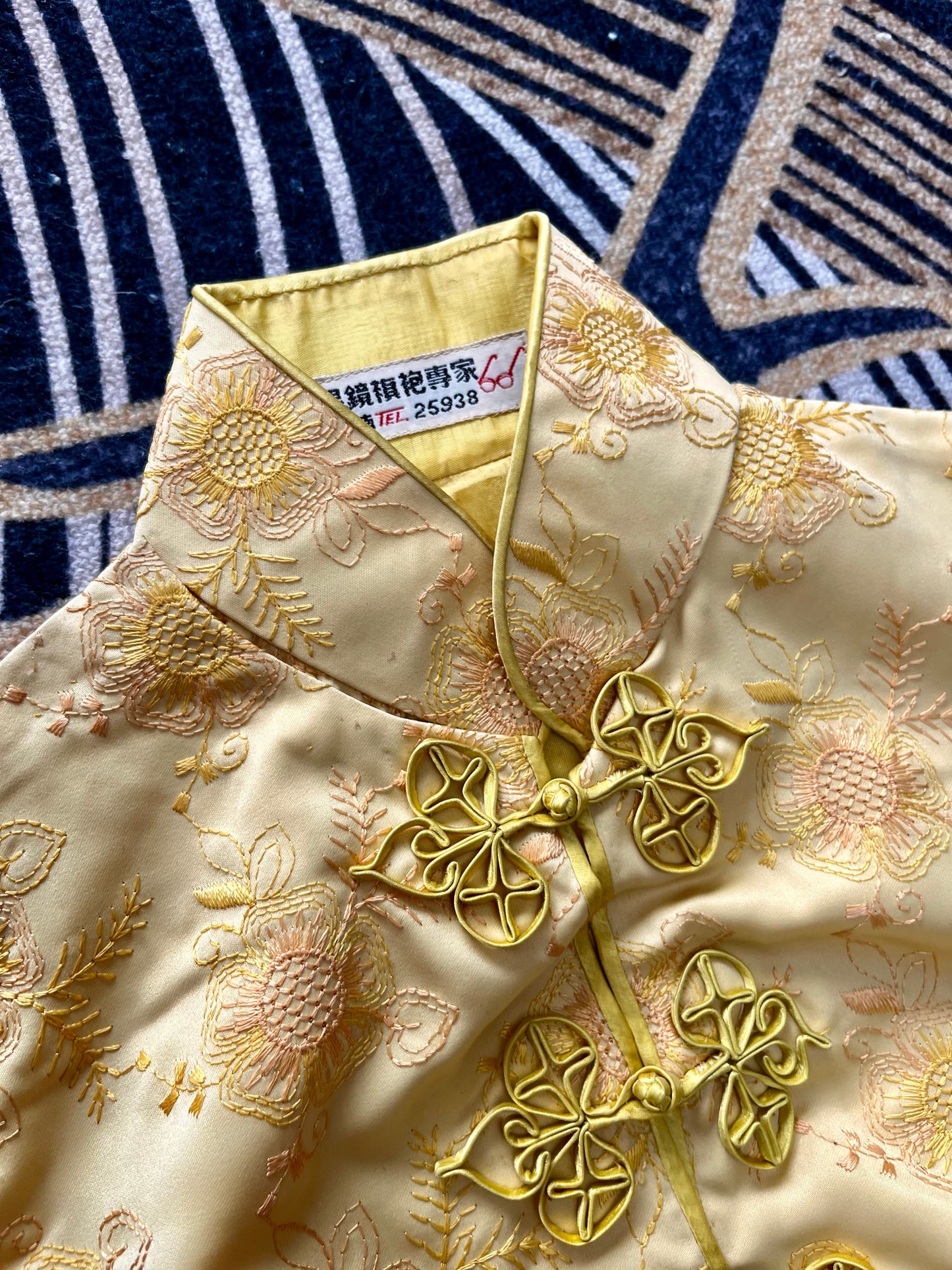
这件诞生于上世纪六十年代台湾的无袖旗袍,以柔滑的淡金色缎面为纸,以多色丝线机绣为墨,写就了一卷流动的东方美学。通身遍布的向日葵纹样,以缠枝为骨,花盘饱满如盛唐牡丹,花瓣以黄、橙、粉渐变丝线晕染,花蕊处点缀细密针脚,仿佛被岁月镀上一层暖光。最引人注目的是领口至胸前的三对立体盘扣,以丝线盘结成“如意铜钱花”造型,扣头如绽放的缠枝莲,扣身嵌铜钱纹,每一针都藏着“花开富贵,财源广进”的世俗祈愿,却又在精致中透出文人式的含蓄典雅。
二、古董衣的故事:从台湾旗袍专家到时光的私藏
这件旗袍的诞生地,是六十年代台湾旗袍工艺的巅峰——“眼镜旗袍专家”(领标可见“眼鏡旗袍專家”字样),彼时台湾旗袍业正值黄金期,名师辈出,以“海派剪裁+本土创新”闻名。这件旗袍采用经典的“海派收腰”工艺,腰线提高至自然腰节上方,无袖设计露出肩颈线条,既保留了传统旗袍的端庄,又融入了六十年代女性追求解放的摩登气息。机绣工艺的运用,是时代转型的见证——彼时台湾纺织业崛起,机绣取代部分手工刺绣,却仍保留了手工盘扣的精髓,堪称“传统与现代的握手”。
领标上的“TEL.25938”号码,是台北老旗袍店的时代印记。据《台湾旗袍史》记载,六十年代台北中山北路一带聚集了数十家旗袍店,“眼镜旗袍专家”以“机绣精品”著称,专为政商名流定制礼服。这件旗袍或许曾属于某位穿梭于台北沙龙的仕女,在圆山大饭店的晚宴上,彩线在灯光下流转,如意纹随步履轻晃,成为那个年代“东方美学现代化”的鲜活注脚。如今,随着手工旗袍式微,这类保存完好的六十年代台湾机绣旗袍已成稀缺品,每一道丝线的褶皱里,都藏着半部台湾时尚史。
三、艺术风格与稀缺性:六十年代台湾旗袍的“黄金标本”
从艺术风格看,这件旗袍完美诠释了“六十年代台湾新古典主义”:
- 色彩美学:淡金底色摒弃了传统旗袍的浓艳,取法宋代汝窑“雨过天青云破处”的淡雅,却在彩线刺绣中透出盛唐气象,暗合《文心雕龙》“隐秀”之说——“隐也者,文外之重旨者也;秀也者,篇中之独拔者也”,淡金为“隐”,彩线为“秀”,于简约中见繁复。
- 纹样创新:向日葵作为“向阳而生”的象征,在传统缠枝纹中注入现代生命力,呼应六十年代全球“自然主义”风潮,却以东方缠枝技法呈现,形成“西意东形”的独特张力。
- 工艺价值:机绣与手工盘扣的结合,是台湾旗袍从“手工定制”向“半工业化”转型的见证,这类“过渡期精品”因存世量稀少,已成为收藏界追逐的“活化石”。
这件旗袍不仅是衣物,更是一段凝固的时光。当指尖抚过那些细密的机绣针脚,仿佛能触摸到六十年代台北街头的风——那是传统与现代交织的风,是东方美学在时代浪潮中倔强绽放的风。
备注:这件旗袍与以下两件有着相同的来源/出处:
Measurements / Size Guide:
Bust / Waist / Hips: 88/64/92 cm
Total Length: 130 cm
Detailed Description:
Born in 1960s Taiwan, this sleeveless qipao uses smooth, pale-gold satin as its paper and multi-colored machine embroidery as its ink to compose a flowing scroll of Oriental aesthetics. The sunflower patterns sprawling across the body are structured with "intertwining branches" (Chanzhi), featuring floral heads as full as Tang Dynasty peonies. The petals are rendered with gradients of yellow, orange, and pink silk threads, with dense stitching at the pistils that seems to have been gilded by a warm, aged light. Most striking are the three pairs of 3D decorative buttons (Pankou) stretching from the collar to the chest. These are knotted into a "Ruyi-Coin Flower" shape—the button head resembles a blooming lotus, while the body incorporates a copper coin motif. Every stitch hides a secular wish for "prosperity and wealth," yet reveals a literati-style elegance in its exquisite restraint.
The birthplace of this qipao represents the pinnacle of 1960s Taiwanese craftsmanship: "Yanjing (Spectacles) Qipao Expert" (as seen on the label "眼鏡旗袍專家"). During this golden era, Taiwan’s qipao industry flourished with master tailors famous for blending "Haipai (Shanghai) tailoring with local innovation." This piece features the classic "Haipai cinched waist," with a high waistline positioned above the natural waist, and a sleeveless design that highlights the neck and shoulder lines—preserving traditional dignity while embracing the modern spirit of 1960s female liberation. The use of machine embroidery is a witness to an era in transition; as Taiwan's textile industry rose, machine work began to replace some hand embroidery, yet the essence of the handmade Pankou remained. It is truly a "handshake between tradition and modernity."
The "TEL. 25938" number on the label is a temporal hallmark of old Taipei tailor shops. According to the History of Taiwanese Qipaos, dozens of boutiques clustered around Zhongshan North Road in the 1960s, and "Yanjing" was renowned for its "machine-embroidered masterpieces," custom-making gowns for the political and business elite. This qipao might have belonged to a socialite navigating Taipei’s salons; perhaps at a banquet in the Grand Hotel, the colored threads shimmered under the chandeliers, and the Ruyi motifs swayed with her steps—a vivid footnote to the "modernization of Oriental aesthetics." Today, with handmade qipao craftsmanship waning, such well-preserved specimens from 1960s Taiwan have become rare treasures, with half a century of fashion history hidden in every fold of silk.
Artistically, this qipao perfectly interprets "1960s Taiwanese Neoclassicism":
Color Aesthetics: The pale-gold base abandons the heavy tones of traditional qipaos, drawing inspiration from the "azure sky after rain" elegance of Song Dynasty Ru-ware, yet the embroidery exudes the grandeur of the Tang Dynasty. This aligns with the "Yin-Xiu" theory in The Literary Mind and the Carving of Dragons—"Yin" (hidden) refers to the profound layers beyond the text, while "Xiu" (grace) refers to the outstanding brilliance within. The pale gold is the "Yin," and the colored threads are the "Xiu," achieving complexity within simplicity.
Motif Innovation: As a symbol of "living toward the sun," the sunflower injects modern vitality into traditional intertwining vines. This echoes the global "Naturalism" trend of the 1960s but is presented through Eastern techniques, creating a unique tension of "Western spirit in Eastern form."
Craftsmanship Value: The fusion of machine embroidery and handmade buttons marks the transition from "bespoke hand-tailoring" to "semi-industrialization." These "transitional masterpieces" have become "living fossils" chased by collectors due to their extreme scarcity.
This qipao is not just clothing; it is a moment of solidified time. When your fingertips brush those dense embroidery stitches, it feels as if you can touch the wind of 1960s Taipei—a wind where tradition and modernity interlace, a wind where Oriental aesthetics bloomed stubbornly amidst the waves of a new era.
PS: This piece shares the same provenance as the two ones listed below: