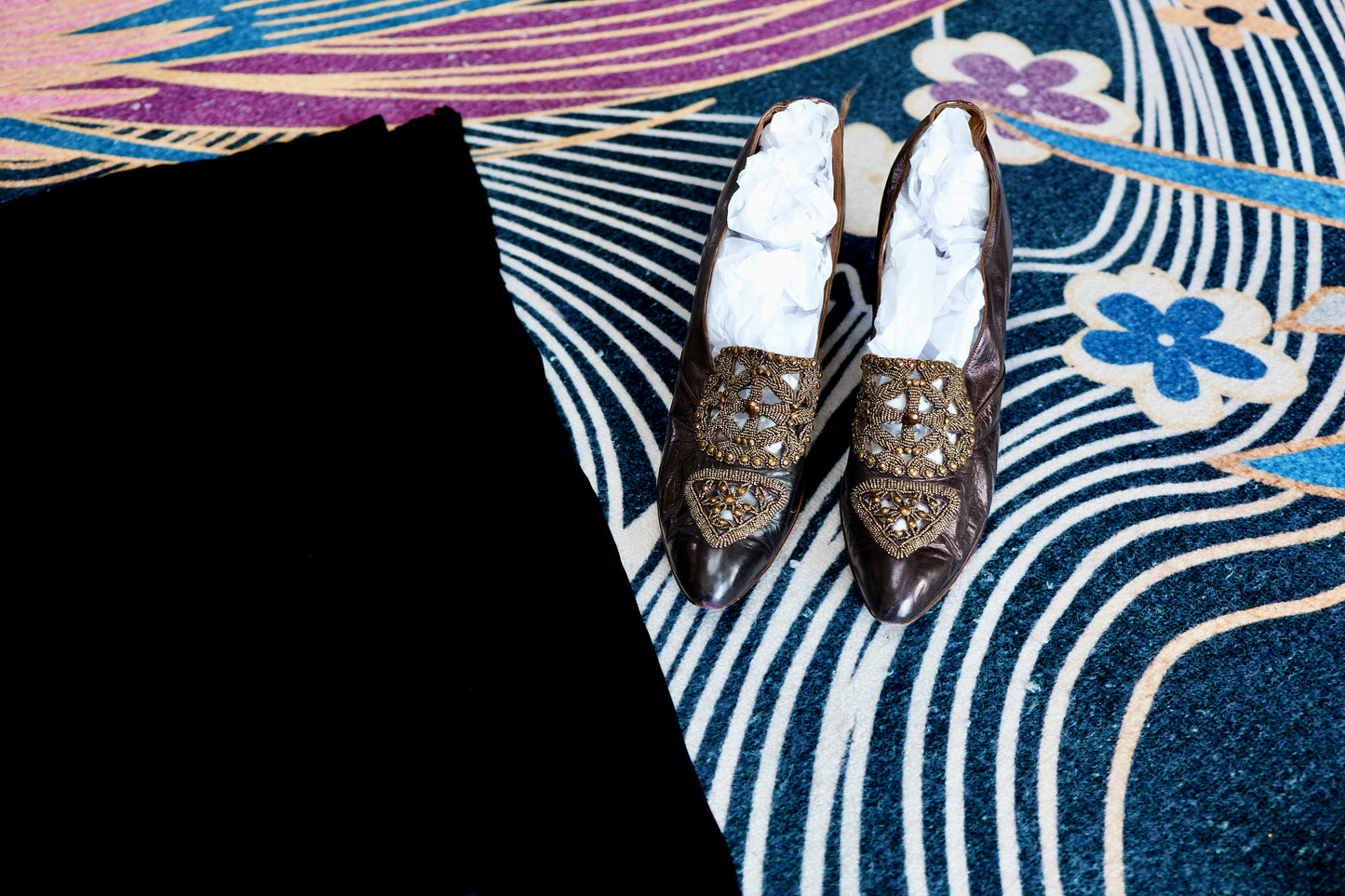
足尖诗篇:二十年代民国 Art Deco 风格钉珠皮鞋美学考释
这双上世纪二十年代的民国Art Deco牛皮钉珠古董鞋,是中西文化碰撞与融合的璀璨结晶,堪称“脚尖上的民国史诗”。
鞋身以深棕色牛皮为底,皮质温润如玉,历经百年岁月沉淀,泛出低调而内敛的光泽,仿佛诉说着旧时光的沉静与优雅。最引人注目的,是鞋头那精妙绝伦的钉珠装饰——以细密的金铜色珠子为“笔”,在皮革上勾勒出几何与花卉交织的图案:中心是放射状的星芒纹,象征Art Deco风格对现代性与未来感的追求;四周环绕着缠枝莲纹的变体,线条流畅而富有韵律,暗合中国传统吉祥寓意。珠子排列如星河倾泻,疏密有致,每一颗都经过手工穿缀,凝聚着民国匠人“慢工出细活”的匠心。
这双鞋诞生于1920年代的上海滩,彼时正值中国社会剧烈转型的“摩登时代”。西方Art Deco风格随租界文化涌入,与本土审美悄然碰撞。这双鞋正是这一历史切片的见证者:它采用西式高跟鞋的立体剪裁,贴合足弓,彰显女性解放的思潮;却又在装饰上保留中式钉珠工艺,将传统“盘扣”“绣花”的细腻移植到鞋履之上,形成“西体中魂”的独特美学。据《申报》记载,当时南京路的“先施公司”“永安公司”已开始销售此类“中西合璧”的女鞋,价格不菲,专供新式知识女性与名媛闺秀,是身份与品味的象征。
其稀缺性更在于工艺的不可复制性。钉珠工艺需先以细铜丝将珠子串联成网,再逐针缝于皮革,耗时费力,一双鞋往往需匠人数日之功。而Art Deco风格强调的几何对称与机械美学,又要求图案精准无误,稍有偏差便破坏整体韵律。加之牛皮材质易老化,百年间能完整保存至今者,可谓凤毛麟角。
正如张爱玲在《更衣记》中所言:“民国初年的时装,是中西文化的一场温柔角力。”这双鞋正是这场“角力”的具象化表达——它不仅是行走的工具,更是时代精神的载体:既有对传统的眷恋,又有对现代的向往;既含蓄内敛,又大胆革新。它静卧于蓝白相间的几何纹地毯上,仿佛在无声地诉说:真正的美,从不被时间所困,而是在岁月的长河中,愈发熠熠生辉。
Poetry on the Tips of Toes: An Analytical Study of 1920s Republic-Era Art Deco Beaded Leather Antique Shoes
This pair of 1920s Republic-era Art Deco beaded leather antique shoes is a brilliant crystallization of the collision and fusion between Eastern and Western cultures—truly a "Republic-era epic on the tips of one's toes."
I. Texture and Material: The Patina of a Century The body of the shoe uses deep brown cowhide as its base. The leather is as warm and mellow as jade; having settled through a hundred years of history, it emits a low-key, restrained luster that whispers of the tranquility and elegance of days gone by. Most striking is the exquisite beadwork adorning the toe. Using fine bronze-gold beads as a "brush," the artisan traced a pattern where geometry and florals intertwine: the center features a radiant starburst motif—a symbol of the Art Deco pursuit of modernity and futurism—surrounded by variations of the traditional Chinese "intertwining lotus" (Chanzhi Lian). The lines are fluid and rhythmic, carrying auspicious traditional meanings. The beads are arranged like a pouring galaxy, meticulously hand-stitched with the "slow work yields fine results" craftsmanship of the Republic era.
II. Historical Context: The "Modern Era" of Old Shanghai Born in 1920s Shanghai, these shoes witnessed the "Modern Era" of China’s dramatic social transformation. As Western Art Deco style flowed in through the Concession culture, it quietly collided with local aesthetics. These shoes are a physical slice of that history: they adopt the three-dimensional tailoring of Western high heels to contour the arch—reflecting the burgeoning liberation of women—while retaining traditional Chinese beading techniques. It is a unique aesthetic of "Western Body, Eastern Soul." According to records in the Shen Bao newspaper, department stores like Sincere (Xianshi) and Wing On (Yongan) on Nanjing Road sold such "East-meets-West" footwear at premium prices, catering exclusively to modern intellectual women and socialites as a symbol of status and taste.
III. Rarity and Craftsmanship: The Irreproachable Stitch Their rarity lies in the non-replicable nature of the craft. The beading required threading beads onto fine copper wire to form a mesh before stitching them needle-by-needle onto the leather—a laborious process taking days for a single pair. Furthermore, the geometric symmetry demanded by Art Deco aesthetics required absolute precision; the slightest deviation would ruin the overall rhythm. Given that cowhide ages easily over a century, finding a pair preserved in such complete condition is exceptionally rare.
Conclusion As Eileen Chang wrote in A Record of Changing Clothes: "The fashion of the early Republic was a gentle wrestling match between Eastern and Western cultures." These shoes are the concrete expression of that "wrestling match." They are more than tools for walking; they are carriers of the era's spirit—clinging to tradition while yearning for modernity. Resting upon a blue-and-white geometric carpet, they silently declare: True beauty is never trapped by time, but shines ever more brilliantly within its long river.