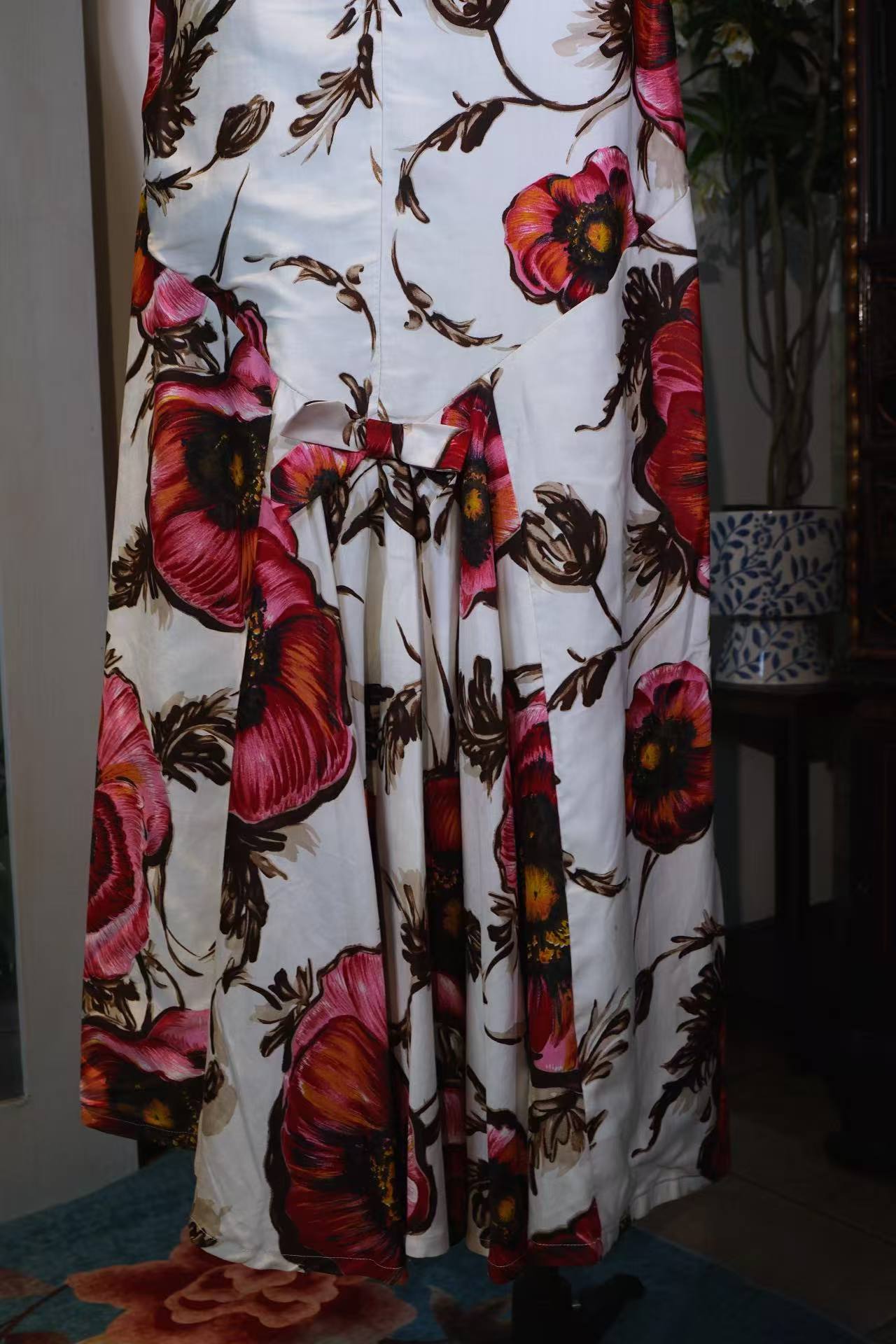
白缎朱华:六十年代香港手绘油画法绣钉珠礼服裙
【衣图志】
白缎为纸,朱华作墨。此裙以素白丝缎为底,手绘大朵罂粟花(或蜀葵)图腾,花瓣以朱砂、胭脂晕染,花蕊点金,枝叶以墨褐勾勒,笔触如行云流水,兼具写意与写实之妙。裙身正面与背面的珠绣装饰,以银线穿引亮片、珍珠,构成缠枝花卉纹样,光线下流转生辉,恍若将《诗经》“桃之夭夭,灼灼其华”的盛景,凝于方寸衣料之间。
【裙史话】
上世纪六十年代,香港制衣业初兴,东西方文化在此碰撞交融。彼时,西方时尚界正经历“摇摆伦敦”的变革,而东方传统工艺却在香港匠人手中焕发新生。此裙正是这一时代的缩影:手绘技法承袭中国工笔花卉的细腻,法绣钉珠则借鉴欧洲宫廷礼服的奢华,二者在香江畔的裁缝作坊里相遇,成就了这件“中体西用”的孤品。
裙上的手绘图案,并非简单的印花复制,而是匠人以颜料直接在缎面上作画,每一朵花的形态、每一根枝的走向皆独一无二。这种“活”的图案,让裙装脱离了流水线的冰冷,成为承载着匠人心血的艺术品。而背面的蝴蝶结设计,既呼应了六十年代女性追求自由与柔美的时代精神,又暗合中国传统文化中“结”的吉祥寓意,可谓匠心独运。
【艺文考】
若论此裙的艺术价值,可溯至《考工记》“天有时,地有气,材有美,工有巧”的造物观。手绘与法绣的结合,正是“材美工巧”的极致体现:丝缎的柔滑、颜料的饱满、珠绣的璀璨,在匠人手中浑然一体,宛如一幅可穿戴的油画。裙上的花卉图案,既有中国传统“折枝花”的构图意趣,又融入西方印象派的色彩张力,堪称“东西方美学的对话”。
而从稀缺性来看,六十年代香港产的古董礼服,存世量本就稀少,更遑论如此精湛的手绘与珠绣工艺。在快时尚席卷全球的今日,这件承载着慢工细活的古董衣,不仅是时尚史的见证,更是对“匠人精神”的礼赞。正如沈从文在《中国古代服饰研究》中所言:“衣裳是文明的载体,亦是时代的镜子。”此裙镜中,照见的不仅是六十年代的香江风华,更是一个时代对美的执着追求。
【结语】
着此裙者,非为炫技,实为传承。它让现代人得以触摸那个东西方文化激荡的年代,感受匠人指尖的温度,聆听布料间流淌的历史回响。正如《文心雕龙》所云:“情往似赠,兴来如答。”当你穿上它,便与六十年前的匠人完成了一场跨越时空的对话,让那段被时光尘封的香江往事,在今日的衣香鬓影中,重新绽放。
Crimson Blooms on White Satin: A 1960s Hong Kong Hand-Painted and Beaded Evening Gown
【The Iconography | 衣图志】
White satin as the paper, crimson blooms as the ink. This gown utilizes pristine white silk satin as its base, featuring hand-painted totems of grand poppies (or hollyhocks). The petals are suffused with cinnabar and rouge gradients, with golden stippling at the pistils and ink-brown outlines for the stems. The brushwork flows like moving clouds, balancing impressionism with realism. The French beadwork (Lunéville embroidery) on both sides utilizes silver thread to anchor sequins and pearls into winding floral motifs, shimmering under light—as if the radiant imagery of "The peach tree is young and elegant, brilliant are its flowers" from the Book of Songs has been condensed onto the fabric.
【The Historical Narrative | 裙史话】
In the 1960s, Hong Kong’s garment industry was burgeoning, serving as a crucible for Eastern and Western cultures. While the Western fashion world was undergoing the "Swinging London" revolution, traditional Eastern crafts were finding a rebirth in the hands of Hong Kong artisans. This gown is a microcosm of that era: the hand-painting technique inherits the delicacy of Chinese Gongbi (meticulous) floral art, while the beadwork draws from the opulence of European court dress. Their encounter in a Hong Kong workshop resulted in this unique masterpiece of "Eastern Essence with Western Utility."
The hand-painted patterns are not mere printed replicas; each flower’s form and each branch’s curve is a singular artistic gesture. This "living" design elevates the garment beyond the coldness of assembly lines into a soulful work of art. The bowknot design on the back echoes the 1960s pursuit of freedom and femininity while subtly aligning with the auspicious symbolism of "knots" in Chinese tradition.
【Artistic & Literary Analysis | 艺文考】
The artistic value of this gown can be traced to the creative philosophy in The Artificer's Record (Kao Gong Ji): "The season has its heaven, the land has its qi, the materials have their beauty, and the craftsmen have their skill." The integration of hand-painting and French embroidery is the ultimate manifestation of this "material beauty and master skill." The silk's smoothness, the pigment's richness, and the beadwork's brilliance harmonize into a "wearable oil painting."
In terms of rarity, antique gowns from 1960s Hong Kong are already scarce, let alone those featuring such exquisite handwork. In today’s world of fast fashion, this piece serves as a monument to "Craftsmanship." As Shen Congwen noted: "Clothing is the carrier of civilization and the mirror of an era." In this mirror, we see not only the glamour of old Hong Kong but a persistent pursuit of beauty.
【Conclusion | 结语】
To wear this gown is not to show off technique, but to carry forward a legacy. It allows us to touch an era of cultural agitation and feel the warmth of an artisan's fingertips. As the Dragon-Carving and the Literary Mind (Wen Xin Diao Long) says: "Affection sent out is a gift, and inspiration returned is a response." To don this garment is to complete a cross-temporal dialogue with a craftsman from sixty years ago.