深圳溯源
Couldn't load pickup availability
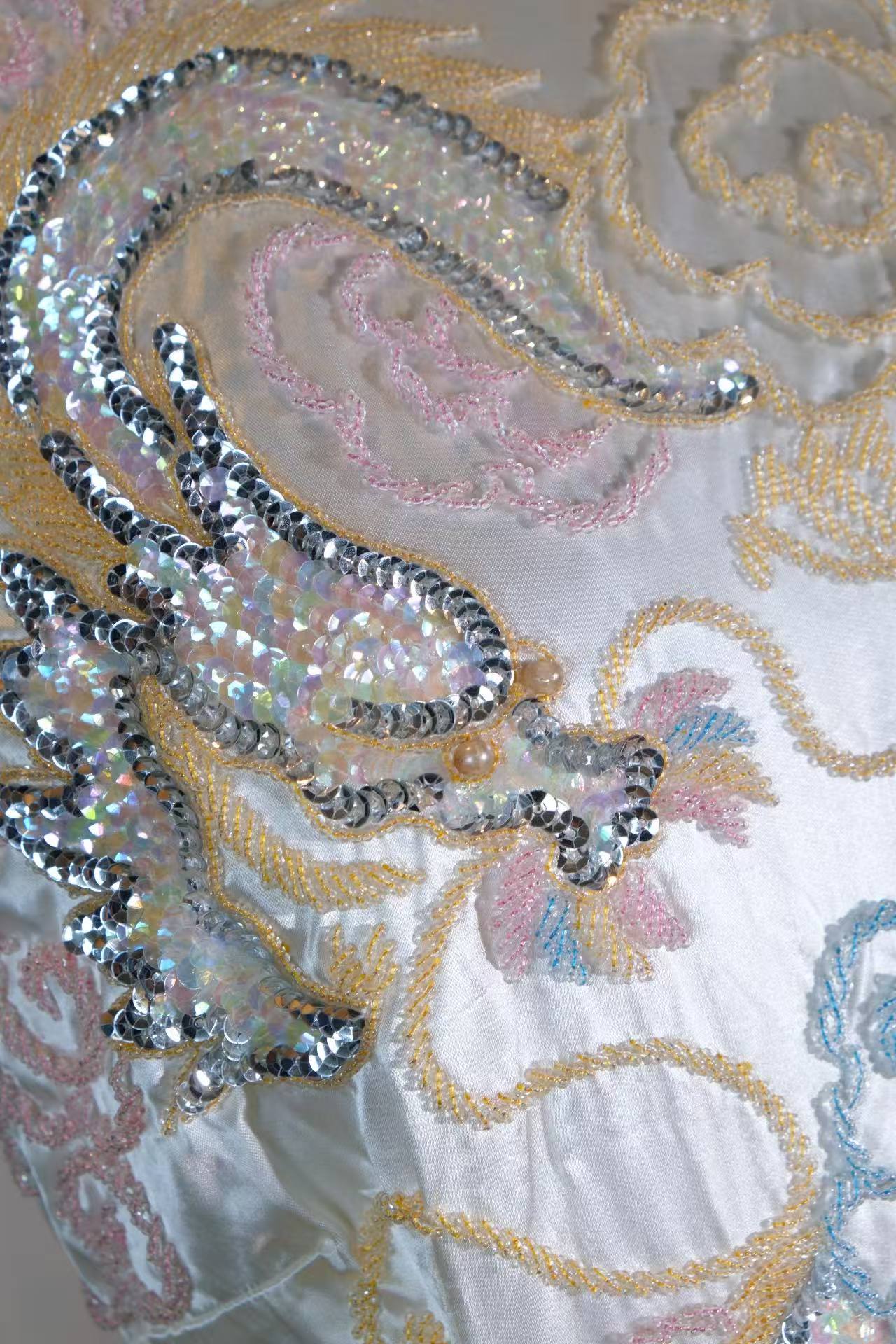
这是一件诞生于上世纪六十年代香港的祥云龙凤潮绣钉珠无袖礼服裙
此裙非仅为衣,实为一段被穿在身上的历史。六十年代的香港,
《礼记·曲礼》有云:“礼者,天地之序也。”服饰之礼,
潮绣,作为中国四大名绣之一,尤以“钉金绣”与“珠绣”著称。
此裙之稀缺,不仅在于其年代久远,
今日,此裙重现于世,不仅为收藏者所珍,更为研究者所重。
This is a sleeveless evening gown from 1960s Hong Kong, featuring "Chao" embroidery (Teochew embroidery) with auspicious cloud, dragon, and phoenix motifs. Set against a pristine white satin base, the gown is meticulously embroidered with auspicious clouds, dragons, phoenixes, and peonies. The fine stitching and layered sequins seamlessly blend the solemnity of Oriental totems with the elegance of Western tailoring. The winding dragon and soaring phoenix are outlined in silver thread, adorned with powder-blue beads that form swirling clouds and foliage. Amidst the shimmering pearlescent light, it appears as if the phoenix is cradled by auspicious mists and the dragon is soaring through the heavens. Peonies bloom in full majesty along the sides of the skirt—soft pink petals gently unfurling and green leaves bearing dew—radiating a natural sense of opulence. Every detail is exquisite, every stitch ingenious; it is a masterpiece of "beadwork" within Chao embroidery and a microcosm of the East-meets-West fashion of 1960s Hong Kong, known then as the "Paris of the East."
This gown is more than a mere garment; it is a piece of wearable history. In 1960s Hong Kong, industries flourished as Chinese and Western cultures collided fiercely yet merged quietly. Elite women of the time inherited traditional etiquette while yearning for modern freedom. Their wardrobes held both the subtle reserve of the Qipao and the bold flair of Western evening gowns. This gown is a concrete expression of that zeitgeist—an Oriental soul in a Western body, adorned with Chao beadwork, perfectly combining Eastern auspiciousness with Western social etiquette. Research suggests such gowns were mostly worn by the daughters of wealthy tycoons or socialites for weddings, birthday banquets, or significant social events—luxuries far beyond the reach of ordinary families. The production cycle spanned several months, handcrafted stitch by stitch by embroiderers from Chaozhou. Every bead required precise positioning; a single error could render the entire effort futile. Consequently, very few have survived, and those preserved in their entirety are true rarities.
The Book of Rites states: "Ritual is the order of Heaven and Earth." The etiquette of dress is the externalization of order and aesthetics. The union of the dragon and phoenix has symbolized emperors and empresses since antiquity, becoming popularized among civilians by the Ming and Qing dynasties as an auspicious sign for marriages and celebrations. The Book of Songs says: "The modest, retiring, virtuous young lady is a fine mate for our prince." The phoenix embroidered here represents more than a totem; it embodies the virtue of a "virtuous lady," its posture dignified yet agile, echoing the description in the Ode to the Nymph of the Luo River: "As graceful as a startled swan, as supple as a swimming dragon," merging feminine softness with strength. The surrounding clouds signify "auspicious mists and radiant omens," symbolizing heavenly blessings and long-lasting fortune. The peony, the "King of Flowers," represents "national grace and heavenly fragrance," a metaphor for the prosperity of a golden age. These three elements unite to form a complete auspicious discourse that aligns with both traditional ritual and the aesthetics of the era.
Chao embroidery, one of China's four famous embroidery styles, is particularly renowned for its "gold-thread inlay" and "beadwork." Its techniques are complex, emphasizing the qualities of "flatness, alignment, fineness, density, uniformity, luster, harmony, and smoothness," and are characterized by a strong three-dimensional effect and shimmering brilliance. Guangdong Xin Yu records: "Chaozhou embroidery features ever-changing needlework... radiant with gold and silver threads, pearls, and jewels, magnificent and stately." This gown is a living inheritance of that tradition. The dragon and phoenix are not flat; they are built up with layers of beadwork to create a relief-like sculptural effect. From a distance, they look like dragons leaping through a sea of clouds; up close, every scale and feather is distinct, shimmering like stars fallen to earth. Every bead was hand-strung and stitched; the density and precision of the arrangement are breathtaking. Remarkably, after sixty years, not a single bead has fallen, and the colors have not faded—testament to the exquisite craftsmanship and superior materials used.
The rarity of this gown lies not only in its age but in the irreproducible nature of its cultural value. 1960s Hong Kong sat at the turning point between tradition and modernity; garments blending Chinese and Western elements were unique products of that era. With the spread of mechanized production, manual Chao embroidery gradually declined, making such large-scale and complex beaded gowns nearly impossible to find today. It is more than clothing; it is a flowing cultural relic, carrying the memories and aesthetics of a generation and witnessing the rise and transformation of a city. As The Dragon-Carving and the Literary Mind notes: "Affection sent out is a gift, and inspiration returned is a response." Gazing at this gown, one can almost hear the bustle of 1960s Hong Kong streets and see the elegant silhouettes of socialites entering ballrooms, feeling the unique gentleness and prosperity of that time.
Today, the reappearance of this gown is prized by collectors and esteemed by researchers. With its exquisite patterns, masterful craftsmanship, and profound cultural connotations, it narrates a fashion legend buried by time. It reminds us that true beauty never fades; instead, it shines brighter through the sediment of years. Like the dragon and phoenix leaping amidst auspicious clouds, it endures through the storms of time to become eternal.