深圳溯源
60年代 - 黑底黄玫瑰:1960年代香港旗袍的摩登叙事 | 1960s - Yellow Roses on Black: A Modernist Narrative of 1960s Hong Kong Cheongsams
60年代 - 黑底黄玫瑰:1960年代香港旗袍的摩登叙事 | 1960s - Yellow Roses on Black: A Modernist Narrative of 1960s Hong Kong Cheongsams
Couldn't load pickup availability
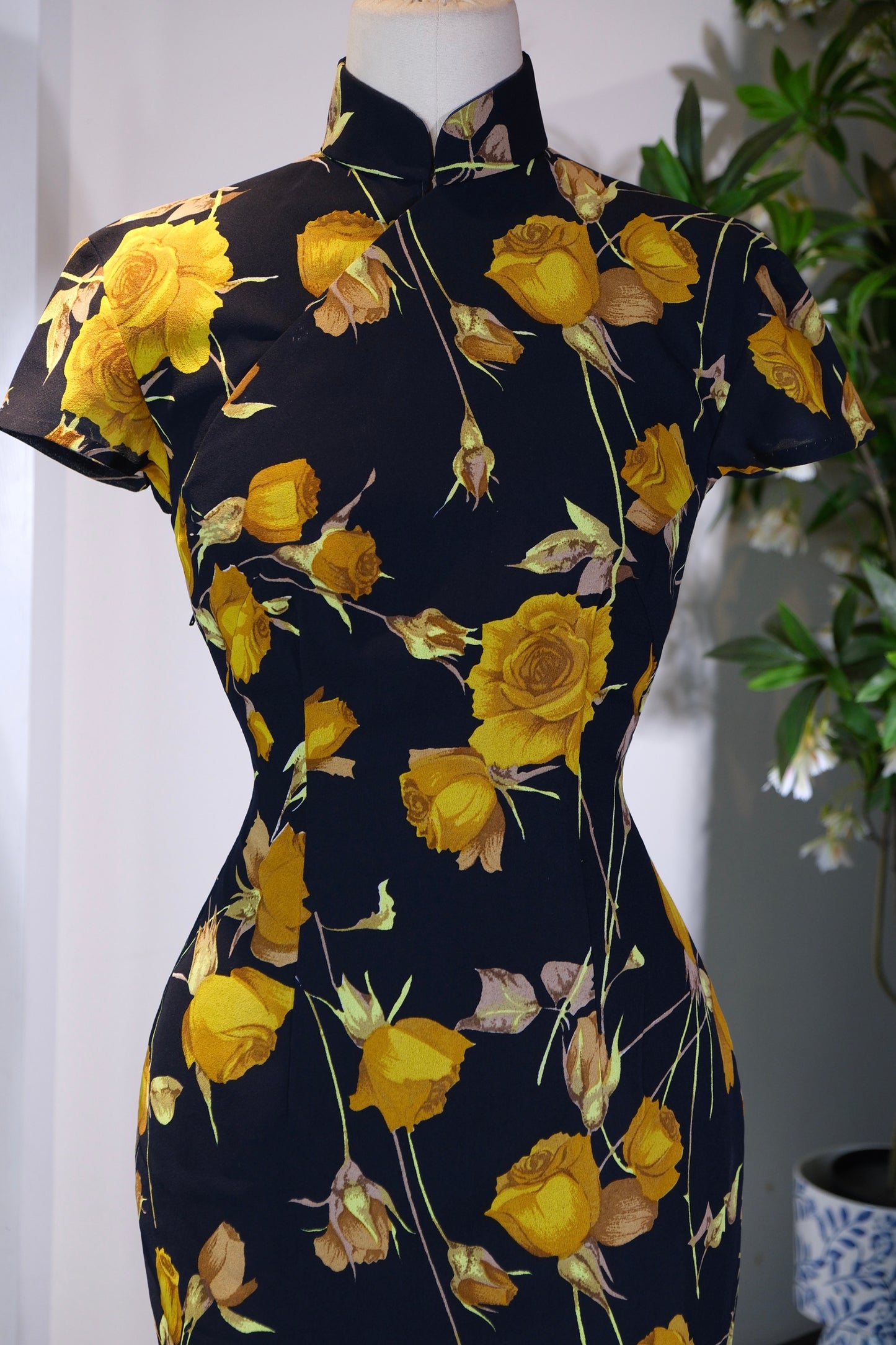
黑底黄玫瑰:1960年代香港旗袍的摩登叙事
衣服尺寸:
胸围/腰围/臀围:88/72/96 厘米
衣长:98 厘米
细节描述:
当视线落在这件1960年代的香港产古董旗袍上,首先攫住目光的,是那黑底上肆意绽放的黄玫瑰——它们不是工笔勾勒的温婉花卉,而是带着油画笔触的浓烈生命,花瓣边缘晕染着琥珀色的光,花蕊处沉淀着蜜蜡般的暖,连细瘦的枝条都似有风拂过,在墨色夜幕里摇曳出金色的涟漪。
这图案绝非简单的装饰,而是1960年代香港东西方文化碰撞的视觉隐喻。彼时的香港,旗袍正从传统宽袍大袖向修身摩登转型,西方立体剪裁与东方含蓄美学在此交融。黑底如旧时光的留白,黄玫瑰则是都市摩登女性的宣言:她们既保留着旗袍立领盘扣的古典风骨,又以明艳花卉打破素色沉寂,正如张爱玲在《更衣记》中所写:“民国初年的时装,大部分的灵感是得自西方的……然而那并不妨碍她们在衣襟上绣一朵带露的玫瑰。”这件旗袍的玫瑰,恰是这种“带露的鲜活”——花朵的排列疏密有致,既有传统“折枝花卉”的写意,又暗合西方装饰艺术的几何韵律,每一朵都似在讲述一个关于“新与旧”“中与西”的故事。
古董衣的价值,往往藏于时间的褶皱里。这件旗袍诞生于香港制衣业的黄金年代,彼时的旗袍作坊多由上海南迁的裁缝开设,他们将海派旗袍的精致工艺带到香江,又融入本地市井的烟火气。可以想象,它或许曾被一位穿高跟鞋、烫卷发的港式名媛穿着,赴过兰桂坊的晚宴,或是坐在叮叮车里掠过弥敦道的霓虹;又或许在某个雨夜,被小心叠进樟木箱,与旧报纸、月份牌一同封存了半个世纪。如今,它的丝缎虽经岁月摩挲,却依旧泛着温润光泽,针脚细密处可见当年“红帮裁缝”的功力——立领的弧度贴合颈项,腰线的收省恰到好处,连袖口的滚边都带着手工的温度。
从艺术风格看,这件旗袍堪称“装饰艺术”与“东方美学”的混血儿。黑与黄的撞色大胆而克制,既非传统中国红的热烈,也非西方纯黑的肃穆,而是带着香港特有的市井摩登感;玫瑰的写实笔触与传统旗袍的写意留白形成张力,恰如1960年代香港的文化生态——在殖民语境下,本土意识正悄然萌芽,既拥抱外来潮流,又坚守文化根脉。这种稀缺性,不仅在于其年代久远(1960年代香港产旗袍存世量已极为稀少),更在于它完整保留了那个时代的审美密码:没有过度的装饰,却以图案与剪裁的精准平衡,诠释了“少即是多”的摩登哲学。
抚摸这件旗袍,仿佛触摸到一段流动的香江往事。它不是博物馆里的标本,而是依然鲜活的时尚叙事——当现代女性穿上它,黑底黄玫瑰便会在都市霓虹中重新绽放,将1960年代的摩登与21世纪的自信,编织成一首跨越时空的旗袍诗。正如时尚史家瓦莱丽·斯蒂尔所言:“古董衣的价值,不在于它的‘旧’,而在于它承载的‘新’——那是属于每个时代穿着者的独特故事。”而这件黄玫瑰旗袍的故事,正等待新的篇章。
Yellow Roses on Black: A Modernist Narrative of 1960s Hong Kong Cheongsams
Measurements / Size Guide:
Bust / Waist / Hips: 88/72/96 cm
Total Length: 98 cm
Detailed Description:
When one’s gaze falls upon this 1960s vintage Hong Kong-made cheongsam (qipao), the first thing that seizes the eye is the exuberant bloom of yellow roses against a black backdrop. These are not the gentle, meticulously outlined flora of traditional ink painting, but vivid life forms rendered with the bold strokes of an oil painting. The edges of the petals are tinged with an amber glow, while the pistils hold a warmth akin to beeswax. Even the slender branches seem to sway as if brushed by a breeze, creating golden ripples against the ink-black night of the fabric.
This pattern is far from mere decoration; it is a visual metaphor for the collision of Eastern and Western cultures in 1960s Hong Kong. During this era, the cheongsam was transforming from traditional loose robes into a modern, form-fitting silhouette—a place where Western 3D tailoring fused with Eastern subtle aesthetics. The black base serves as the "negative space" of days gone by, while the yellow roses act as a manifesto for the modern urban woman. They retained the classical integrity of the standing collar and pankou toggles, yet broke the silence of plain colors with brilliant blossoms. As Eileen Chang wrote in A Chronicle of Changing Clothes: "Most of the inspiration for early Republican fashion was drawn from the West... yet that did not stop women from embroidering a dew-laden rose upon their lapels." The roses on this garment are precisely that—vibrant and "dew-laden." Their arrangement is rhythmic; they possess the freehand spirit of traditional "broken branch" floral motifs while subtly echoing the geometric cadence of Western Art Deco. Each blossom seems to tell a story of "New and Old," of "East and West."
The value of vintage clothing is often tucked away within the folds of time. This cheongsam was born during the golden age of Hong Kong’s garment industry, when qipao workshops were largely run by tailors who had migrated south from Shanghai. They brought the exquisite craftsmanship of Shanghainese style to the Fragrant River, blending it with the vibrant "street-level" energy of local life. One can imagine it being worn by a Hong Kong socialite with high heels and permed hair, attending a dinner in Lan Kwai Fong or gliding past the neon lights of Nathan Road in a "Ding Ding" tram. Or perhaps, on a rainy night, it was carefully folded into a camphor chest, sealed away for half a century alongside old newspapers and calendar posters. Today, though its silk has been weathered by years, it still radiates a mellow luster. The fine stitching reveals the prowess of the "Hong Bang" tailors of yore—the curve of the collar fits the neck perfectly, the waist darts are expertly placed, and even the piping on the sleeves carries the warmth of a human hand.
Artistically, this cheongsam is a "hybrid" of Art Deco and Eastern aesthetics. The contrast of black and yellow is bold yet restrained—neither as fiery as traditional Chinese red nor as somber as Western pure black, but possessing a specifically Hong Kong sense of "metropolitan chic." The realistic depiction of the roses creates a tension with the traditional "blank space" of the qipao, mirroring the cultural ecology of 1960s Hong Kong. Within a colonial context, local consciousness was quietly budding; people embraced foreign trends while fiercely guarding their cultural roots. Its scarcity lies not only in its age (1960s Hong Kong cheongsams are now exceedingly rare) but in the fact that it perfectly preserves the aesthetic code of that era: an absence of excessive ornamentation, yet a modern philosophy of "less is more" achieved through the precise balance of pattern and cut.
Touching this cheongsam feels like touching a flowing history of the Fragrant River. It is not a specimen in a museum, but a living fashion narrative. When a modern woman wears it, the yellow roses on black will bloom once more amidst urban neon, weaving the modernism of the 1960s and the confidence of the 21st century into a cross-temporal poem of the cheongsam. As fashion historian Valerie Steele once said: "The value of vintage clothing lies not in its 'oldness,' but in the 'newness' it carries—the unique story of every wearer from every era." And the story of this yellow rose cheongsam is simply waiting for its next chapter.
Share