深圳溯源
无法加载取货服务可用情况
衣服尺寸:
胸围/腰围/臀围/衣长:88/78/92/108 厘米
细节描述:
在服装史的浩瀚星河中,总有一些织物能穿越时光的尘埃,以静默的姿态诉说一个时代的风华。这件上世纪六十年代香港工坊出品的古董旗袍,便是一首用丝绒与色彩谱写的无声诗篇。它不仅是衣饰,更是一段被精心封存的历史切片,见证了东西方美学在那个特殊年代的深情相拥。
【纹样:流动的工笔与抽象的梦境】
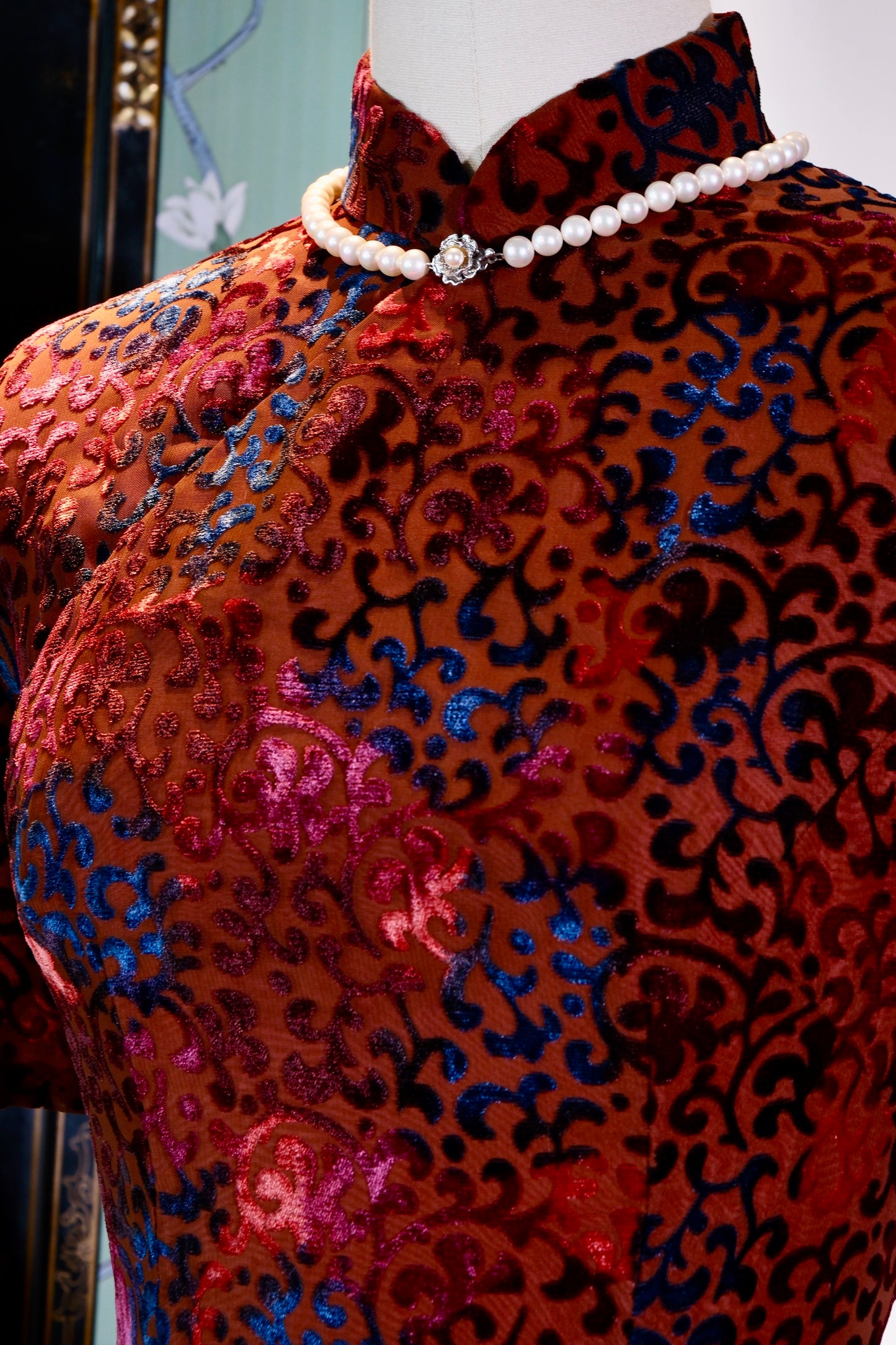
细观其表,衣身图案绝非寻常印染可比。它以传统缠枝莲纹为骨,却打破了古典纹样的严谨对称,转而以一种近乎现代抽象艺术的姿态蔓延。深蓝如夜海,酒红似残阳,紫粉若晚霞,三色在意大利进口烧花丝绒的肌理上交织、晕染、流淌。
这种“手绘晕染”工艺,要求匠人具备极高的水墨掌控力。颜料在丝绒表面的渗透并非均匀分布,而是随着织物的纹理自然呼吸,形成了一种类似宋代汝窑“雨过天青云破处”般的微妙渐变。每一朵花的绽放,每一片叶的卷舒,都带着手工的温度与不可复制的偶然性。正如《长物志》中所追求的“虽由人作,宛自天开”,这图案仿佛是大自然在暮色时分投射在窗棂上的光影,被匠人奇迹般地捕捉并定格在了衣料之上。
【工艺:烧花丝绒与立体剪裁的对话】
面料本身即是传奇。六十年代的香港,作为远东时尚之都,汇聚了全球顶级的纺织资源。这件旗袍选用的意大利进口烧花丝绒,代表了当时织物科技的巅峰。烧花工艺通过化学药剂腐蚀掉部分绒毛,留下凹凸有致的浮雕感花纹,使得光线在衣物表面流转时,呈现出丰富的明暗层次。
而在剪裁上,它完美诠释了“港式旗袍”的黄金法则。不同于早期海派旗袍的平面剪裁,这件作品运用了西式立体省道技术,精准地贴合人体曲线,却又在立领处保留了东方的含蓄与端庄。这种“西体中用”的设计哲学,正是张爱玲笔下那个“各人住在各人的衣服里”的时代的最佳注脚——女性开始追求身体的解放,却依然不愿舍弃那份深入骨髓的优雅。
【稀缺:绝版的时光与孤品的价值】
在学术视野中,这件旗袍的稀缺性不仅在于其材质的昂贵,更在于其工艺的不可再生性。六十年代后,随着成衣工业的崛起,这种耗时耗力的手绘晕染与烧花丝绒结合的工艺逐渐失传。如今存世的同类藏品,多已进入博物馆或顶级私人藏家之手。
它是一件活着的文物,记录了那个中西文化剧烈碰撞又完美融合的黄金时代。穿上它,你不仅仅是在展示一件衣服,更是在演绎一段关于美、关于技艺、关于那个遥远而迷人的六十年代香港的传奇。它是可触摸的艺术,是穿在身上的历史,更是世间难得的孤品。
Measurements / Size Guide:
Bust / Waist / Hips / Total Length: 88/78/92/108 cm
Detailed Description:
In the vast galaxy of garment history, certain textiles transcend time to silently recount the elegance of a bygone era. Produced by a Hong Kong atelier in the 1960s, this antique qipao is a silent poem composed in velvet and color. More than mere attire, it is a preserved slice of history—a physical witness to the passionate embrace between Eastern and Western aesthetics during a golden age.
The surface patterning of this garment moves far beyond conventional printing or automated dyeing. Utilizing traditional interlocking lotus (chanzhilian) forms as its structural core, the design departs from rigid classical symmetry, extending across the fabric with the fluid confidence of modern abstract art. Deep ocean blue, rich burgundy, and dusty mauve sunset tones interweave, bleed, and flow naturally across the pile of the Italian devoré velvet.
Hand-Painted Gradient Technique (Shouhui Yunran): Executing hand-painted gradients on textured pile requires exceptional mastery over liquid dye behavior. The pigment does not absorb uniformly; instead, it bleeds organically along the velvet fibers, creating subtle, atmospheric transitions reminiscent of the prized "sky-after-rain" glaze (yuguo tianqing) seen in Ru ware porcelain.
Artisanal Uniqueness: Because the dye reacts dynamically with the burnt-out velvet pile during application, every floral contour and leaf curve carries subtle, unreproducible variations. Echoing the classical design ideal from Treatise on Superfluous Things (Chang Wu Zhi)—"Though crafted by human hands, it appears as though wrought by nature"—the pattern feels like evening shadows cast upon a windowpane, miraculously captured and fixed onto cloth.
The base textile itself is a remarkable specimen. In the 1960s, Hong Kong stood as the fashion capital of the Far East, gathering premier global textile resources. The imported Italian devoré (burn-out) velvet selected for this garment represented the pinnacle of mid-century textile engineering.
Italian Devoré Velvet (Shaohua Silong): The devoré process uses chemical paste to selectively dissolve cellulose backing fibers while leaving raised velvet pile intact. This creates an embossed relief pattern that catches light dynamically as the wearer moves, yielding deep contrast between sheer mesh, matte backing, and lustrous pile.
Structural Tailoring ("West-for-Structure, East-for-Form"): In terms of silhouette, the garment exemplifies the golden rules of Hong Kong qipao drafting. Departing from early two-dimensional Shanghai-style patterns, it incorporates discrete Western darting (shengdao) to contour closely to the body. Simultaneously, it preserves the high mandarin collar and modest neckline, balancing bodily expression with traditional dignity. This design philosophy provides a fitting note to Eileen Chang’s observation of an era where "everyone lived within their own clothes"—women pursued physical liberation without sacrificing an intrinsic, deeply rooted elegance.
Assessed through an academic lens, the archival value of this piece rests not only on its costly materials, but on the irreversible obsolescence of its production methods.
Obsolete Hybrid Craft: Following the expansion of mass ready-to-wear manufacturing in the late 1960s and 1970s, the time-intensive combination of imported devoré velvet with manual hand-painted gradients largely disappeared from commercial production.
Museum-Grade Preservation: Devoré velvet is notoriously sensitive to friction, pile crushing, and moisture degradation over long periods. Preserving both the structural backing mesh and the vibrancy of hand-applied dyes across six decades requires exceptional environmental care.
A Living Artifact: Most surviving specimens of this quality have entered museum collections or private archives. The garment serves as a physical record of 1960s Hong Kong—a moment when traditional Chinese heritage, fleeing master craftsmen from Shanghai, and European textile imports intersected to redefine modern East Asian apparel.
This 1960s hand-painted Italian devoré velvet qipao transcends simple garment function. It is a living artifact of a golden era where Eastern tradition and Western technique collided and harmonized along the Victoria Harbour. To wear or steward such a piece is to perform a story of art, skill, and enduring grace—a tactile piece of history worn upon the body.