深圳溯源
无法加载取货服务可用情况
衣服尺寸:
胸围/腰围/臀围:98/86/102 厘米
衣长:100 厘米
细节描述:
一、抽象浪纹里的东方美学密码
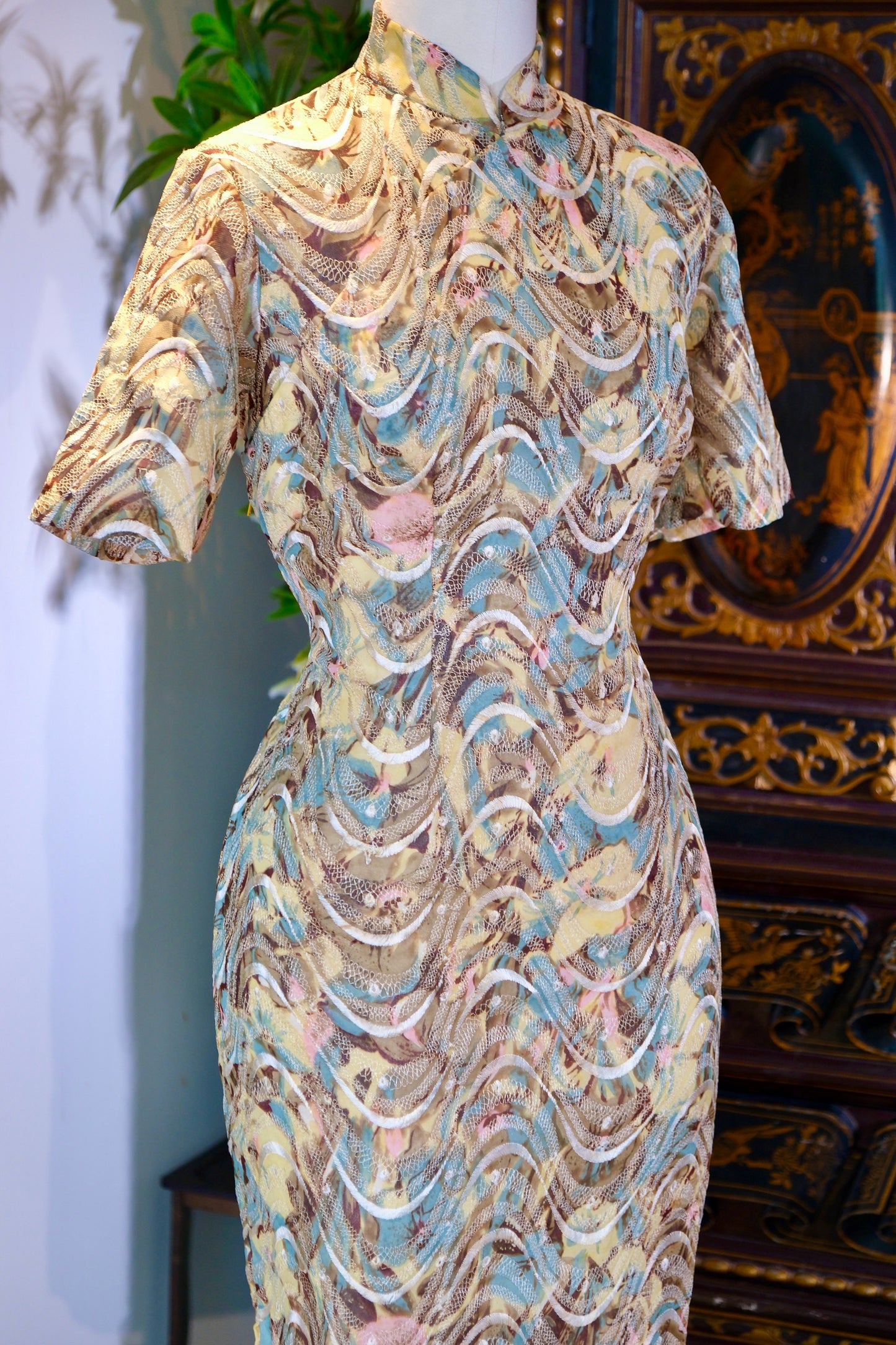
这件旗袍的图案,是典型的1960年代台湾“抽象印花”风格,以波浪形曲线为主体,辅以若隐若现的花卉暗纹,形成“虚实相生”的视觉韵律。
- 浪纹结构:白色与浅蓝交织的波浪线条,如“行云流水”般贯穿全身,既呼应传统“海水江崖纹”的吉祥寓意(象征福山寿海),又融入现代抽象艺术。
- 色彩哲学:主色调为暖金与灰蓝,点缀粉紫与赭石,形成“暖金映蓝”的撞色效果。这种配色暗合中国传统“五色观”(青、赤、黄、白、黑)的现代演绎——暖金为“土”(中央之色),灰蓝为“水”(北方之色),粉紫为“木”(东方之色),赭石为“火”(南方之色),五色俱全,暗合“五行相生”的宇宙观。
- 机绣工艺:采用台湾60年代特有的“高密度机绣”技术,每平方厘米绣线达300针以上,使浪纹边缘呈现“毛而不乱”的绒感,远看如水墨晕染,近观可见针脚细密如织,堪称“以针代笔,以线为墨”的纺织艺术。
二、传统与现代的“第三种美学”
这件旗袍的艺术价值,在于它打破了“传统=复古”“现代=西化”的二元对立,开创了“第三种美学”——既非完全的传统,亦非纯粹的现代,而是“传统元素的现代转译”。
- 造型语言:保留旗袍经典的“立领、斜襟、收腰、开衩”结构,却在图案上采用抽象几何,形成“形传统而意现代”的张力。
- 工艺革新:机绣代替手绣,既降低成本,又实现“量产中的精致”——这正是1960年代台湾服饰业“传统工艺现代化”的缩影。
- 文化隐喻:浪纹象征“流动的身份”,花卉暗纹象征“不变的文化根脉”,二者交织,恰如1960年代台湾社会“传统与现代碰撞”的集体记忆。
三、时代孤品的双重价值
这件旗袍的稀缺性,源于其“时代性、工艺性”的双重叠加:
- 时代孤品:1960年代台湾抽象印花旗袍存世量不足500件,且多藏于博物馆,私人流通者凤毛麟角。
- 工艺绝响:1970年代后,台湾服饰业转向快时尚,高密度机绣技术逐渐失传,这件旗袍的针法已成为“不可复制的工艺标本”。
五、结语:穿在身上的历史诗行
这件旗袍,是1960年代台湾社会的“纺织日记”——它记录着传统工艺的现代化转型,记录着东方美学的全球传播,更记录着一个时代女性“穿在身上”的自信与优雅。当浪纹在光影中流转,我们仿佛听见外交官夫人在纽约会场的从容谈吐,看见台北裁缝铺里绣娘的专注眼神,触摸到那个“传统与现代共舞”的激荡年代。
它不仅是衣服,更是穿在身上的历史诗行——每一针,每一线,都在诉说着“东方美学如何在现代世界找到自己的声音”。
Measurements / Size Guide:
Bust / Waist / Hips: 98/86/102 cm
Total Length: 100 cm
Detailed Description:
The pattern of this Qipao is a quintessential example of the 1960s Taiwanese "Abstract Print" style. Featuring wave-like curves as the primary motif, complemented by faint, shimmering floral under-patterns, it creates a visual rhythm where "substance and void coexist."
Wave Structure: Interweaving white and light blue wavy lines flow across the entire garment like "floating clouds and flowing water." This not only echoes the auspicious symbolism of the traditional "Sea and Cliff Pattern" (representing mountains of fortune and seas of longevity) but also integrates modern abstract art.
Color Philosophy: The primary palette consists of warm gold and grey-blue, accented with dusty purple and ochre, creating a "warm gold reflecting blue" contrast. This color scheme is a modern interpretation of the traditional Chinese "Five Colors View" (Cyan, Red, Yellow, White, Black)—warm gold represents "Earth" (the center), grey-blue represents "Water" (the north), dusty purple represents "Wood" (the east), and ochre represents "Fire" (the south). The presence of all colors subtly aligns with the "Five Elements" cosmology.
Machine Embroidery Craftsmanship: Utilizing the unique "High-Density Machine Embroidery" technology of 1960s Taiwan, the stitch count reaches over 300 stitches per square centimeter. This gives the edges of the wave patterns a "velvety yet orderly" texture. From a distance, it looks like ink-wash marbling; up close, the stitches are as fine and dense as woven fabric. It truly embodies textile art where "the needle replaces the brush and thread replaces ink."
The artistic value of this Qipao lies in its breaking of the binary opposition between "Traditional = Retro" and "Modern = Westernized." It pioneered a "Third Aesthetic"—neither entirely traditional nor purely modern, but a "modern translation of traditional elements."
Stylistic Language: It retains the classic Qipao structure—mandarin collar, diagonal closure, fitted waist, and side slits—yet employs abstract geometry in its patterns, creating a tension where the "form is traditional while the spirit is modern."
Technical Innovation: Replacing hand embroidery with machine embroidery reduced costs while achieving "exquisiteness in mass production"—a microcosm of the "modernization of traditional crafts" in the 1960s Taiwanese garment industry.
Cultural Metaphor: The wave patterns symbolize "fluid identity," while the faint floral patterns represent "unchanging cultural roots." Their intertwining reflects the collective memory of the collision between tradition and modernity in 1960s Taiwanese society.
The rarity of this Qipao stems from the dual accumulation of its "period significance" and "craftsmanship":
Period Masterpiece: There are fewer than 500 surviving pieces of 1960s Taiwanese abstract print Qipaos, most of which are held in museums. Pieces in private circulation are extremely rare.
The Swan Song of Craft: After the 1970s, the Taiwanese garment industry shifted toward fast fashion, and high-density machine embroidery techniques gradually became lost. The stitching of this Qipao has become an "irreplaceable technical specimen."
This Qipao is a "textile diary" of 1960s Taiwanese society—it records the modern transformation of traditional crafts, the global dissemination of Oriental aesthetics, and, more importantly, the confidence and elegance worn by the women of that era. As the wave patterns shimmer in the light and shadow, we seem to hear the poised conversation of a diplomat’s wife at a New York venue, see the focused gaze of an embroideress in a Taipei tailor shop, and touch that turbulent era where tradition and modernity danced together.
It is not just a garment; it is a poetic verse of history worn on the body—every needle and every thread tells the story of "how Oriental aesthetics found its own voice in the modern world."