Gilded Cloud Shoulder: A Republic of China Year 30 (1940s) Art Deco Silk Gown and "Shanghai-Style Old Dreams"
I. Gilded Glow Upon the Skirt: The "Light and Shadow" of Silk
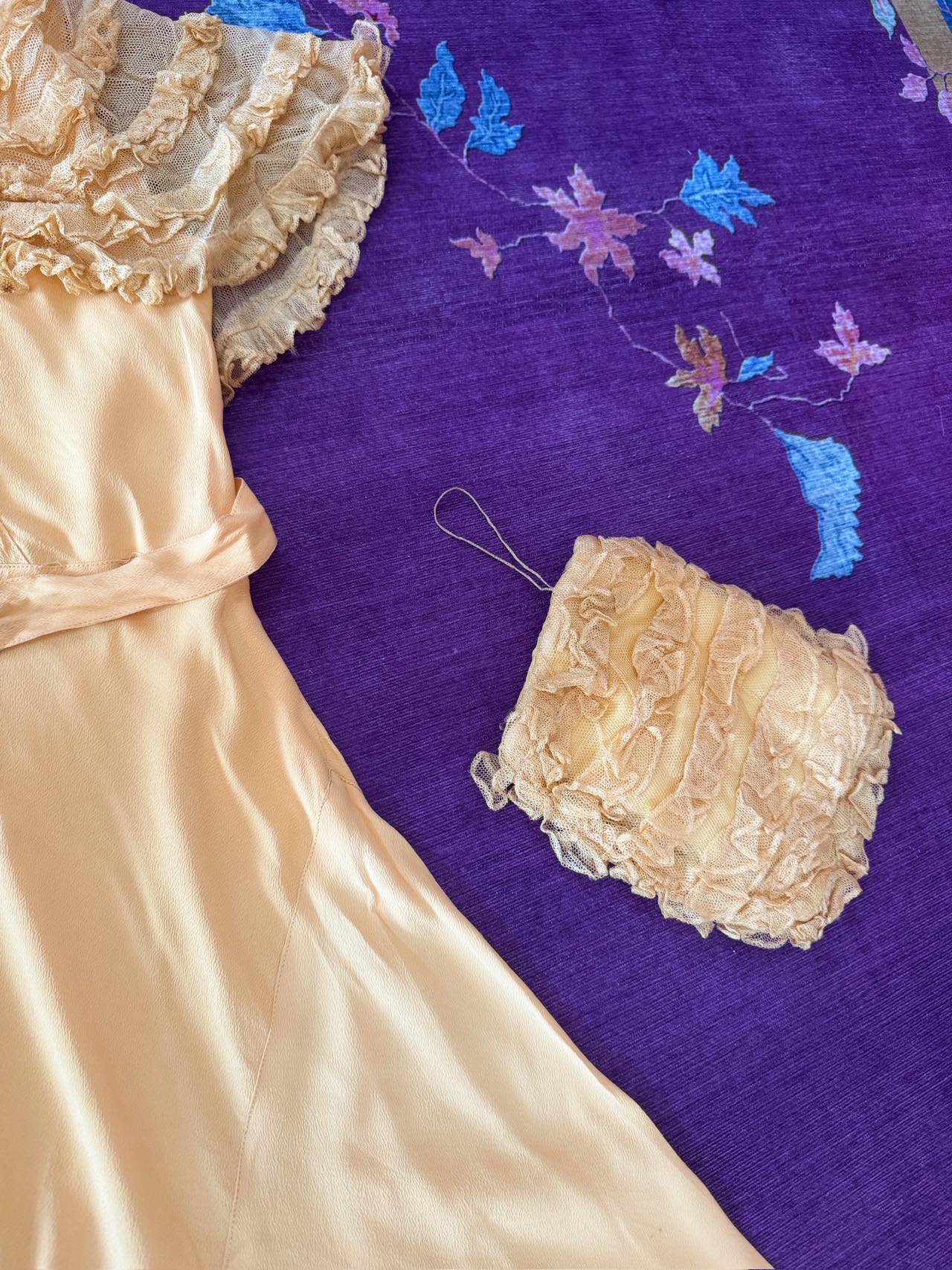
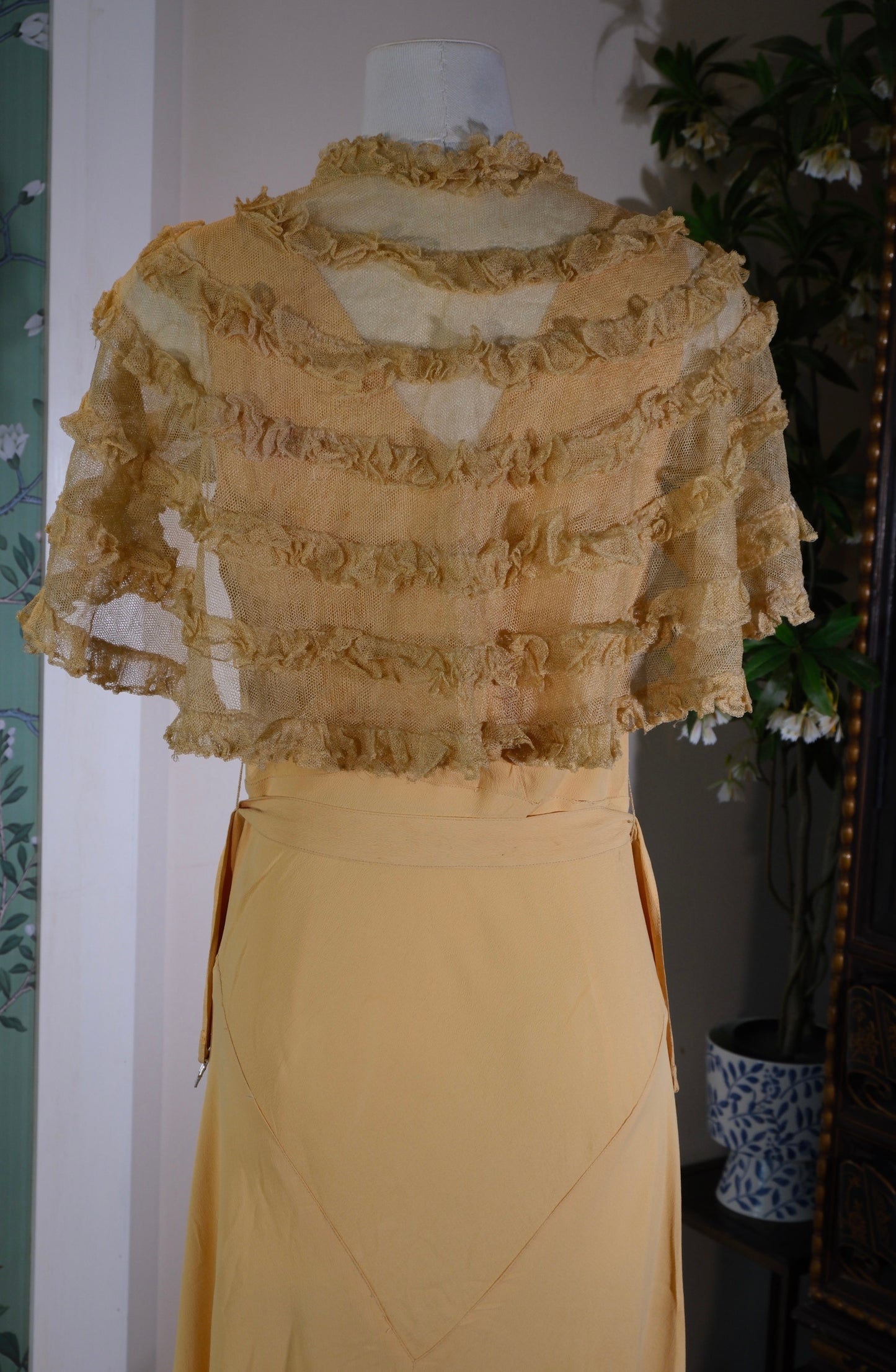
This Art Deco silk gown from the 1940s takes the posture of a "gilded cloud shoulder," condensing the warm softness of Eastern silk and the geometric aesthetics of Western Art Deco within its warp and weft. The main body of the skirt utilizes a champagne-colored silk, with a dim radiance of "autumn flowing gold" running through its threads. Distinct from the monotony of ordinary satin, this silk requires a specialized "triple-warp and triple-weft" weaving technique to create a texture that is "rich but not cloying, smooth but not floating." This perfectly aligns with the design philosophy from The Treatise on Superfluous Things (Chang Wu Zhi): "Rather thick than thin; rather deep than superficial."
The sheer mesh cape at the neckline unfurls in the form of a traditional "cloud shoulder" (yunjian). Each single layer of mesh requires the artisan's immense patience through "thousands of stitches and lines" to fix it in place, shaping lifelike, three-dimensional pleats. This subtly channels the Eastern poetic imagery of "a cloud shoulder wrapping the neck," yet reconstructs the flat, two-dimensional nature of a traditional cloud shoulder through "Art Deco geometric lines," forming a visual tension of "one soft and one rigid, one Eastern and one Western."
II. The Bow Knot Around the Waist: The "Private Romance" of Silk
The champagne-colored silk belt around the waist is tied in the form of a "bow knot." Each single pleat requires the artisan's immense patience through "thousands of stitches and lines" to fix it in place, shaping a lifelike, three-dimensional form that subtly echoes a private romance of "flying wing to wing." The edge of the belt is finished in a "wavy" contour, echoing the sheer mesh cape at the neckline, yet retaining the elegance of a traditional belt through "Eastern-style implicitness," precisely as The Book of Songs (Shi Jing) describes: "There is a beautiful lady, graceful and clear-eyed."
III. The Crowning Touch of the Handbag: The "Refined Romance" of Mesh
The matching sheer mesh handbag is the crowning touch of this ensemble. The main body of the handbag utilizes champagne-colored mesh, finished along the edge in a "wavy" contour. The transparency of the mesh merges perfectly with the warm softness of the silk, creating a visual tension of "one revealing and one solid, one abstract and one concrete." The front of the handbag features a three-dimensional embellishment of "layered petals" folded from champagne mesh, echoing the sheer cape at the neckline and subtly carrying a private romance of "twin blossoms on a single stalk."
IV. Century-Old Dreams: From Vancouver's Chinatown to Montreal's "Shanghai-Style Gala"
The owner of this gown was precisely a lady from the aforementioned Canadian "old money" family. In the 1940s, she might have stunned the crowd at a "Shanghai-Style Gala" in Montreal, pairing this gown with the previously mentioned pure silver woven dress: the dim luster of the champagne silk making her skin appear as fair as snow, the sheer mesh cape at the neckline unfolding like "a cloud shoulder wrapping the neck," the bow knot at her waist evoking a "sprite of the dark night," and the mesh petals of the handbag feeling like "springtime blossoms in full bloom."
V. Artistic Masterpiece: A Cross-Cultural "Unique Fashion Chronicle"
The rarity of this gown lies in its status as a living fossil of "cross-cultural fashion." Fewer than ten Art Deco silk gowns from the Republic of China era survive worldwide, and the combination of "champagne silk + sheer mesh cape + mesh handbag + bow belt" makes this a unique piece among unique pieces. The silk required the craftsmanship of the Jiangnan Weaving Bureau "using silk as the bone and satin as the soul"; the sheer mesh cape required the weaving skills of French artisans "using thread as ink and the needle as a pen"; and the bow belt required the creative inspiration of "cross-cultural romance." The fusion of these three elements achieves a cross-cultural masterpiece where "the garment carries the culture."
VI. Conclusion: "Shanghai-Style Old Dreams" Worn on the Body
When fingertips brush across the sheer mesh cape of the neckline, it feels as though one can touch the "Shanghai-Style Gala" of Montreal from a century ago—reflecting the warm softness of Eastern silk, the geometric precision of Western Art Deco, and the glory and forbearance of a Canadian "old money" family in a foreign land. This gown represents "perseverance amidst diaspora" and a "reconciliation between tradition and modernity"; moreover, it stands as a "Shanghai-style old dream" written with attire by a lady from that turbulent era a century ago.