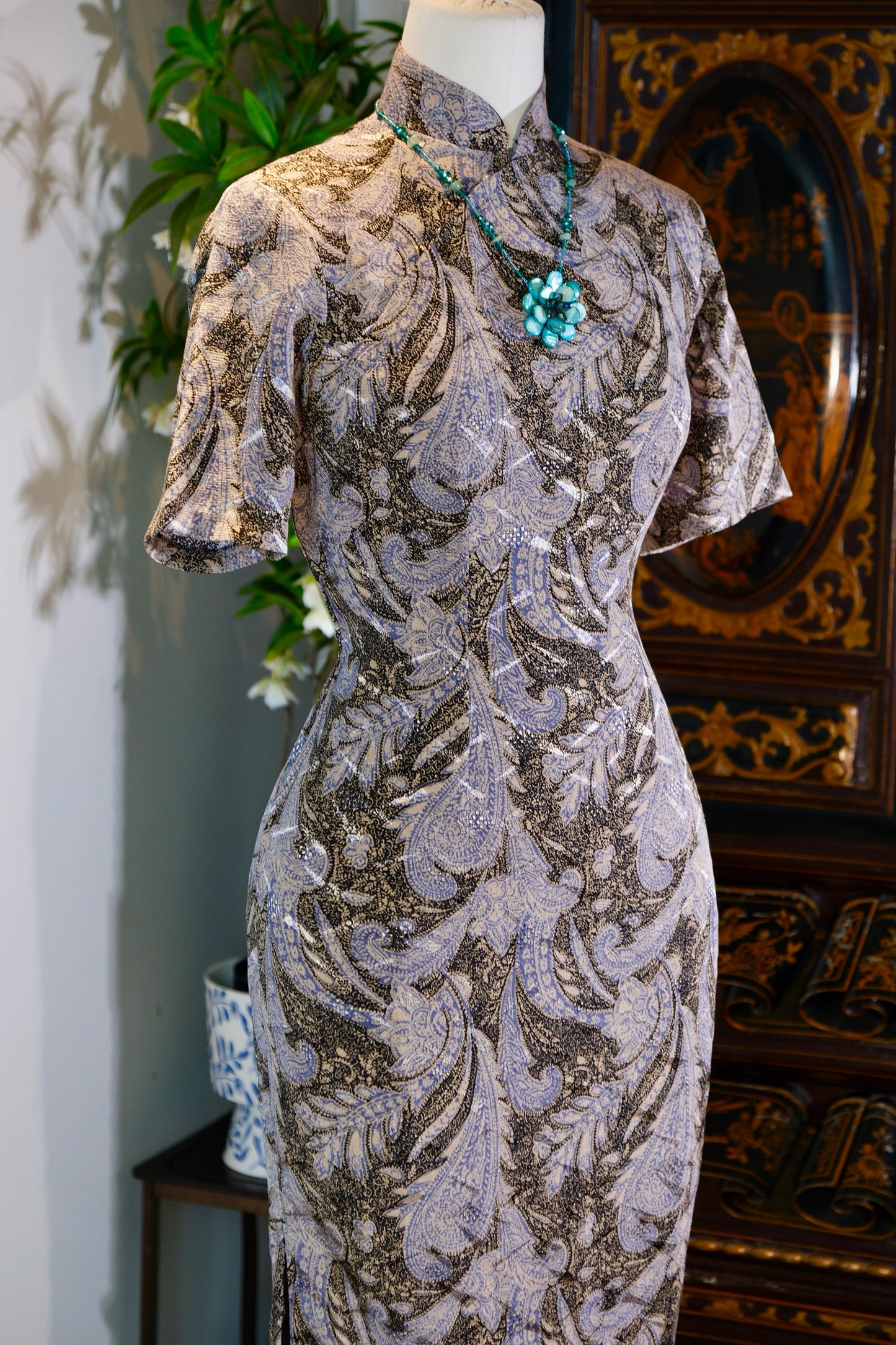
佩斯利提花古董旗袍——六十年代台湾织造的东方诗学
衣服尺寸:
胸围/腰围/臀围:88/744/94 厘米
衣长:108 厘米
细节描述:
当指尖抚过这件旗袍的提花面料,仿佛触到了上世纪六十年代台湾纺织业的黄金岁月。暗纹底布上,佩斯利纹样如藤蔓般舒展,卷草纹与忍冬纹在经纬间交织,似从波斯细密画中借来的异域密码,又在台湾织机的巧手下化作灰蓝与银棕的雅致碰撞。这些源自印度克什米尔的“生命之树”纹样,褪去了浓艳,带着六十年代特有的克制与优雅,恰如余光中笔下“月光还是少年的月光,九州一色还是李白的霜”的温柔注脚——不张扬,却自有风骨。
六十年代的台湾裁缝,以“滚、镶、嵌、宕”四法为骨,将本土织造的提花面料裁剪成贴合身形的曲线。立领的弧度如天鹅颈项,短袖的收口藏着彼时女子的矜持,腰间的省道似书法中的“飞白”,留白处尽是呼吸的韵律。这件旗袍的珍贵,在于它串联起两个时空:六十年代台湾纺织业的鼎盛时期(彼时台湾已是亚洲纺织重镇,提花工艺融合东西方审美),以及当代人对东方美学的回望。
如今,这样的古董旗袍已成“衣中孤本”。佩斯利纹样在六十年代台湾产旗袍中本就罕见(多见于出口绸缎),而彼时的手工提花工艺已近失传,存世量不足百件。它不仅是衣物,更是穿在身上的“流动博物馆”——每一道提花都是织工的指纹,每一处缝线都是岁月的批注。当现代时装在“复古”与“创新”间摇摆,这件旗袍早已用六十年的沉默证明:真正的经典,从不需要追赶潮流,它只是静静站在那里,便是一整个时代的风华。
The Paisley Jacquard Antique Cheongsam: Eastern Poetics Woven in 1960s Taiwan
Measurements / Size Guide:
Bust / Waist / Hips: 88/744/94 cm
Total Length: 108 cm
Detailed Description:
As one’s fingertips brush across the jacquard fabric of this cheongsam (qipao), it feels like touching the golden age of the Taiwanese textile industry in the 1960s. Upon the dark-patterned ground, the Paisley motifs stretch like vines—intertwining scrolling grass and honeysuckle patterns between the warp and weft. They appear as exotic ciphers borrowed from Persian miniatures, transformed by the skilled looms of Taiwan into an elegant collision of dusty blue and silver-brown. These "Tree of Life" patterns, originally from Kashmir, have shed their flamboyant intensity, adopting the restraint and grace characteristic of the 1960s. They serve as a gentle footnote to the poetry of Yu Kwang-chung: "The moonlight is still the moonlight of youth, and the land is still covered in the frost of Li Bai"—unassuming, yet possessing an inherent strength of character.
The Taiwanese tailors of the 1960s used the four classical techniques of "piping, inlaying, embedding, and draping" as the structural bone, tailoring locally woven jacquard fabrics into silhouettes that perfectly contoured the body. The curve of the standing collar resembles a swan’s neck; the finish of the short sleeves hides the reserve of the era's women; and the waist darts are like the "flying white" (feibai) in calligraphy—the negative spaces are filled with the rhythm of breath. The preciousness of this cheongsam lies in its ability to bridge two temporal spaces: the peak of Taiwan's textile industry (when Taiwan was an Asian textile hub, blending Eastern and Western aesthetics in jacquard craft) and the modern-day retrospective of Eastern aesthetics.
Today, such an antique cheongsam has become a "unique volume among garments." Paisley patterns were already rare in 1960s Taiwanese-made cheongsams (mostly found in silk fabrics destined for export), and the manual jacquard techniques of that time are now nearly extinct, with fewer than a hundred pieces remaining in existence. It is more than clothing; it is a "mobile museum" worn on the body—every jacquard weave is the fingerprint of a weaver, and every stitch is a marginal note made by Time. While modern fashion wavers between "vintage" and "innovation," this cheongsam has proven through sixty years of silence that true classics never need to chase trends; they simply stand there, embodying the elegance of an entire era.