深圳溯源
无法加载取货服务可用情况
衣服尺寸:
胸围/腰围/臀围:96/90/100 厘米
衣长:107 厘米
细节描述:
【图案描述:以“素”为饰,以“形”传神】
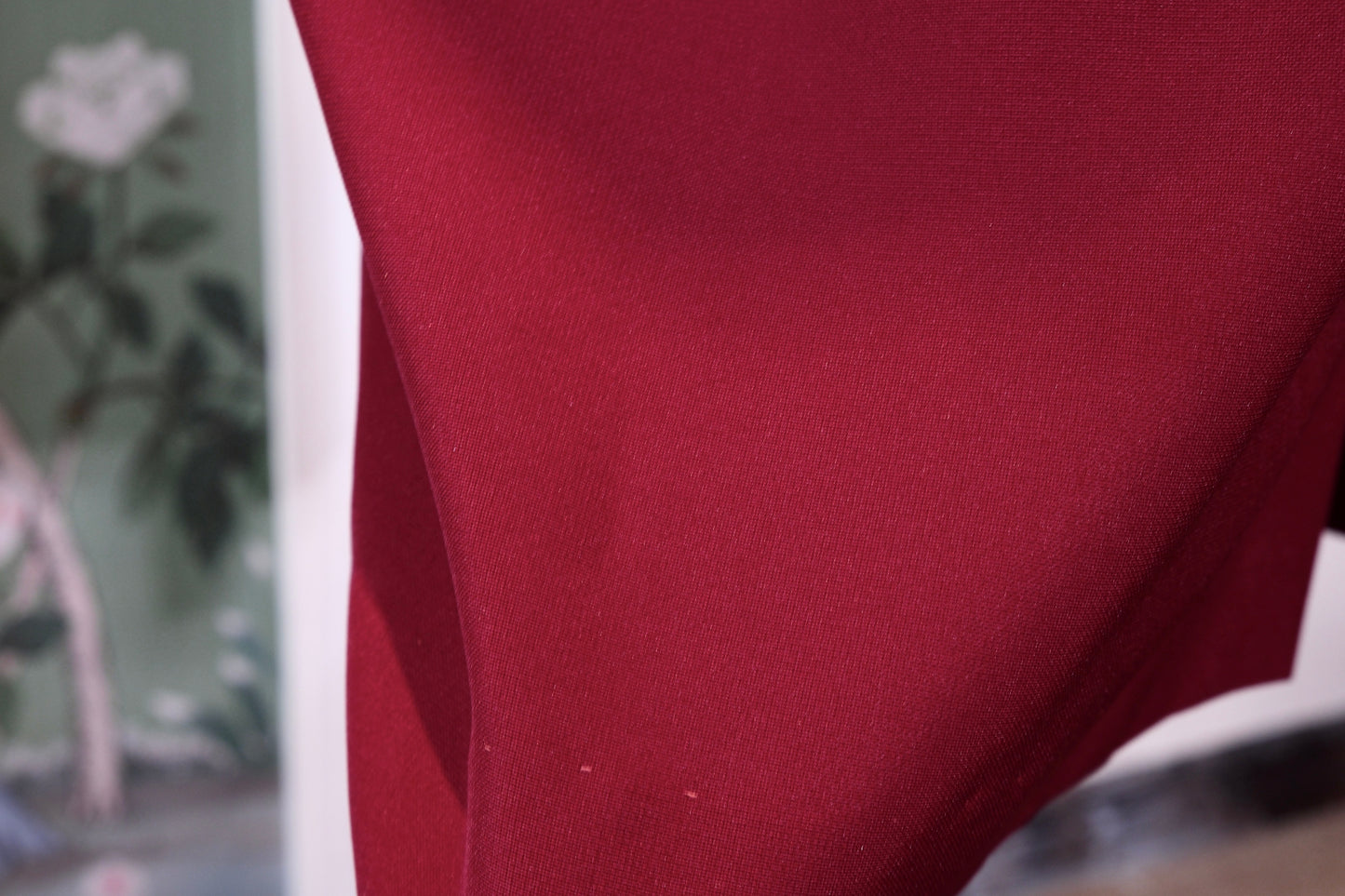
这件旗袍摒弃了传统服饰中繁复的纹样堆砌,通体采用正红纯色面料(色泽如陈年朱砂,沉稳而不艳俗),无任何刺绣、印花或织锦装饰。其美感全凭剪裁线条勾勒:立领挺括如松,贴合颈部却不束缚;七分袖利落收束,露出纤细手腕;腰身通过立体省道(dart)自然收拢,勾勒出女性柔美曲线;裙摆垂坠流畅,行走间如水波微漾。这种“无图案之图案”,恰是六十年代台湾旗袍受西方极简主义与本土实用美学双重影响的产物——以“留白”彰显气韵,以“廓形”传递风骨,正如宋代画论所言“计白当黑”,在至简中见至美。
【故事溯源:海岛风华里的时代剪影】
上世纪六十年代的台湾,正处于文化交融的特殊时期:一方面,大陆移民带来的海派旗袍技艺在此扎根;另一方面,战后经济复苏催生了“实用主义”审美,加之西方现代设计理念涌入,促使旗袍从“闺阁华服”转向“日常着装”。这件旗袍诞生于台北某老字号裁缝铺(彼时台湾旗袍业因移民潮迎来黄金期,匠人们既承袭苏绣、京绣的细腻针法,又大胆简化工艺以适应快节奏生活)。它或许曾属于一位女教师、银行职员或文艺工作者——她们穿着它穿梭于牯岭街的书肆、西门町的咖啡馆,或是参加学校的毕业典礼、家庭的节庆聚会。衣料上的细微褶皱、领口处若有若无的岁月痕迹,皆是时光的吻痕,诉说着那个年代女性“外柔内刚”的生活姿态:既保有东方女性的温婉含蓄,又展现出新时代女性的独立干练。
【艺术风格与稀缺性:引经据典证价值】
- 艺术风格:中西合璧的“新中式”先驱
这件旗袍的设计暗合《考工记》“天有时,地有气,材有美,工有巧”的造物智慧:选料考究(推测为台湾本土生产的优质棉麻混纺,透气亲肤且挺括有型),剪裁精准(省道位置、袖长比例皆符合人体工学),色彩克制(正红在传统语境中象征吉祥庄重,却因无绲边、无花扣而褪去“俗艳”,更显高级)。同时,它呼应了六十年代全球时尚界的“极简革命”——如Coco Chanel所言“奢华的反面不是贫穷,而是庸俗”,这件旗袍以“去装饰化”的姿态,将东方服饰的“意境美”与西方的“功能美”完美融合,成为研究“亚洲现代服饰转型”的鲜活样本。
- 稀缺性:不可复制的时代孤品
如今,六十年代台湾产的原版古董旗袍存世量极少:一方面,彼时旗袍多为“定制款”,批量生产少,且历经半个多世纪,保存完好的更是凤毛麟角;另一方面,“无绲边、无花扣”的纯色素雅设计在当时虽属创新,却因不符合后来“复古风潮”对“传统元素”的刻板印象,未被大量仿制,反而使其成为“断代史”般的存在。正如沈从文先生在《中国古代服饰研究》中所强调:“服饰是穿在身上的历史。”这件旗袍不仅是一件衣物,更是六十年代台湾社会风貌、审美变迁、工艺演进的“活化石”——它的每一处细节(从面料纹理到缝线走向),都在无声地讲述着那个时代的故事,具有极高的收藏与研究价值。
【结语:藏一件旗袍,藏一段风华】
当我们凝视这件旗袍,看到的不仅是红色的布料与流畅的线条,更是一个时代的呼吸与心跳。它是历史的切片,是美学的宣言,更是无数女性生命故事的载体。若你有幸拥有它,便拥有了与六十年代台湾风华对话的权利——在某个午后,轻抚衣料,仿佛能听见老裁缝铺里的缝纫机声,看见街巷中身着旗袍的身影,触摸到那段被时光珍藏的、独属于东方的优雅与坚韧。
Measurements / Size Guide:
Bust / Waist / Hips: 96/90/100 cm
Total Length: 107 cm
Detailed Description:
This qipao completely discards the stacking of complex patterns found in traditional garments. The entire piece utilizes a solid vermilion-red fabric (with a hue resembling aged cinnabar—deep and stabilized, rather than loud and gaudy), entirely free of any embroidery, printing, or brocade decoration. Its beauty relies entirely on the configuration of its tailored lines: the standing collar is as crisp and upright as a pine tree, fitting the neck closely without restriction; the three-quarter sleeves terminate cleanly, exposing a slender wrist; the waist is naturally drawn in through three-dimensional darts (立体省道), sculpting the soft curves of the female silhouette; and the lower hem falls in a fluid drape, rippling like soft water waves as the wearer walks. This "pattern of no pattern" is precisely the product of 1960s Taiwanese qipao design under the dual influence of Western minimalism and local pragmatic aesthetics—using "negative space" (留白) to showcase artistic vitality and the "silhouette" to convey structural character. Just as classical Song dynasty painting theory notes "treating white space as ink" (计白当黑), the pinnacle of beauty is found within absolute simplicity.
During the 1960s, Taiwan was in a unique period of cultural convergence. On one hand, the tailoring techniques of Shanghai-style (海派) qipaos brought over by mainland immigrants took deep root; on the other hand, post-war economic recovery sparked a "pragmatic" aesthetic. This, combined with the influx of Western modern design philosophies, prompted the qipao to transition from "boudoir luxury" to "everyday functional attire." This specific qipao was born in an old, established tailor shop in Taipei (a time when Taiwan’s qipao industry entered a golden era due to the migration wave, where artisans both inherited the delicate stitching methods of Suzhou and Beijing embroidery and boldly simplified construction to adapt to a fast-paced lifestyle). It may have belonged to a female schoolteacher, a bank clerk, or a literary worker—women who wore it while navigating the bookstores of Guling Street (牯岭街), the modern cafes of Ximending (西门町), or attending school graduation ceremonies and family holiday gatherings. The subtle creases on the fabric and the faint traces of time along the collar line are honest chronological marks, chronicling the lifestyle posture of that era's women—gentle on the outside but resilient on the inside (外柔内刚)—preserving the warmth and modesty of Eastern women while showcasing the independence and capability of a new era.
The design of this qipao secretly aligns with the manufacturing wisdom found in the classical text The Book of Diverse Crafts (《考工记》): "The sky has its seasons, the earth has its climate, materials have their beauty, and craftsmanship has its skill" (天有时,地有气,材有美,工有巧). The material selection is meticulous (hypothesized to be a premium, Taiwan-localized cotton-linen mixed weave that is highly breathable, skin-friendly, and structurally crisp), the tailoring is precise (the dart placement and sleeve proportions conform flawlessly to human ergonomics), and the use of color is highly restrained. While vermilion-red symbolizes auspiciousness and solemnity in traditional contexts, the complete omission of piping borders or fabric frog closures strips away any potential gaudiness, making it appear exceptionally elevated. Concurrently, it echoes the "minimalist revolution" shaking the global fashion landscape in the 1960s—as Coco Chanel famously stated, "The opposite of luxury is not poverty, but vulgarity." By adopting a stance of absolute de-ornamentation, this qipao perfectly merges the poetic imagery of Eastern clothing with Western functional utility, serving as a living sample for studying the transformation of modern Asian dress.
Today, authentic original 1960s Taiwanese-produced antique qipaos are exceptionally rare in modern markets. On one hand, qipaos during that era were predominantly custom bespoke commissions rather than mass-produced runs, and after more than half a century, specimens preserved in unblemished condition are few and far between. On the other hand, although the elegant plain design—completely devoid of piping and frog closures—was an innovative breakthrough at the time, it did not conform to the stereotyped traditional elements sought out by later "retro commercial trends." As a result, it completely escaped mass modern reproduction, causing it to stand as an irreplaceable chronological record (“断代史”). Just as Shen Congwen emphasized in Studies of Ancient Chinese Clothing (《中国古代服饰研究》): "Clothing is history worn on the body." This qipao transcends standard garments, acting as a true living fossil of 1960s Taiwanese social life, aesthetic evolution, and technical craftsmanship. Every single detail—from the texture of the weave to the direction of the stitching passes—silently tells the story of that generation, carrying exceptionally high collection and research value.
When we gaze upon this qipao, we see far more than red fabric and fluid lines; we feel the breath and heartbeat of a specific era. It is a physical slice of history, a manifesto of design aesthetics, and a physical capsule for the life stories of countless women. If you are fortunate enough to possess it, you gain the right to converse directly with the mid-century glamour of 1960s Taiwan. On a quiet afternoon, lightly touching the textile, one can almost hear the low hum of the sewing machines in that old custom atelier, catch a glimpse of the elegant silhouettes passing through the city streets, and touch that refined Eastern grace and resilience preserved by time.
Suyuan Archival Textile Registry — Documenting the material culture, preserving the technical lineage of ancestral craft.