深圳溯源
无法加载取货服务可用情况
衣服尺寸:
胸围/腰围/臀围:88/80/104 厘米
衣长:108 厘米
细节描述:
【图案:经纬间的诗意密码】
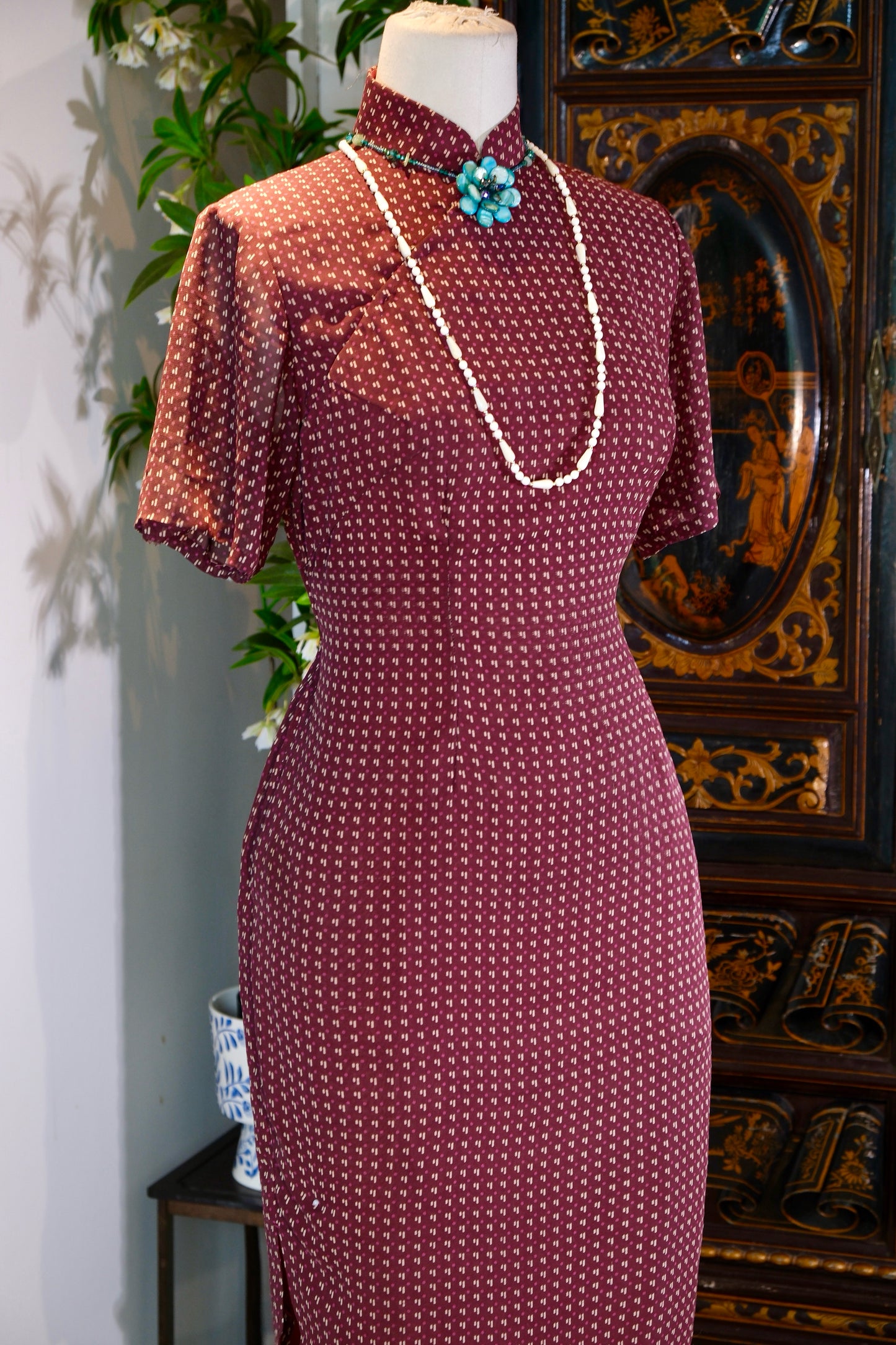
这件上世纪六十年代的台湾产印花雪纺旗袍,以酒红为底色,缀满细密的米白几何点阵纹样。这些看似简约的点状排列,实则暗藏匠心:它们既非传统缠枝莲的繁复,也非西式波点的直白,而是将中式“留白”意境与六十年代现代主义审美相融——点阵如星子散落夜空,又似江南雨巷中湿润的青石板纹理,在轻盈的雪纺面料上流转出“疏影横斜”的雅致。雪纺的通透感让图案若隐若现,行走间仿佛有微风拂过墨色宣纸,将“虚实相生”的东方美学演绎得淋漓尽致。
【故事:衣褶里的时代回响】
六十年代的台湾,正处于文化交融的十字路口。彼时,旗袍从民国时期的“宽身长摆”演变为更贴合女性曲线的修身剪裁,却仍保留着立领、盘扣等东方符号;而西方战后时尚浪潮(如迪奥“New Look”的收腰理念)也悄然渗透,催生出这种“中西合璧”的独特风格。
这件旗袍的诞生,或许源自台北某条老巷的裁缝铺:老师傅用进口雪纺料(当时台湾纺织业刚起步,优质面料多依赖进口),结合本地匠人对“曲线美”的理解,一针一线勾勒出女性的柔美与力量。它可能曾陪伴一位女教师走过课堂,或在某个夏夜随她赴一场音乐会——雪纺的轻盈让她行动自如,酒红的端庄又衬出知识女性的温婉。如今,当我们触摸这泛黄的衣料,仿佛能听见旧时光里的缝纫机声、街巷的叫卖声,以及那个年代女性对“美”的执着追求。
【艺术与稀缺:不可复制的时光孤品】
从艺术价值看,这件旗袍是“传统与现代对话”的活标本:立领、斜襟延续千年服饰文脉,修身剪裁与雪纺材质则拥抱六十年代的摩登精神。正如《礼记·深衣》所言“袂圜以应规,曲袷如矩以应方”,旗袍的形制本就承载着“天圆地方”的哲学,而这件作品的点阵印花,又以抽象语言重构了传统纹样的当代性——它不模仿自然,却比自然更具韵律感。
稀缺性更在于“时代的不可逆”:六十年代的台湾旗袍,因社会转型(从农业社会向工商业过渡)、面料工艺迭代(雪纺逐渐被化纤取代)、审美变迁(七十年代后旗袍式微)等因素,存世量极少。加之这件作品保存完好(雪纺易脆化,能留存至今已是奇迹),其“孤品”属性更显珍贵。它不仅是衣物,更是研究东亚时尚史、女性史的“实物文献”——每一处针脚、每一寸褪色,都是历史的注脚。
【结语:穿在身上的文明史诗】
当我们将这件旗袍悬于展架,或轻披于身,便是在与一个时代对话。它告诉我们:真正的美,从不是复古的复刻,而是传统的“创造性转化”。正如学者沈从文在《中国古代服饰研究》中所言:“服饰是穿在身上的历史。”这件六十年代的台湾旗袍,正以它的酒红与点阵、雪纺与曲线,书写着一段关于“东方如何拥抱世界,世界如何重塑东方”的温柔史诗。
Measurements / Size Guide:
Bust / Waist / Hips: 88/80/104 cm
Total Length: 108 cm
Detailed Description:
This 1960s printed chiffon qipao from Taiwan features a deep wine-red background, adorned all over with dense, delicate geometric dot-matrix patterns in cream white. These seemingly simple dot arrangements actually conceal deep ingenuity: they offer neither the complexity of traditional intertwined lotuses nor the bluntness of Western polka dots. Instead, they blend the Chinese artistic concept of liubai (negative space) with 1960s modernist aesthetics. The dot matrix resembles stars scattered across a night sky, or the texture of wet cobblestones in a southern rainy alley, flowing with a "sparse shadows slanting across" elegance on the lightweight chiffon fabric. The sheer quality of the chiffon allows the pattern to appear half-hidden and half-visible. As one walks, it feels as though a gentle breeze is brushing over ink-washed Xuan paper, vividly interpreting the Eastern aesthetic of "interplay between reality and illusion."
In the 1960s, Taiwan stood at a cultural crossroads. At that time, the qipao was evolving from the loose, long-hemmed silhouettes of the Republican era into a more form-fitting tailored cut that contoured to the female silhouette, while still retaining Eastern symbols such as the mandarin collar and frog buttons. Meanwhile, postwar Western fashion trends—such as Dior's "New Look" cinched-waist philosophy—quietly permeated the culture, giving rise to this unique, East-meets-West style.
The birth of this qipao might trace back to a tailor shop in an old alley of Taipei. Combining imported chiffon fabric (as Taiwan's textile industry was just emerging and high-quality fabrics relied heavily on imports) with local artisans' understanding of "curvaceous beauty," the master tailor outlined feminine softness and inner strength stitch by stitch. It might have accompanied a schoolteacher through her classroom, or graced a summer night as she attended a concert. The weightlessness of the chiffon granted her freedom of movement, while the dignity of the wine-red hue accentuated the gentle grace of an intellectual woman. Today, when we touch this aged fabric, we can almost hear the hum of old sewing machines, the vendors' cries in the streets, and the persistent pursuit of "beauty" by women of that bygone era.
From an artistic perspective, this qipao serves as a living specimen of the "dialogue between tradition and modernity." The mandarin collar and side closure (pajin) carry forward a millennium of clothing heritage, while the tailored silhouette and chiffon material embrace the modern spirit of the 1960s. As stated in The Book of Rites: Shenyi, "The sleeves are rounded to correspond with the compass, and the collar is curved to correspond with the square." The very form of the qipao carries the philosophy of "the round sky and the square earth." The dot-matrix print of this piece reconstructs the contemporary nature of traditional patterns through abstract language—it does not mimic nature, yet it possesses a rhythm stronger than nature itself.
Its rarity lies even more in the "irreversibility of time." Due to social transitions (from an agricultural society to an industrial and commercial one), iterations in textile craftsmanship (chiffon was gradually replaced by synthetic fibers), and shifts in aesthetics (the decline of the qipao after the 1970s), 1960s Taiwanese qipaos survive in very limited numbers today. Furthermore, because this piece has been preserved in excellent condition—a true miracle given how easily chiffon becomes brittle with age—its status as a one-of-a-kind treasure is all the more precious. It is not merely a garment, but a physical archive for studying East Asian fashion and women's history; every stitch and every inch of fading serves as a footnote to history.
When we hang this qipao on a display rack or gently drape it over our shoulders, we are engaging in a dialogue with an era. It tells us that true beauty is never a literal replication of the past, but rather a "creative transformation" of tradition. As the scholar Shen Congwen noted in Researches on Ancient Chinese Costumes, "Clothing is history worn on the body." This 1960s Taiwanese qipao, with its wine-red and dot matrix, its chiffon and curves, is writing a tender epic about "how the East embraced the world, and how the world reshaped the East."