溯源
无法加载取货服务可用情况
衣服尺寸:
胸围/腰围/臀围/衣长:84/68/84/87 厘米
细节描述:
一、衣上无纹,却藏万象
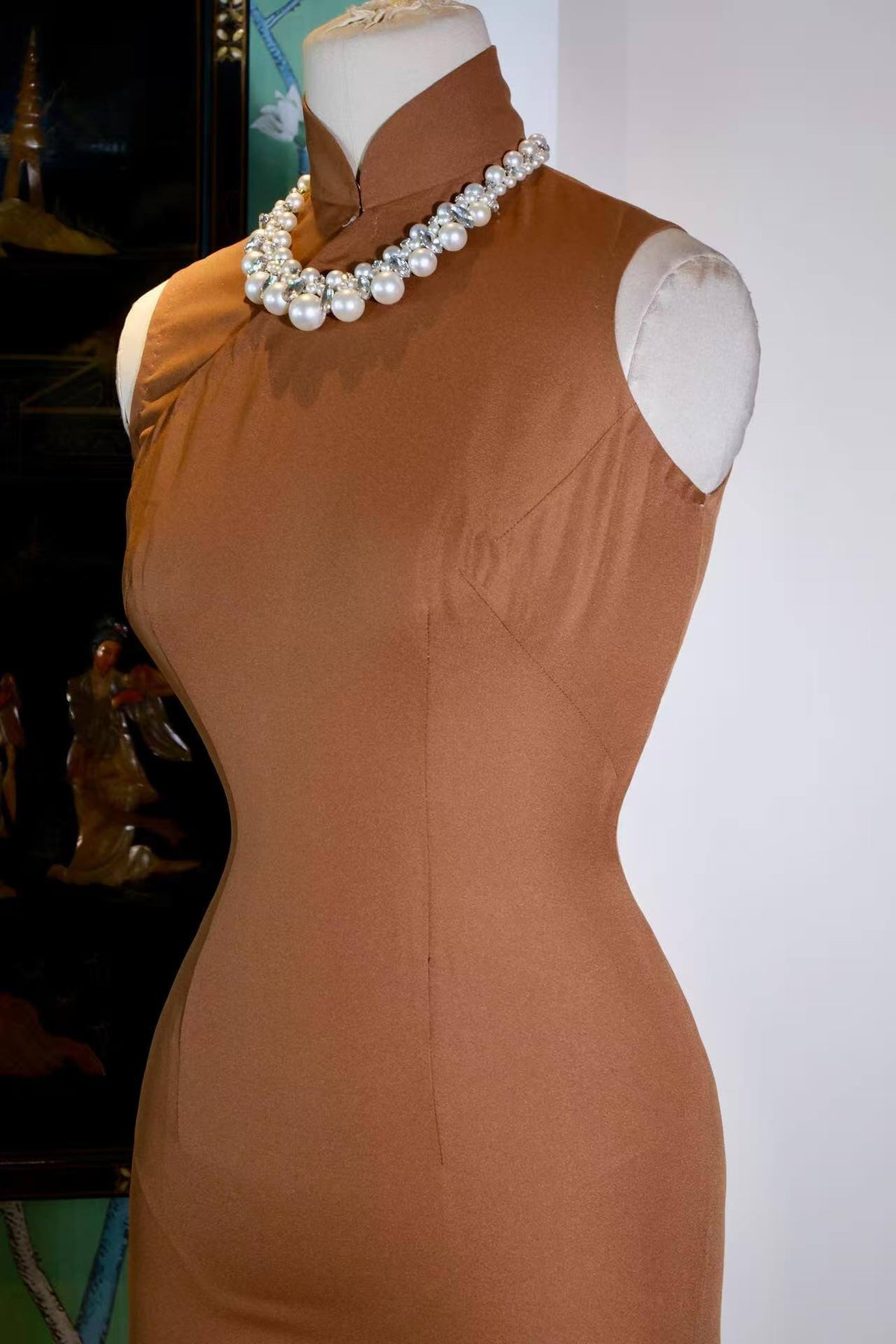
此件旗袍通体素色,无刺绣、无印花,却以面料本身的肌理与剪裁的线条为“纹”。上世纪六十年代欧洲进口的西装面料,质地挺括而不失柔韧,表面泛着低调的哑光光泽,如老茶般醇厚温润。这种面料在当时极为稀缺,多用于高级定制西装,匠人将其用于旗袍制作,既保留了西式面料的垂坠感与塑形力,又融入了中式立领、斜襟、收腰的经典形制。衣身无多余装饰,仅以精准的省道(darts)勾勒出女性曲线,从肩线到腰臀的过渡如行云流水,恰似中国画中的“留白”艺术——以无形胜有形,以素净显风华。
二、古董衣的故事:跨越海峡的时光信物
这件旗袍诞生于1960年代的台湾,彼时台湾正处于“中西交融”的时尚转型期。一方面,本土裁缝延续着苏杭旗袍的精湛工艺;另一方面,欧美战后经济复苏带来的面料贸易,让欧洲高档西装料流入亚洲市场。这件旗袍正是这一历史背景的缩影:它可能是某位名媛为出席重要场合定制的战袍,也可能是海外归侨对故土文化的深情寄托。面料从欧洲漂洋过海,在台湾匠人手中被赋予东方灵魂,针脚里藏着那个时代女性对“优雅”的独特理解——不张扬,却自有风骨;不繁复,却处处见匠心。如今它静静陈列,如同一封未寄出的信,诉说着半个世纪前的审美与故事。
三、引经据典:素衣之美,自古有之
《诗经·卫风》有云:“素以为绚兮”,意为素净本身就是一种绚烂。这件旗袍的“素”,恰是对这一古典美学的现代诠释。明代文震亨在《长物志》中论及服饰:“衣以适体为贵,色以雅正为上”,此件旗袍的驼色(或称“茶褐”)正是传统色谱中的“雅正之色”,既非浓艳,亦非寡淡,如秋日暖阳般温润含蓄。而欧洲西装面料的运用,则暗合了晚清民国以来“中学为体,西学为用”的服饰革新理念——以西方材质承载东方形制,既保留了旗袍的文化根脉,又注入了时代的摩登气息。这种“中西合璧”的稀缺性,使其成为研究20世纪中叶东亚服饰史的重要实物标本。
四、艺术风格与稀缺性:不可复制的时代印记
从艺术风格看,这件旗袍属于“简约主义”与“东方韵味”的完美融合。它摒弃了传统旗袍常见的滚边、盘扣等装饰元素,转而通过面料质感与剪裁精度展现美感,这与同时期西方“New Look”强调曲线美的设计理念不谋而合,却又比西方设计多了几分东方的内敛与克制。其稀缺性体现在三个方面:一是面料的不可再生性——六十年代欧洲进口西装料存世量极少,且多为博物馆级藏品;二是工艺的断代风险——能精准驾驭此类硬挺面料并做出柔美曲线的老裁缝已寥寥无几;三是文化价值的独特性——它是冷战时期两岸三地与欧美文化交流的微观见证,承载着超越服饰本身的历史重量。
结语
这件旗袍不是简单的“旧衣”,而是一件活着的文物。它以素色为纸,以剪裁为笔,书写着六十年代的审美密码;它以面料为媒,串联起东西方的时尚对话。穿上它,仿佛能触摸到那个时代女性的体温与心跳——她们在变革中寻找自我,在传统与现代之间走出了一条属于自己的优雅之路。这或许就是古董衣最动人的地方:它不仅是被收藏的对象,更是被传承的精神。
Measurements / Size Guide:
Bust / Waist / Hips / Total Length: 84/68/84/87 cm
Detailed Description:
I. Patternless Garment, Yet Concealing All Things
This cheongsam is solid and plain throughout—devoid of embroidery or printed motifs—yet takes the natural texture of its fabric and the lines of its tailoring as its "patterns." Crafted from suits fabric imported from Europe in the 1960s, the texture is crisp yet pliable, casting a understated matte sheen on its surface akin to the mellow warmth of aged tea. Such fabric was extraordinarily scarce at the time, mostly reserved for bespoke luxury suits; when artisans applied it to cheongsam tailoring, it preserved the drape and structural silhouette of Western textiles while integrating classic Eastern forms: the mandarin collar, slanted placket, and cinched waist. Free of extraneous ornamentation, the dress relies solely on precise darting (darts) to contour female curves, with transitions from shoulder lines to waist and hips flowing like moving clouds and water—mirroring the artistic principle of "leaving blank space" (Liu Bai) in Chinese painting: where formlessness triumphs over form, and pure simplicity reveals peerless elegance.
II. The Story of a Vintage Garment: A Token of Time Across the Strait
This cheongsam was born in 1960s Taiwan, when the island was navigating a fashion transition marked by the "fusion of East and West." On one hand, local tailors carried forward the exquisite techniques of Suzhou and Shanghai cheongsams; on the other hand, fabric trade driven by post-war economic recovery in Europe and America allowed high-grade European suitings to flow into Asian markets. This cheongsam serves as a miniature epitome of that historical backdrop: it may have been a custom "power dress" commissioned by a socialite for an important occasion, or a deep sentimental anchor held by an overseas Chinese returnee for her ancestral homeland. Crossing oceans from Europe, the fabric was endowed with an Eastern soul in the hands of Taiwanese artisans, with every stitch concealing that era's unique understanding of "elegance" among women—unostentatious yet possessing its own character; un-complex, yet revealing master craftsmanship in every detail. Today it stands quietly displayed, like an unposted letter narrating the aesthetics and stories of half a century ago.
III. Drawing from Classics: Plain Beauty, Enduring Since Antiquity
The Classic of Poetry (Book of Songs · Airs of Wei) states: "Plain ground makes the splendor," meaning that plain simplicity is itself a form of brilliance. The "plainness" of this cheongsam is precisely a modern interpretation of this classical aesthetic. Wen Zhenheng of the Ming Dynasty noted regarding attire in Treatise on Superfluous Things: "Garments value fitting the body; colors prioritize elegance and correctness." The camel shade (or "tea brown") of this cheongsam represents precisely an "elegant and correct color" from the traditional color palette—neither ostentatiously bright nor blandly thin, but warm and subtle like autumn sunlight. Meanwhile, the application of European suit fabric quietly aligns with the apparel reform concept of "Chinese learning as the core, Western learning for practical application" maintained since the late Qing Dynasty and Republican era—using Western materials to carry Eastern forms, preserving the cultural roots of the cheongsam while infusing it with modern era flair. This rarity of "East-meets-West" harmony makes it an important physical specimen for studying mid-20th-century East Asian costume history.
IV. Artistic Style and Rarity: An Irreplicable Mark of an Era
From an artistic style perspective, this cheongsam represents a flawless fusion of "Minimalism" and "Eastern Charm." It abandons decorative elements common to traditional cheongsams, such as piping and frog buttons, turning instead to fabric texture and tailoring precision to demonstrate beauty. This coincides with the design ethos of the contemporary Western "New Look" that emphasized body curves, yet possesses a degree of Eastern subtlety and restraint lacking in Western designs. Its rarity is embodied in three aspects: first, the non-renewable nature of the fabric—surviving quantities of 1960s imported European suitings are extremely scarce, mostly reserved as museum-grade specimens; second, the generational interruption risk of craftsmanship—master tailors who could precisely control such stiff suitings while molding feminine curves have grown exceedingly few; third, the uniqueness of cultural value—it serves as a microscopic witness to cultural exchanges among mainland China, Taiwan, Hong Kong, Europe, and America during the Cold War era, carrying historical weight transcending the garment itself.
Epilogue
This cheongsam is not simply an "old piece of clothing," but a living cultural artifact. It takes plain color as paper and tailoring as its brush, writing the aesthetic code of the 1960s; it uses fabric as a medium, linking together an East-West fashion dialogue. Putting it on, one can almost touch the warmth and heartbeat of women from that era—who sought selfhood amid transformation, stepping out onto a path of elegance that belonged uniquely to them between tradition and modernity. This is perhaps the most touching aspect of vintage attire: it is not merely an object to be collected, but a spirit to be inherited.