溯源
无法加载取货服务可用情况
【文献综述与美学赏析】
在服装史的宏大叙事中,20世纪60年代是极具张力的十年。彼时,伊夫·圣·罗兰(Yves Saint Laurent)刚推出蒙德里安系列,而法国高级定制工坊则在进行着一场关于“传统与反叛”的博弈。这件60年代的法式小黑裙,正是那个黄金时代下“建筑感廓形(Architectural Silhouette)”的典范。
一、 墨染重华:关于黑色的文学意象
这件晚装以纯粹的黑作为底色,却毫无沉闷之气,反倒呈现出一种“墨染重华”的高级质感。中国文学常言“大音希声,大象无形”,黑色作为色彩的终极包容,恰似暗夜般深邃。在60年代的法国,黑色褪去了维多利亚时代的沉重丧服标签,被赋予了摩登与独立的女性力量——它既是《蒂凡尼的早餐》中奥黛丽·赫本的经典优雅,也是香奈儿女士口中“绝对的美”。
二、 镂空之诗:东方屏风上的法式蕾丝
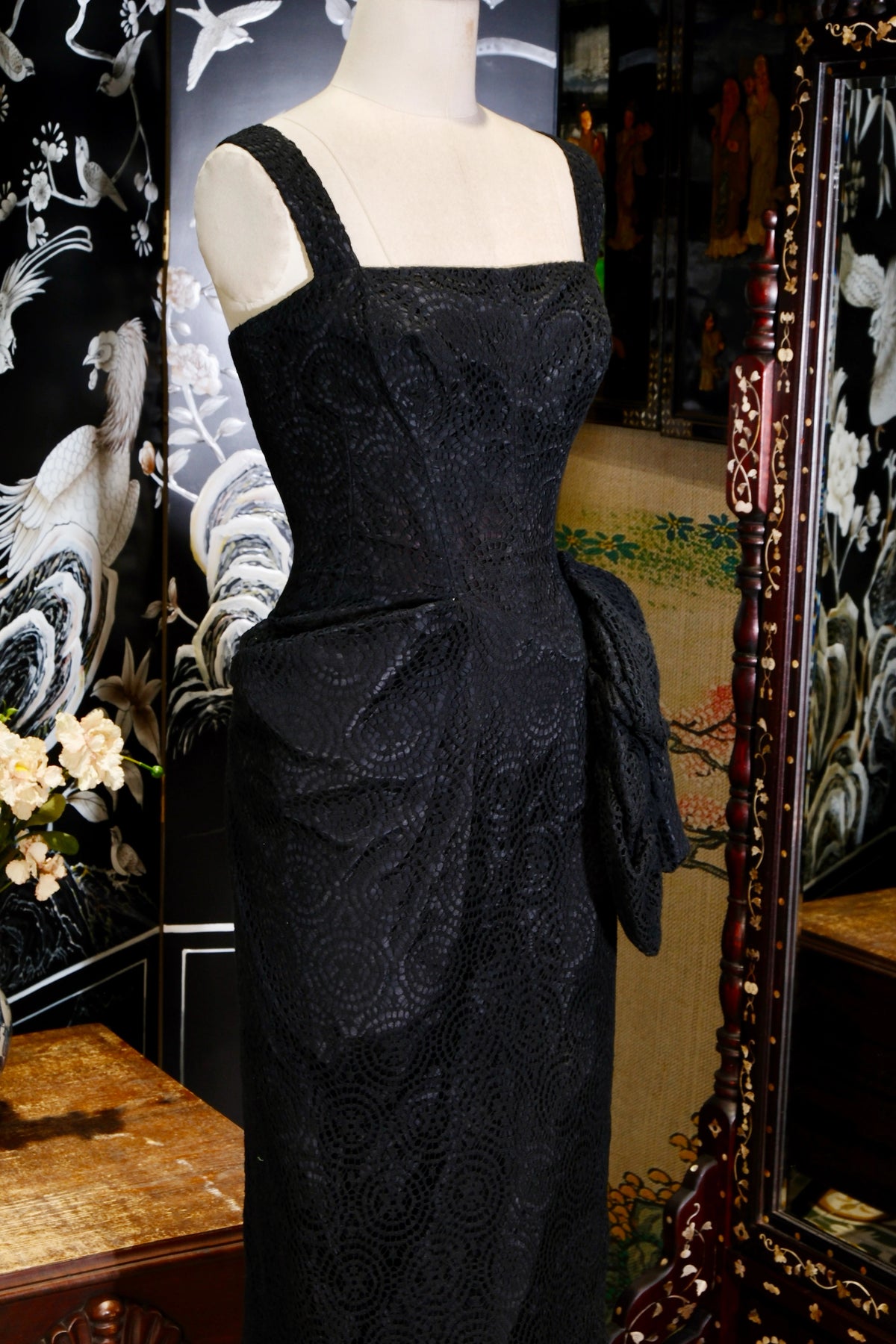
这件礼服的面料极具考究,采用了进口的重工提花蕾丝。不同于轻薄的渔网蕾丝,这种面料具有极佳的挺括度。裙身布满了圆环相扣的镂空图案,宛如宋代瓷器上的冰裂纹,又似东方水墨画中晕开的墨梅。
这种大面积的镂空工艺,在服装学术语中称为“透叠(Overlapping)”。它巧妙地利用皮肤若隐若现的色泽,打破了黑色的封闭感。在光影的折射下,黑色的蕾丝如同暗夜中悄然绽放的黑蔷薇,既克制冷峻,又充满了诱惑的呼吸感。
三、 建筑美学:侧畔的立体花结
从版型的角度审视,这件礼服的设计堪称绝妙。
它摒弃了50年代克里斯汀·迪奥(Christian Dior)那种极尽奢华的“沙漏型”大摆,转而采用更为利落、干练的铅笔裙(Pencil Dress)剪裁。这种H型或窄A型的廓形,完美契合了60年代女性解放、追求自由与效率的时代精神。
最为惊艳的笔触,在于其左臀部的立体堆褶设计。
这一夸张的侧部花结,在视觉上极具冲击力。它并非简单的平面装饰,而是通过精密的立体剪裁,将蕾丝面料进行堆叠、折叠与定型。这在西方服装史中被称为“不对称美学(Asymmetry)”。它让人联想到法国巴洛克艺术中那种繁复的曲线美,又如同一朵凝固的黑牡丹,在腰臀之间傲然盛开。这一设计不仅在视觉上极大地收窄了腰肢,更通过强烈的体积对比,赋予了裙子极强的雕塑感与动态美。
四、 方领古韵:东西方美学的碰撞
领部采用经典的法式方领(Square Neckline),这种设计源自欧洲文艺复兴时期的宫廷服饰,能够完美展露女性的锁骨与肩颈线条。在这张照片中,模特身后的中国风黑底花鸟屏风,为这件法式礼服提供了一个绝妙的文化参照系。
西方的立体雕塑感与东方的平面留白美学在此交汇。方领的端庄、侧畔花结的张扬、镂空面料的细腻,构成了一幅跨越国界与文化的绝美画卷。
【结语】
这件60年代的法式黑裙,不仅是一件衣物,更是一座微型的建筑,一首无声的十四行诗。它承载了那个时代女性觉醒的优雅,用针线编织出永恒的浪漫与高贵。穿上它,不仅是穿上了60年代的法式风情,更是穿起了一段关于时光与美的永恒记忆。
Within the grand narrative of fashion history, the 1960s was a decade charged with intense aesthetic tension. As Yves Saint Laurent introduced his iconic Mondrian collection, French haute couture ateliers were simultaneously engaged in a subtle dialogue between tradition and rebellion. This 1960s French little black dress stands as a quintessential specimen of the era's architectural silhouette (Architectural Silhouette).
Rendered in pure black, this evening gown remains entirely free of somber monotony, instead projecting an elevated, ink-drenched richness. Classical literature speaks of how "the greatest sound is silence, the greatest form is invisible"—and black, serving as the ultimate chromatic embrace, echoes the profound depths of midnight. In 1960s France, black stripped away its Victorian mourning connotations to become the definitive emblem of modern, independent female power—marrying Audrey Hepburn’s cinematic grace in Breakfast at Tiffany's with Coco Chanel's declaration of absolute beauty.
The fabric execution of this gown demonstrates exceptional rigor, utilizing imported heavyweight jacquard lace. Diverging from diaphanous mesh lace, this textile possesses superior structural body. The skirt is blanketed in interconnected ring-cutwork motifs reminiscent of ice-crackle glazes on Song dynasty porcelain, or ink-plums blossoming across Eastern water-ink washes.
In sartorial terminology, this expansive cutwork technique is termed overlapping translucency (Overlapping). It artfully leverages skin tones peeking through the pattern to break the opacity of black. Under shifting light and shadow, the dark lace unfolds like a black rose blooming silently in the dark—restrained, cool, yet filled with alluring breathability.
Structurally, the gown’s pattern-making achieves absolute brilliance. It discards the hyper-elaborate hourglass volume of Christian Dior’s 1950s creations in favor of a sleek, crisp pencil silhouette (Pencil Dress). This streamlined H-line or narrow A-line contour perfectly aligned with the 1960s spirit of female emancipation, efficiency, and personal freedom.
The defining touch resides in the structural drape detail at the left hip. This dramatic side-knot commands immediate visual focus. Far from a flat embellishment, it is engineered through precision three-dimensional draping that folds, layers, and fixes the lace into form. Within Western fashion history, this embodies the principle of asymmetric aesthetics (Asymmetry). It evokes the intricate curlicues of French Baroque art—resembling a black peony frozen in full bloom across the waist and hip. This architectural intervention visually narrows the waist while introducing a dynamic, sculptural contrast of volume.
The bodice features a classic French square neckline (Square Neckline), a form descending from European Renaissance court attire that gracefully exposes the collarbones and shoulder line. Photographed against a traditional Chinese black-lacquer screen adorned with floral and avian motifs, the gown engages in an exquisite cross-cultural dialogue. Western sculptural three-dimensionality meets Eastern planar negative space. The decorum of the square neck, the theatricality of the side knot, and the delicacy of the cutwork textile merge to compose a canvas transcending geographic and cultural boundaries.
This 1960s French black dress transcends mere apparel; it functions as a micro-architecture and a silent sonnet. It encapsulates the dignified female awakening of its era, weaving eternal romance and nobility through needle and thread. Slipping into it means wrapping oneself not merely in 1960s French allure, but in an enduring memory of time and beauty.