深圳溯源
无法加载取货服务可用情况
衣服尺寸:
胸围/腰围/臀围/衣长:104/96/120/114 厘米
细节描述:
“锦衣旗袍诗,曼玉花样时。”
在服装史的浩瀚长河中,20世纪60年代是旗袍发展的“黄金余晖”。这一时期的旗袍,褪去了40年代的繁复堆砌,转而追求更为立体、现代且极具建筑感的剪裁。今日所展示的这件藏品,正是那个时代台湾高级定制工艺的巅峰见证——出自赫赫有名的“眼镜旗袍专家”之手,采用当时极为珍贵的日本进口机绣蕾丝面料制成。
一、 纹样解析:银杏织锦,金风玉露
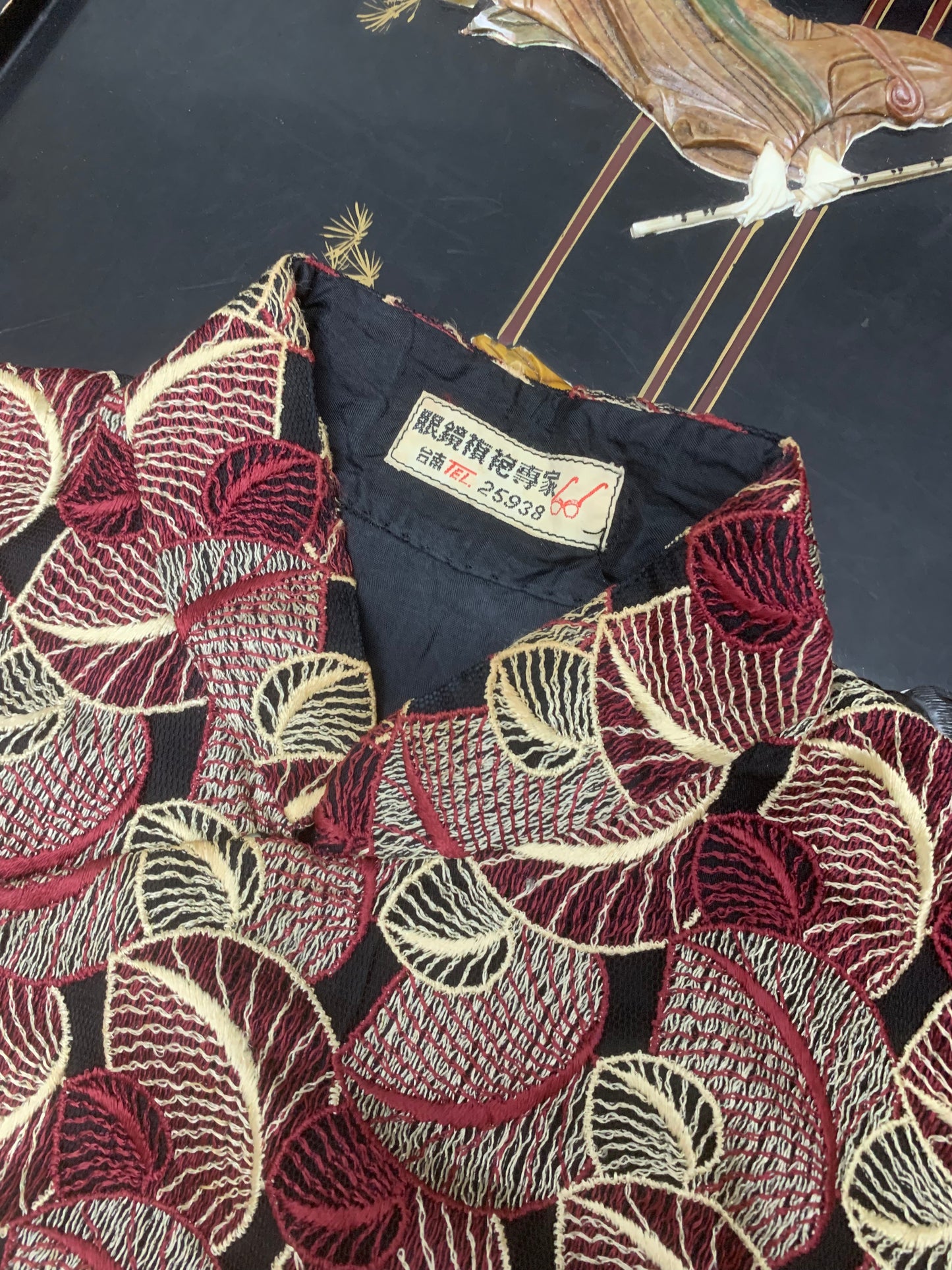
细观此衣,最摄人心魄莫过于其面料纹样。这并非普通的印花,而是极具立体感的重工机绣。
图案以银杏叶(Ginkgo)为核心意象,层层叠叠,铺陈开来。在中国传统文化中,银杏象征着长寿与坚韧,因其叶形如扇,又被称为“鸭脚”,古人云:“深灰浅火略相遭,小苦微甘韵最高”,赋予了其高洁的文人品格。
在这件旗袍上,设计师运用了极高超的色彩美学:
- 底色为深邃的暗夜黑,如同静谧的夜空;
- 主调为醇厚的勃艮第酒红(Burgundy),带着岁月的沉淀与女性的妩媚;
- 勾勒则使用了带有金属光泽的古铜金线。
这种配色的精妙之处在于,酒红的丝绒质感与金线的硬朗光泽形成了强烈的视觉对冲。每一片“银杏叶”都通过密集的针法呈现出浮雕般的肌理,仿佛秋风过处,落叶纷飞却被瞬间凝固在了织物之上。这种“满地锦绣”的视觉效果,既有宋锦的华丽,又有西方Art Deco(装饰艺术)风格的几何韵律。
二、 工艺溯源:东洋技艺,宝岛风华
领标上清晰的“眼镜旗袍专家”字样,揭示了其身世。在上世纪中叶的台湾,由于汇聚了来自上海、苏州等地的顶尖裁缝,加之当时作为亚洲纺织重镇的地位,诞生了一批技艺精湛的旗袍店。“眼镜旗袍专家”便是其中的佼佼者,代表了当时台式旗袍严谨、合身、讲究归拔工艺的流派。
更为难得的是其面料——日本进口机绣蕾丝。在60年代,日本的重工刺绣面料是奢侈品中的奢侈品。请注意观察袖口与衣身的细节,这种蕾丝并非轻飘的网纱,而是具有厚重感的“骨感”面料。它利用高密度的刺绣将图案“种”在底网上,使得整件衣服虽然通透,却拥有极佳的廓形支撑力。这种面料在当时多用于出口或高级定制,存世量极少,能保存至今且色泽如初,实属凤毛麟角。
三、 剪裁与气韵:海派遗风,现代修身
从形制上看,这件旗袍完美继承了海派旗袍的精髓并加以改良。
- 立领:高度适中,既修饰颈部线条,又不显拘谨,保留了东方的含蓄美。
- 省道:胸省与腰省的转移极其精准,这是老式裁缝“归拔”功夫的体现,无需紧身胸衣便能塑造出女性自然的S型曲线。
四、 结语:穿在身上的博物馆
张爱玲曾言:“对于不会说话的人,衣服是一种语言,随身带着的是袖珍戏剧。”
这件60年代的古董旗袍,不仅仅是一件御寒蔽体的衣物,它是一部微缩的纺织工业史,是一首关于时间与美的散文诗。它见证了那个年代女性对美的极致追求,也记录了东西方纺织技艺交融的辉煌瞬间。
在这个快时尚泛滥的年代,拥有一件这样经过半个世纪洗礼、针脚依然细密、色泽依然醇厚的古董衣,不仅是收藏了一份稀缺的艺术品,更是珍藏了一段永不褪色的优雅传奇。
Measurements / Size Guide:
Bust / Waist / Hips / Total Length: 104/96/120/114 cm
Detailed Description:
As historical costume axioms declare: "A poem woven in splendid brocade captures the sovereign grace of an era; an elite wardrobe freezes the cinematic majesty of lost time." Within the vast chronological trajectory of East Asian costume history, the 1960s represents the defining "golden twilight" of the classical qipao. Shifting decisively away from the complex, sometimes heavy multi-layered embellishments characteristic of the 1940s, the tailoring philosophy of this decade turned aggressively toward a hyper-articulated, modernized, and profoundly architectural pattern-drafting blueprint. The pristine archival specimen under review here stands as a monumental historical testament to the absolute apex of high-customization tailoring (Gaoji Dingzhi) executed in mid-century Taiwan. Bearing the definitive historical mark of the celebrated "Glasses Qipao Expert" atelier, this garment was engineered from a textile matrix of extreme economic and cultural preciousness: 1960s imported Japanese high-density machine-embroidered lace.
A close formal appraisal of the outer epidermis of this garment isolates its surface ornamentation as an exceptional feat of post-war textile design engineering. This is not a flat, topical dye print; rather, it is a high-mass, high-relief specimen of heavy-industrial mechanical embroidery.
Iconographic Mapping and Semiotics: The decorative schema organizes itself entirely around the organic morphology of the Ginkgo biloba leaf (Yinxingye), mapped in dense, overlapping cascading clusters that envelop the structural panels of the chassis. Within classical Chinese literary systems, the ginkgo leaf—famously known in antiquity as the "duck-foot leaf" (Yajiaoye) due to its elegant, fan-like geometry—serves as a potent signifier of longevity, resilience, and unyielding intellectual rectitude. It evokes the elevated, detached aesthetic landscape described by ancient literati who praised its subtle, bitter-sweet character and complex, quiet dignity.
Chromatic Synthesis and Dimensional Contrast: The master tailor deployed a highly sophisticated, high-contrast color scheme to achieve maximum optical weight. The absolute grounding field is a deep, light-absorbent midnight black, functioning like a silent night sky. Atop this dark void, the primary structural motifs are rendered in a rich, saturated Burgundy wine-red, carrying an immense sense of historical depth and mature feminine sensuality. The definitive structural outlines of each individual leaf are then executed with metallic-lustre bronze-gold filaments. The genius of this composition resides in the intense visual friction generated between the soft, implied depth of the wine-red fibers and the metallic rigidity of the surrounding gold thread. Every ginkgo leaf acts as a micro-sculpture, engineered through dense, hyper-compact needlework to yield a true embossed relief (Fubiao). It creates an illusion where falling autumn leaves are instantaneously frozen in time across the textile grid. This total visual density achieves the monumental, "all-over" luxury characteristic of classical Song Dynasty Brocades (Songjin) while seamlessly absorbing the precise, geometric, and rhythmic cadence of Western Art Deco design.
The inner physical architecture of this garment preserves a pristine, unaltered cloth label reading "Glasses Qipao Expert" (Yanjing Qipao Zhuanjia), a critical material anchor that unlocks its institutional provenance.
The Taiwanese High-Customization Crucible: During the mid-20th century, the island of Taiwan witnessed a historical convergence of elite tailoring lineages. Master craftsmen fleeing the tectonic political shifts of mainland China—most notably the foundational patriarchs of the legendary Shanghai Style (Haipai) and Suzhou guilds—re-established their elite ateliers in Taipei and other major urban centers. Operating alongside Taiwan's emerging position as a high-tier textile processing hub in East Asia, these shops birthed an era of unprecedented sartorial precision. The "Glasses Qipao Expert" atelier emerged as an undisputed vanguard of this movement, representing a rigorous, highly disciplined school of tailoring that demanded mathematical precision in anatomical fit, seamless grainline alignment, and a master-tier command of high-temperature fabric manipulation.
The Physics of the Japanese Embroidered Matrix: The structural soul of this garment is entirely dictated by its imported fabric. In the 1960s, Japanese heavy-industrial embroidered textiles represented the absolute zenith of luxury imports. A physical inspection of the cuffs and internal seams demonstrates that this fabric is completely distinct from standard, lightweight decorative mesh. It is an exceptionally heavy, "skeletal" lace matrix featuring a pronounced structural framework (Jingu). By utilizing ultra-high-density automated needle configurations, the floral patterns are literally anchored directly into a structural net backing. This allows the qipao to appear visually translucent and breathing, while simultaneously maintaining a powerful, self-supporting structural skeleton that holds a crisp, sculptural silhouette against the body. Because this caliber of material was restricted almost exclusively to high-end export contracts and private haute couture commissions, its global survival rate is infinitesimally small. For a specimen to survive six decades with its structural lattice entirely uncompromised and its chemical coloration untarnished is an extreme archival rarity.
Structurally, this specimen perfectly preserves the foundational orthodoxy of the Shanghai lineage while seamlessly implementing the advanced, close-contouring modifications of post-war modernism.
The Disciplined Stand-Up Collar: The classic Mandarin collar assembly (Liling) is executed with moderate, measured height. It acts as an intentional framing device that elongates and disciplines the cervical lines of the wearer, honoring traditional Confucian visual decorum and introverted modesty without inflicting physical restriction or impeding the natural kinetic rotation of the head.
The Mathematics of Contour Darting: A rigorous technical evaluation reveals an immaculate execution of contour darting across the bust and waist parameters. The seamless redirection of fullness from the chest to the hip lines is achieved via a master-class deployment of traditional "Gui-Ba" processing—a demanding technique where flat woven textiles are physically shrunk (Gui) and stretched (Ba) using precise applications of high-temperature moisture and iron-work until the fabric permanently memorizes the three-dimensional, biomorphic curves of the female anatomy. As a direct result, the garment coaxes out a completely natural, fluid "S-curve" profile entirely independent of aggressive Western undergarments or constricting corsetry.
As Eileen Chang famously remarked in her seminal treatises on costume philosophy: "For those who are otherwise mute, clothes function as a sovereign vernacular; they carry a pocket drama wherever they go."
This 1960s antique qipao transcends the utilitarian boundaries of protective apparel; it operates as an eloquent, tangible archive of mid-century industrial textile history and a profound work of material prose. It stands as a silent witness to a generation of East Asian women who pursued an absolute, uncompromised tier of personal elegance, capturing the precise historical moment where globalized textile technologies collided with traditional Chinese aesthetics. In a contemporary global landscape dominated by the transient, disposable metrics of fast fashion, to hold a specimen of this caliber—where the hidden stitching remains fiercely intact and the chromatographic depth remains completely uncompromised after half a century—is not merely to possess a rare antique. It is to inherit a living, unyielding monument of sovereign grace and timeless design history.