深圳溯源
无法加载取货服务可用情况
衣服尺寸:
胸围/腰围/臀围:96/80/100 厘米
衣长:102 厘米
细节描述:
一、图案描述:暗香浮动,隐于经纬
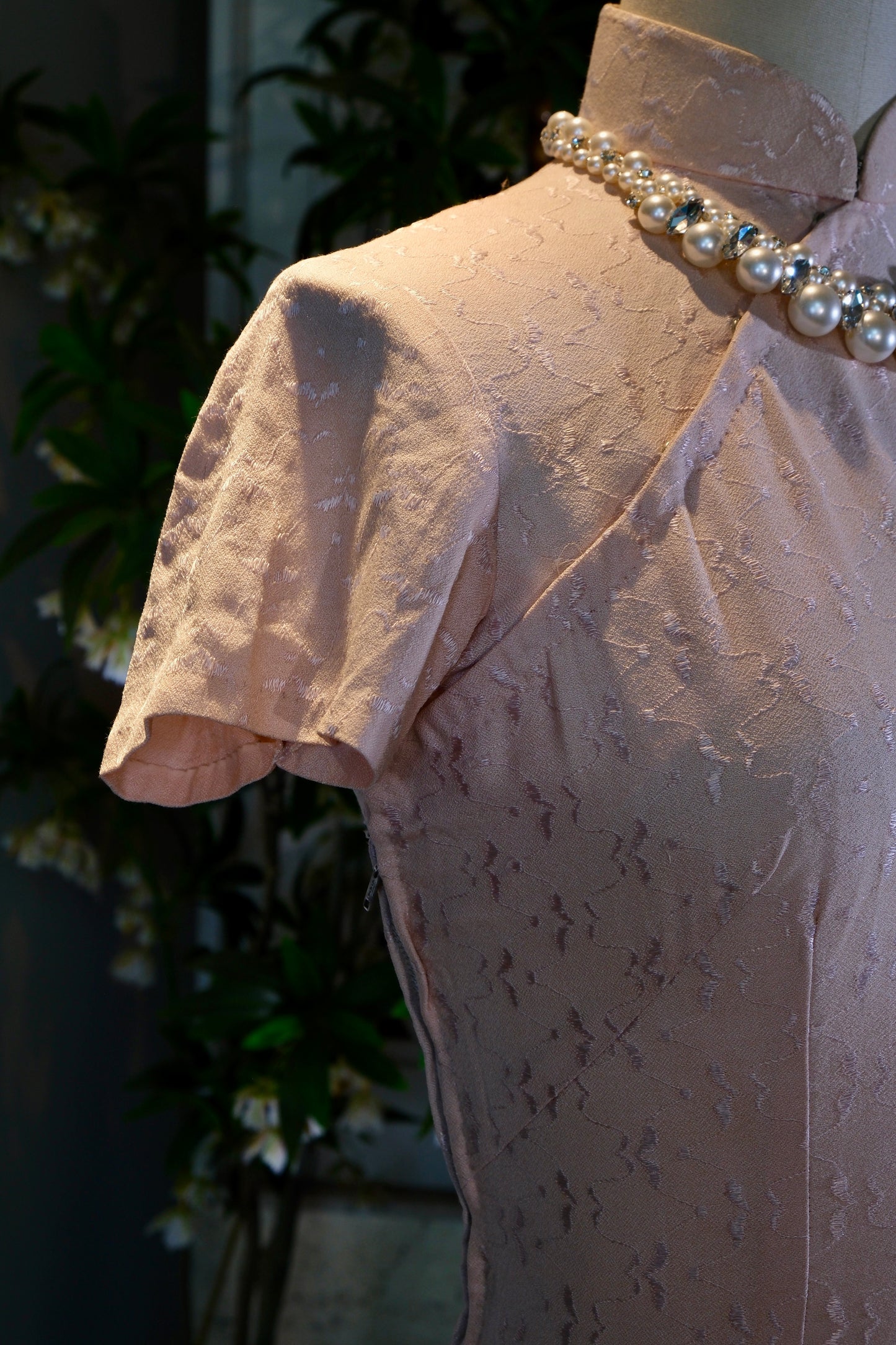
这件上世纪六十年代的香港产古董旗袍,其面料上的提花暗纹堪称“低调的奢华”。它并非张扬的大面积印花,而是采用高难度的提花织造工艺,将纹样直接织入丝绸肌理之中。
细看之下,这是一种极具古典韵味的缠枝莲与云雷纹变体。银白色的丝线在淡粉色的底料上若隐若现,构成了连绵不断的几何化花卉图案。这种纹样布局疏密有致,既保留了传统吉祥寓意的庄重,又融入了六十年代现代主义设计的简洁线条。光线流转间,暗纹如水面波光般闪烁,仿佛张爱玲笔下那“一袭华美的袍”,不喧哗,自有声。
二、历史溯源:香江流金岁月的缩影
这件旗袍诞生于上世纪六十年代的香港,那是一个东西方文化剧烈碰撞却又完美融合的“流金岁月”。彼时的香港裁缝业正处于巅峰,海派旗袍的精髓随移民南下,与西方的立体剪裁技法在香江交汇。
这不仅仅是一件衣服,它是那个时代女性意识觉醒的见证。六十年代的旗袍开始大胆收腰,强调女性的S型曲线,袖口缩短至手肘以上,甚至出现无袖设计,旨在展现女性的独立与自信。这件旗袍采用了当时极为考究的归拔工艺,通过高温熨烫使平面布料产生立体弧度,无需省道便能完美贴合人体曲线,这是如今机器量产无法复刻的手工温度。
三、引经据典与艺术风格:衣以载道,锦瑟华年
《诗经·秦风》有云:“锦衣狐裘,颜如渥丹。”古人早已懂得服饰是身份与审美的外化。而这件旗袍,恰如其分地诠释了“哀而不伤,艳而不俗”的中式美学。
- 色彩美学: 它的色调介于藕粉与裸色之间,古人称之为“妃色”或“肉红”,是一种极具包容性且显肤白的颜色。这种低饱和度的粉色,褪去了少女的稚气,沉淀出一种经过岁月洗礼的温润感,正如宋代瓷器中的影青,淡雅而深远。
- 稀缺性: 真正的古董旗袍,贵在“孤品”二字。六十年代的真丝提花面料如今已难觅踪迹,侧边拉链(那是西风东渐的典型特征,六十年代开始普及金属拉链替代传统盘扣以便穿脱)的结合,使其成为研究服装史不可多得的实物标本。
四、结语:收藏一段流动的歷史
在这个快时尚泛滥的年代,拥有一件六十年代的香港古董旗袍,不仅是拥有了一件衣物,更是收藏了一段关于美、关于匠心、关于那个黄金时代的记忆。它静静地立在那里,用那一身繁复而内敛的暗纹,诉说着“最是人间留不住,朱颜辞镜花辞树”的永恒叹息,等待着下一位懂它的主人,续写风华。
Measurements / Size Guide:
Bust / Waist / Hips: 96/80/100 cm
Total Length: 102 cm
Detailed Description:
The tone-on-tone jacquard shadow motifs (Tihua Anwen) slicing through the textile matrix of this 1960s antique Hong Kong-produced qipao operate as the literal definition of "low-profile luxury." It completely rejects ostentatious, large-scale surface printing, utilizing instead a highly complex jacquard weaving engineering that integrates the patterning directly into the structural grain of the silk.
A precise appraisal reveals a highly classical, stylized variation of interlinking lotus vines (Chanzhilian) and ancient cloud-and-thunder fret designs (Yunleiwen). Argent-white silk filaments emerge and submerge fluidly across a pale roseate grounding chassis, constructing an uninterrupted, geometricized floral network. This motif configuration balances dense and sparse parameters with immense calculation, preserving the solemn dignity of heritage auspicious semiotics while absorbing the clean, disciplined lines characteristic of 1960s Western modernism. Under shifting angles of illumination, these shadow motifs glint like fractured sunlight across a moving water surface—vividly materializing the iconic sentiment penned by Eileen Chang: "a magnificent robe" that requires no loud declaration, commanding its own absolute resonance.
This qipao was birthed within 1960s Hong Kong—a unique historical window where Eastern and Western design systems collided with immense force, yet reconciled into perfect synthesis. During this timeline, the regional tailoring apparatus reached its absolute technical zenith; the core drafting intelligence of the Shanghai lineage (Haipai) migrated south with master artisans, intersecting gracefully with Western three-dimensional ergonomic principles along the shores of Victoria Harbour.
The garment transcends its utility as clothing to function as a vital physical archive documenting the mid-century awakening of independent female consciousness. The 1960s qipao pattern aggressively executed waist reductions to articulate the biological S-curve of the female form, while shortening cuffs well above the elbow or deleting them entirely into sleeveless architectures to broadcast an autonomous metropolitan identity. This specific specimen exhibits an immaculate execution of the era's elite Guiba ("shaping through ironing and stretching") technique; by applying calculated high-temperature thermal tension, the tailor compelled a flat textile plane to generate three-dimensional organic curves that adhere flawlessly to the anatomy with a absolute minimization of unnecessary darting. This delivers a degree of artisanal warmth and structural nuance that contemporary, machine-driven mass production is fundamentally incapable of replicating.
The ancient Classic of Poetry · Odes of Qin (Shijing) famously states: "Clad in embroidered robes and fox furs, his countenance is as if stained with vermilion." Long ago, the ancients decoded apparel as the ultimate physical exteriorization of sovereign identity and aesthetic alignment. This qipao flawlessly interprets that exact mid-century Chinese aesthetic doctrine: "poignant without fracturing into grief, opulent without succumbing to vulgarity."
Chromatographic Aesthetics: The tonal calibration operates in the subtle space between lotus-root pink and contemporary nudes—classified in heritage nomenclature as "Consort Pink" (Feise) or flesh-red (Rouhong), a highly inclusive palette that illuminates the skin's natural radiance. This low-saturation roseate value completely sheds the naive innocence of youth, precipitating a warm, jade-like maturity processed through decades of natural environmental aging—reminiscent of the crystalline, pale-blue depth (Yingqing) found in rare Song Dynasty ceramics, deep and boundless.
Absolute Scarcity Metrics: Within the international antique apparel registry, the value of an asset is dictated absolutely by its non-reproducible status as a unique holotype (Gupin). 1960s high-density silk jacquard yardages have completely vanished from the contemporary textile trade apparatus. Furthermore, the integration of a discrete side-zipper assembly—a definitive material index of the Westernization of apparel engineering, as high-purity metal zippers systematically replaced traditional manual frog closures during this specific decade to accommodate accelerated urban mobility—renders this chassis an irreplaceable primary document for costume history research.
In a contemporary marketplace saturated by the transient velocity of fast-fashion industrialization, curating a 1960s Hong Kong antique qipao extends far beyond acquiring a vintage luxury asset; it represents the permanent archiving of a material memory centered on human craft, discipline, and a golden epoch. Standing in monumental silence, the garment uses its complex yet interiorized shadow motifs to utter the eternal, bittersweet sigh of Chinese classical literature: "Most fleeting in this human world is youth departing the mirror, and blossoms departing the tree." It waits patiently for its next rightful custodian—one who truly decodes its structural language—to continue its cross-generational narrative of timeless elegance.