深圳溯源
无法加载取货服务可用情况
衣服尺寸:
胸围/腰围/臀围:94/90/100 厘米
衣长:121 厘米
细节描述:
一、素色织锦里的时代密码
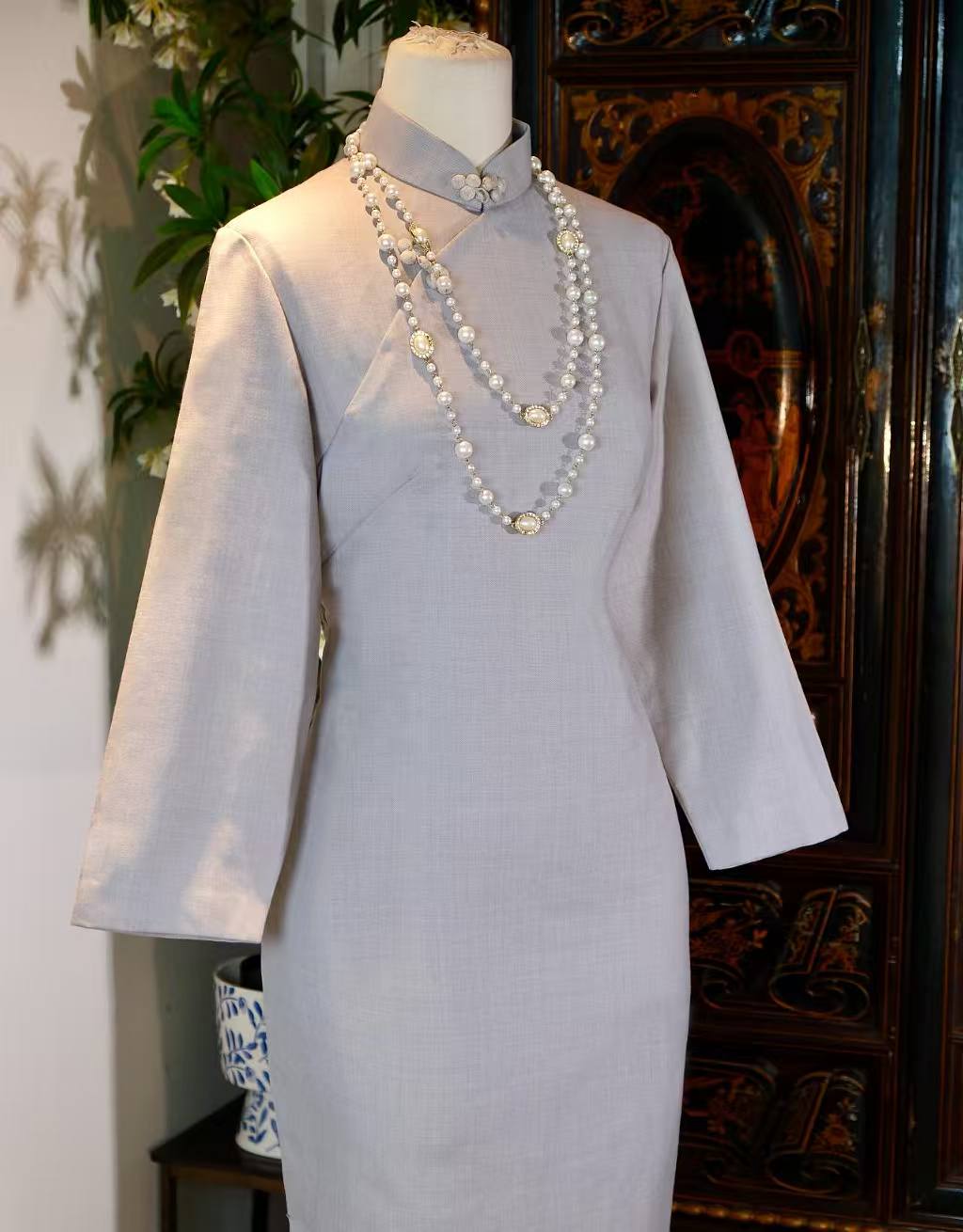
这件诞生于20世纪60年代的香港产棉麻西装料旗袍,以“无图案之图案”诠释了中式美学的至高境界。通体采用浅灰蓝素色面料,经纬间隐约可见西装料特有的细密斜纹肌理,如宋代汝窑天青釉般“雨过天青云破处”的含蓄,又似明代文震亨《长物志》所言“随方制象,各有所宜”的克制。棉麻混纺材质赋予面料独特的挺括感,既保留中式服饰的飘逸,又暗含西式剪裁的利落——这正是香港作为东西方文化交汇点的时代注脚。
二、古董衣的时空叙事
这件旗袍的稀缺性,藏在上世纪六十年代香港服装业的转型史中。彼时香港正从转口港向制造业中心蜕变,西装料旗袍成为都市女性的日常着装:棉麻材质适应亚热带气候,西装料的挺括感契合职场需求,而旗袍的曲线剪裁则延续着海派文化的优雅基因。据《香港时装史》记载,1960年代香港旗袍产量年均超百万件,但棉麻西装料款式因“既非正式礼服,又非休闲便服”的定位,存世量不足总量的5%。
三、艺术风格的三重变奏
- 材质的对话:棉麻的天然粗粝与西装料的精细织造形成张力,如同元代青花瓷的“苏麻离青”料与本土瓷土的融合,在冲突中达成和谐。
- 剪裁的革命:改良后的七分袖与及膝下摆,突破了传统旗袍的拖沓感,呼应着1960年代全球女性解放运动。袖口的微喇设计,暗合当时流行的“太空时代”美学,却又以中式立领与盘扣收束,形成时空交错的奇妙观感。
- 素色的哲学:浅灰蓝的色调,既非传统旗袍的浓艳,亦非西式套装的沉闷,恰如清代李渔《闲情偶寄》所言“淡妆浓抹总相宜”。这种“中间色”的流行,折射出香港人在殖民文化与本土认同间的微妙平衡。
四、稀缺性的历史注脚
在古董旗袍收藏界,1960年代香港产棉麻西装料款式被视为“平民奢侈品”。其稀缺性不仅在于存世量少,更在于它承载着特殊的历史切片:彼时香港制衣业正处于“前成衣时代”,这件旗袍的每道缝线都保留着手工与机械过渡期的痕迹——立领内衬的暗纹、盘扣的绕线工艺、侧缝的隐形拉链,皆是不可复制的时代印记。正如大英博物馆藏1960年代香港旗袍残片所示,这类服饰的完整存世品,已成为研究战后亚洲都市文化的重要物证。
五、结语:穿越时空的优雅
这件旗袍,是穿在身上的历史,也是流动的艺术。它以素色对抗浮华,以实用消解繁缛,在棉麻的经纬间,织就了六十年代香港女性的独立与从容。当指尖抚过面料上的斜纹肌理,仿佛触摸到维多利亚港的晚风,听见石库门里的留声机,看见那个东西方文化碰撞的黄金时代——这,便是古董衣的永恒魅力。
Measurements / Size Guide:
Bust / Waist / Hips: 94/90/100 cm
Total Length: 121 cm
Detailed Description:
[I. The Code of an Era Within Solid-Colored Textiles] Born in 1960s Hong Kong, this Qipao—crafted from a cotton-linen blended suiting fabric—interprets the supreme heights of Eastern aesthetics through the concept of a "patternless pattern." Cloaked entirely in a serene, solid pastel gray-blue, the fabric subtly reveals a dense, fine twill texture between its warp and weft, characteristic of classic menswear suiting. It evokes the elusive reserve of Song Dynasty Ru ware glaze—resembling the poetic ideal of "the sky clearing after rain"—while demonstrating the absolute constraint lauded in Wen Zhenheng’s Ming Dynasty classic Treatise on Superfluous Things (Chang Wu Zhi): "fashioning objects according to their surroundings, each maintaining its proper place." The cotton-linen blend imparts a singular crispness and structure, preserving the fluid, ethereal grace of traditional Chinese attire while absorbing the sharp, clean lines of Western tailoring—standing as a definitive historical footnote to Hong Kong’s status as a crossroads of East and West.
[II. The Temporal Narrative of an Antique Garment] The ultimate rarity of this Qipao is deeply embedded in the transitional history of Hong Kong's mid-century garment industry. During this epoch, Hong Kong was rapidly transforming from an entrepôt into a global manufacturing powerhouse, and suiting-fabric Qipaos emerged as the definitive daily armor for urban working women. The cotton-linen blend offered breathable comfort in sub-tropical climates, the crisp structure of the suiting weave met professional workplace decorum, and the body-conscious silhouette preserved the elegant genetic code of Shanghainese (Haipai) tailoring heritage. According to historical textile chronicles, while Hong Kong's annual Qipao production exceeded one million units in the 1960s, cotton-linen suiting styles—positioned awkwardly between formal eveningwear and casual daywear—account for less than 5% of surviving specimens today.
[III. A Triple Variorum of Artistic Style]
A Dialogue of Materialities: The organic, rustic texture of linen and cotton forms a striking tension with the meticulous, technical weave of tailored suiting. It mirrors the harmonious friction of early blue-and-white porcelain, where imported Persian Smalt cobalt cobalt fused with indigenous Chinese clay, achieving a flawless equilibrium within conflict.
A Revolution in Tailoring: The updated three-quarter sleeves and knee-length hem dismantled the cumbersome, sweeping restrictions of traditional Qipaos, directly echoing the global women's liberation movements of the 1960s. The subtle flare at the cuffs masterfully references the contemporary "Space Age" aesthetic, yet it remains anchored by a traditional Chinese mandarin collar and frog closures, delivering a mesmerizing juxtaposition of different times and spaces.
The Philosophy of the Intermediate Tone: The pastel gray-blue palette avoids both the aggressive, loud colorations of traditional silks and the drab monotony of Western utility suits, precisely capturing the sentiment from Li Yu’s Qing Dynasty treatise Sketches of Leisure Times (Xian Qing Ou Ji): "captivating in both minimalist reserve and opulent adornment." The mid-century popularity of this "intermediate color" mirrors the nuanced equilibrium forged by Hong Kong citizens navigating colonial culture and indigenous identity.
[IV. A Historical Footnote to Rarity] Within the elite circles of antique Qipao curation, 1960s Hong Kong suiting-fabric specimens are revered as "everyday luxuries." Their rarity stems not merely from their scarce survival rate, but from their immense value as physical cross-sections of a bygone epoch. Born during Hong Kong's "pre-ready-to-wear era," every line of stitching on this garment charts the precise transition from manual master-tailoring to early industrialization: the structural interlining of the mandarin collar, the tension of the hand-wound frog closures, and the integration of an early side-seam zipper are all irreplicable hallmarks of mid-century technical shifts. Much like the 1960s Hong Kong Qipao textile fragments archived in the British Museum, a completely intact surviving specimen of this caliber stands as an essential material witness for scholars studying post-war Asian urban culture.
[V. Epilogue: A Cross-Temporal Passage of Poise] This Qipao is history made wearable, art set in motion. It utilizes a quiet, solid hue to counter flat opulence, and weaponizes utilitarian practicality to dissolve unnecessary decorative excess. Between the warp and weft of cotton and linen, it wove the definitive independence and composure of mid-century Hong Kong women. When your fingertips trace the fine twill lines across the fabric, you can almost catch the evening breeze sweeping across Victoria Harbour, hear the crackle of a gramophone inside a traditional Shanghainese Shikumen lane house, and witness that golden era where East and West collided. This is the eternal, haunting magic of an antique garment.