深圳溯源
无法加载取货服务可用情况
衣服尺寸:
胸围/腰围/臀围:94/84/104 厘米
衣长:108 厘米
细节描述:
一、衣上纹章:当“马”化作流动的暗语
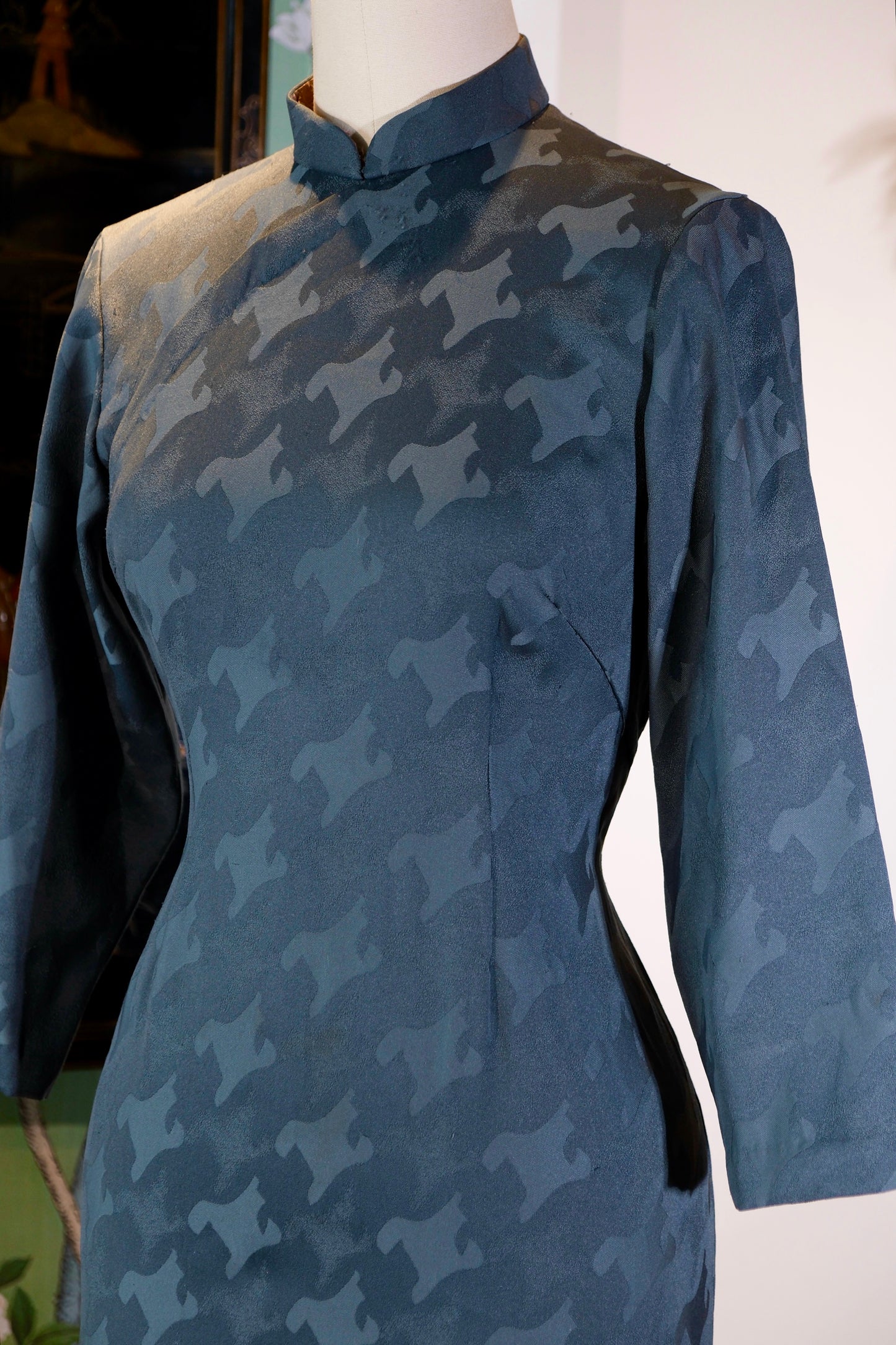
细观衣身,灰蓝色缎面之上,千匹“马”以提花工艺浮沉隐现,如月光下跃动的剪影。这些马纹并非写实骏马,而是经抽象化处理的几何化图腾——马首微昂、四蹄轻扬,以“S”形曲线相连,形成绵延不绝的视觉韵律。
此种纹样暗合《周易·说卦》“乾为马”的意象,马为“健行”之象征,既承袭商周青铜器“马纹”的庄重古意,又融入六十年代现代设计的简约美学。灰蓝底色如深海,马纹似暗涌,行走间光影流转,恰似“马踏飞燕”的灵动被凝固于方寸织物,既含“龙马精神”的传统祈愿,又透出“现代性”的先锋气息。
二、衣脉故事:海峡彼岸的“新中式”觉醒
这件旗袍诞生于1960年代的台湾,正值“中华文艺复兴”思潮涌动之时。彼时,迁台匠人将上海旗袍的修身剪裁与台湾本土织造技艺相融,以提花缎替代传统软缎,既保留“海派旗袍”的曲线美学,又通过“马纹”这一符号,寄托对故土的遥望——马,是“古道西风”的记忆,亦是“驰骋新生”的隐喻。
三、稀缺性:时光淬炼的孤品价值
作为“台湾产古董旗袍”,其稀缺性体现在三重维度:
- 工艺绝响:六十年代台湾提花机尚属稀缺设备,此类“马纹提花缎”需手工调机、逐匹织造,产量极低。今观衣身,提花凸起处仍具立体感,缎面光泽温润如初,足见当年织造之精。
- 时代孤本:1960年代台湾旗袍多受西方影响,此类“传统纹样+现代剪裁”的作品,是“文化坚守”与“时代创新”的罕见结合,存世量不足百件。
- 保存奇迹:历经六十年,衣身无明显褪色、虫蛀,领口、袖口的暗线仍紧密如初,堪称“时光的幸存者”。
四、艺术风格:在“古”与“新”之间
这件旗袍的艺术风格,可概括为“古典意象的现代转译”:
- 纹样:以“马”为核,融青铜纹样的庄重、书法线条的流畅、几何图案的秩序,形成“抽象而不失神韵”的视觉语言。
- 色彩:灰蓝为主色调,如宋代汝窑“天青”般内敛,马纹的浅灰与之形成“同色系渐变”,低调中见层次。
- 形制:在“海派旗袍”基础上,收腰更甚、开衩更高,既保留东方女性的婉约,又暗合六十年代全球“女性解放”的潮流。
《长物志》言:“物之精者,必历岁月。”这件旗袍,是时光写给“美”的情书——它以马纹为笔,以缎面为纸,记录了一个时代的文化坚守与美学突围。今人着之,不仅是穿一件衣服,更是披上一段历史,让六十年前的“马”,在今日的风中,继续奔跑。
Measurements / Size Guide:
Bust / Waist / Hips: 94/84/104 cm
Total Length: 108 cm
Detailed Description:
I. The Emblem on the Garment: When the "Horse" Becomes a Fluid Metaphor Upon close inspection of the garment, a thousand "horses" emerge and vanish within the grayish-blue satin through jacquard craftsmanship, like leaping silhouettes under moonlight. These horse motifs are not realistic depictions but abstract, geometric totems—heads slightly raised, hooves light and airy, connected by "S" curves to form a continuous visual rhythm.
This pattern aligns with the imagery from the I Ching (Shuogua): "Qian is the Horse," a symbol of "vigorous movement." It inherits the solemn antiquity of horse motifs from Shang and Zhou dynasty bronzes while integrating the minimalist aesthetics of 1960s modern design. The grayish-blue base is like the deep sea, with the horse patterns acting as undercurrents. As one moves, light and shadow shift, as if the agility of the "Galloping Horse Treading on a Flying Swallow" has been frozen within this square inch of fabric. it carries both the traditional blessing of the "Dragon-Horse Spirit" and a pioneering aura of "modernity."
II. The Story of the Lineage: The Awakening of "New Chinese Style" Across the Strait This Qipao was born in 1960s Taiwan, during a time when the "Chinese Cultural Renaissance" movement was surging. At that time, migrant artisans blended the slim-fit tailoring of Shanghai Qipaos with local Taiwanese weaving techniques, replacing traditional soft satin with jacquard satin. This preserved the curvilinear aesthetics of the "Haipai Qipao" while using the "horse motif" as a symbol to anchor a distant gaze toward the ancestral homeland—the horse is a memory of "ancient roads and western winds," and a metaphor for "galloping toward a new life."
III. Rarity: The Value of a Unique Piece Tempered by Time As an "Antique Qipao Made in Taiwan," its rarity is manifested in three dimensions:
The Swan Song of Craftsmanship: In 1960s Taiwan, jacquard looms were scarce equipment. This type of "horse-motif jacquard satin" required manual machine tuning and bolt-by-bolt weaving, resulting in extremely low output. Even today, the raised jacquard remains three-dimensional and the satin luster is as warm as ever, attesting to the exquisite weaving of that era.
A Unique Specimen of the Era: While most 1960s Taiwanese Qipaos were influenced by Western trends, works combining "traditional motifs + modern tailoring" are a rare fusion of "cultural persistence" and "epochal innovation," with fewer than a hundred pieces surviving today.
A Miracle of Preservation: After sixty years, the garment shows no significant fading or moth damage. The hidden stitching at the collar and cuffs remains as tight as ever—a true "survivor of time."
IV. Artistic Style: Between the "Ancient" and the "New" The artistic style of this Qipao can be summarized as the "Modern Translation of Classical Imagery":
Motifs: With the "Horse" at its core, it blends the solemnity of bronze patterns, the fluidity of calligraphic lines, and the order of geometric shapes to form a visual language that is "abstract yet full of spirit."
Color: The grayish-blue primary tone is as reserved as the "sky-clear" glaze of Song Dynasty Ru-ware. The light grey of the horse motifs forms a "monochromatic gradient" with the base, showing depth within low-profile elegance.
Form: Building upon the "Haipai Qipao," the waist is cinched further and the side slits are higher, preserving the gentleness of Oriental women while aligning with the global "Women's Liberation" trends of the 1960s.
The Treatise on Superfluous Things states: "The essence of objects must endure through the years." This Qipao is a love letter to "beauty" written by time—using horse motifs as its pen and satin as its paper, it records an era’s cultural persistence and aesthetic breakthrough. To wear it today is not just to put on a garment, but to drape oneself in a segment of history, letting the "horses" of sixty years ago continue to gallop in today's wind.