深圳溯源
无法加载取货服务可用情况
衣服尺寸:
胸围/腰围/臀围/衣长:96/84/106/110 厘米
细节描述:
【器物描述:针尖上的立体花园】
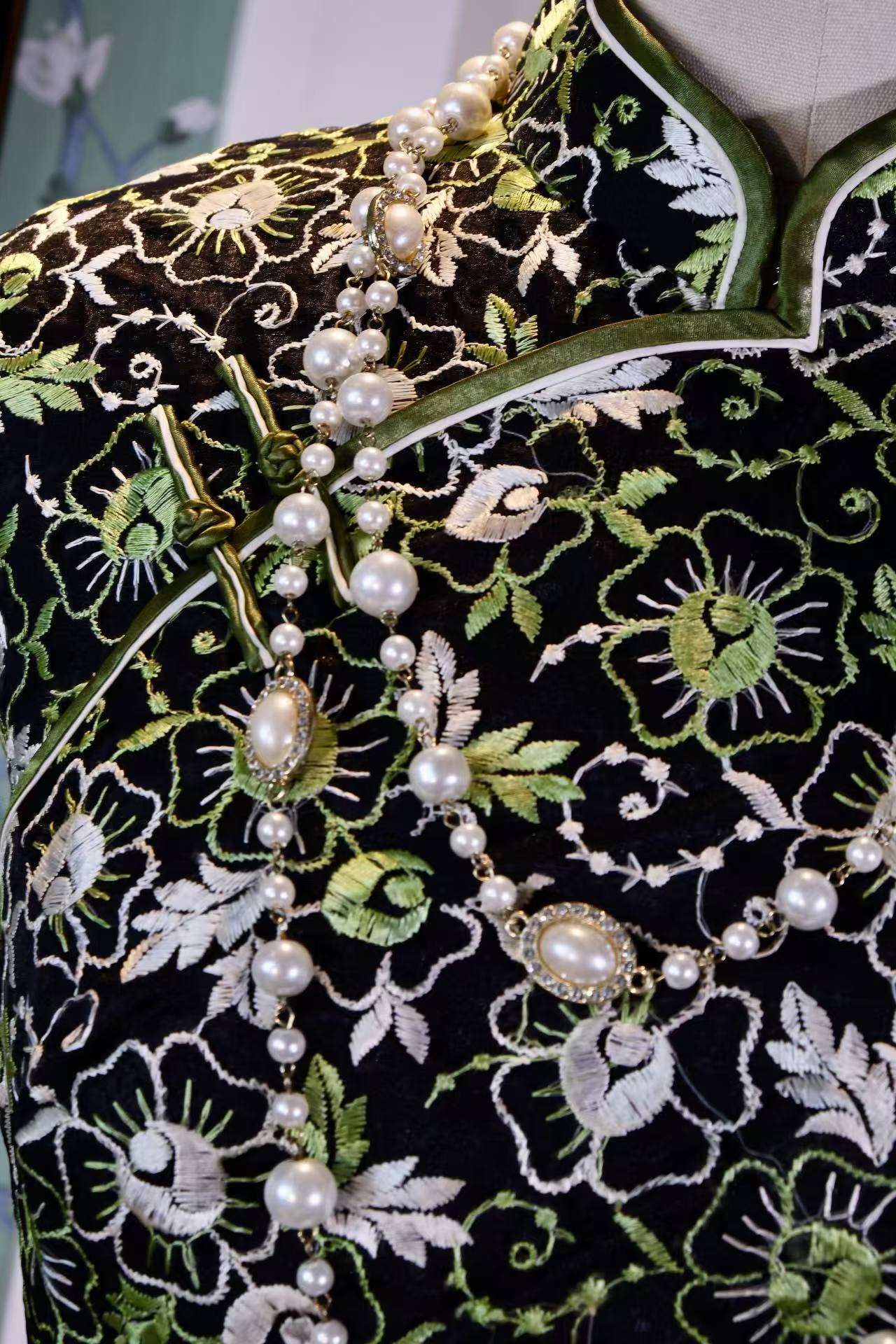
这件旗袍最引人注目的,莫过于其面料上那场盛大的“视觉交响乐”。它并非传统意义上的平面印染,而是采用了上世纪六十年代意大利进口的特种绣花机器织就的满幅刺绣。
- 色彩与质感: 底色是深邃如夜的墨黑,这种黑色具有极强的吸光性,如同宣纸留白前的铺垫,极大地衬托了花纹的亮度。
- 纹样解析: 图案是典型的西式卷草纹(Arabesque)与中式缠枝莲的变体结合。花朵以银白色丝线勾勒轮廓,花蕊处点缀着嫩绿与翠绿,叶片则呈现出一种近乎荧光感的草绿。这种高饱和度的绿色在黑色底布上跳跃,既有波普艺术(Pop Art)前夕的大胆前卫,又保留了古典园林的幽深。
- 工艺细节: 请注意看那些花瓣的边缘,意大利机器的精密之处在于它能模拟手工刺绣的“盘金”效果,线条流畅且带有浮雕般的立体感。领口与袖口的滚边采用了同色系的墨绿缎面,与花纹中的绿叶形成呼应。
【历史溯源:西风东渐下的“黄金时代”】
要读懂这件旗袍,必须回到20世纪60年代的香港。那是张爱玲笔下“乱世中的安稳”已逝,取而代之的是经济腾飞与文化碰撞并存的“摩登时代”。
彼时,香港作为远东的纺织与制衣中心,正处于一个奇妙的十字路口。一方面,来自上海的裁缝大师们带来了最正统的“海派”剪裁技艺——立领的高低、归拔的工艺、腰身的收敛,无不讲究贴合女性身体的自然曲线;另一方面,西方的工业文明正通过贸易涌入。
这件旗袍正是这一历史时刻的结晶。它使用了当时被视为“高科技奢侈品”的意大利进口绣花面料。在那个年代,能穿上这样一件用料考究、融合了欧洲纺织技术与东方审美剪裁的旗袍,不仅是财富的象征,更是身份与品味的极致体现。它见证了香港从转口贸易港向工业化都市转型的辉煌瞬间,是“Made in Hong Kong”黄金时代的实物档案。
【文化互文:衣香鬓影中的文学隐喻】
若要以文学的眼光审视此衣,我不禁想起亦舒在《喜宝》中所写:“我要很多很多的爱。如果没有爱,那么就很多很多的钱。” 60年代的香港女性,正如这件旗袍一样,开始追求一种独立、精致且充满生命力的美。
这满身的繁花,不像清代服饰那般等级森严、寓意沉重(如龙凤呈祥),也不像民国初期那般素雅清淡。它是一种世俗的、热烈的、甚至带有一点点张扬的生命力。这让我联想到李碧华笔下的香港女子,泼辣中带着深情,在这钢筋水泥的森林中,依然要在身上开出一座花园来。
《长恨歌》里王安忆写王琦瑶,“她是上海弄堂里的风流”,而这件旗袍,则是香港半山上的风情。它身上的每一朵刺绣花都像是都市夜归人眼中的霓虹,虽然是人造的(机器绣花),却比自然界的花朵更加永恒。那抹鲜亮的绿,是枯木逢春的渴望,也是在那个快节奏社会中,女性对自我美丽的一种坚持与守望。
【稀缺性与收藏价值】
在古董衣市场上,纯棉麻或普通丝绸的旗袍尚可见到,但像这样保存完好、且明确使用60年代意大利进口机绣面料的港产旗袍,实属凤毛麟角。
1. 面料的不可再生性: 这种特定的意大利老式提花机早已停产,那种特殊的混纺丝线工艺,现代机器难以完美复刻。
2. 工艺的断代: 60年代的香港红帮裁缝或本地名师,如今多已作古或退休,那种纯手工量体裁衣、针对厚重面料进行“归拔”处理(使平面布料产生立体曲面)的技艺,已成绝响。
3. 品相的完美: 刺绣面料极易磨损倒伏,但这件衣服的花纹依然挺括,色泽依然鲜亮,说明原主极为爱惜,存放环境极佳。
这不仅是一件衣服,更是一段被缝合进时光里的历史。它静静地挂在那里,就像一位历经沧桑的老妇人,用她那华丽的沉默,向我们诉说着那个流金岁月的故事。
Measurements / Size Guide:
Bust / Waist / Hips / Total Length: 96/84/106/110 cm
Detailed Description:
The most striking feature of this qipao is undoubtedly the grand "visual symphony" on its fabric. Rather than flat printing or dyeing in the traditional sense, it features an all-over embroidery woven by specialized Italian imported embroidery machinery from the 1960s.
Color and Texture: The base color is a deep midnight black. This black possesses extremely strong light-absorbing properties, acting like the preparation before the leaving of negative space (liubai) on Xuan paper, which immensely highlights the brightness of the patterns.
Pattern Analysis: The motif is a typical combination of Western Arabesque scrollwork and a variation of Chinese interlocking lotus (chanzhilian). The flowers are outlined with silver-white silk threads, the pistils are dotted with light green and emerald green, and the leaves present an almost fluorescent grass green. This high-saturation green leaping against the black ground is both bold and avant-garde, on the cusp of Pop Art, while retaining the profound depth of a classical garden.
Craftsmanship Details: Please look closely at the edges of the petals. The precision of the Italian machinery lies in its ability to simulate the "couching" (panjin) effect of hand embroidery, producing smooth lines and a relief-like three-dimensional texture. The piping along the collar and cuffs uses a matching midnight green satin, echoing the green leaves within the pattern.
To understand this qipao, one must return to Hong Kong in the 1960s. That was an era when the "stability in times of chaos" described by Eileen Chang had vanished, replaced instead by a "modern era" where economic takeoff and cultural collision coexisted.
At that time, as the textile and garment center of the Far East, Hong Kong stood at a wondrous crossroads. On the one hand, master tailors from Shanghai brought the most authentic tailoring techniques—the height of the standing collar, the process of iron-molding (guiba), and the narrowing of the waist were all meticulously calculated to fit the natural curves of the female body. On the other hand, Western industrial civilization was pouring in through trade.
This qipao is precisely the crystallization of this historical moment. It utilized Italian imported embroidered fabric, which was regarded as a "high-tech luxury item" at the time. In that era, being able to wear such a qipao—made of exquisite materials and combining European textile technology with Eastern aesthetic tailoring—was not only a symbol of wealth but also the ultimate manifestation of status and taste. It witnessed the brilliant moment of Hong Kong's transformation from an entrepôt trade port into an industrialized city, serving as a physical archive of the "Made in Hong Kong" golden age.
Examining this garment through a literary lens invokes what Yi Shu wrote in The Story of Xi Bao: "I want a lot of love. If I can't have that, then I want a lot of money." Hong Kong women of the 1960s, just like this qipao, began to pursue a beauty that was independent, exquisite, and full of vitality.
This body full of blooming flowers is not hierarchically rigid or weighted down with heavy symbolism like Qing dynasty attire (such as auspicious dragons and phoenixes), nor is it simple and elegant like that of the early Republican period. It represents a secular, passionate, and even slightly flamboyant vitality. This brings to mind the Hong Kong women in Li Bihua's writings—spicy yet deep with affection—who insist on blooming a garden upon themselves even within this forest of steel and concrete.
In Song of Everlasting Sorrow, Wang Anyi wrote of Wang Qiyao that "she is the romance of the Shanghai alleys," while this qipao is the sophistication of the Hong Kong Mid-Levels. Every embroidered flower on it resembles the neon lights in the eyes of a late-returning city dweller; though artificial (machine-embroidered), they are more eternal than flowers in nature. That touch of bright green is the longing for a withered tree meeting spring, and it is also a woman's persistence and watchfulness over her own beauty in that fast-paced society.
In the vintage clothing market, while qipaos made of pure cotton, linen, or ordinary silk are still to be found, a Hong Kong-manufactured qipao that is so well-preserved and explicitly uses 1960s Italian imported machine-embroidered fabric is truly rare.
Non-renewable Nature of the Fabric: Those specific old-style Italian jacquard machines have long been discontinued, and that special blended silk thread craftsmanship is difficult for modern machines to perfectly replicate.
Generational Discontinuity of the Craft: Most of the Hong Kong tailoring masters or local renowned tailors from the 1960s have now passed away or retired. The skill of pure manual custom-tailoring and performing high-difficulty iron-molding (guiba) treatments on heavy fabrics (to create three-dimensional curved surfaces out of flat cloth) has become a lost art.
Perfection of Condition: Embroidered fabrics are highly susceptible to wear, flattening, or snagging, yet the patterns on this garment remain crisp and the colors remain vibrant, indicating that the original owner cherished it extremely and kept it in an excellent storage environment.
This is not just a piece of clothing, but a segment of history stitched into time. It hangs there quietly, like an old woman who has been through the vicissitudes of life, using her magnificent silence to tell us the story of those golden years.