深圳溯源
无法加载取货服务可用情况
衣服尺寸:
胸围/腰围/臀围:88/74/94 厘米
衣长:120 厘米
细节描述:
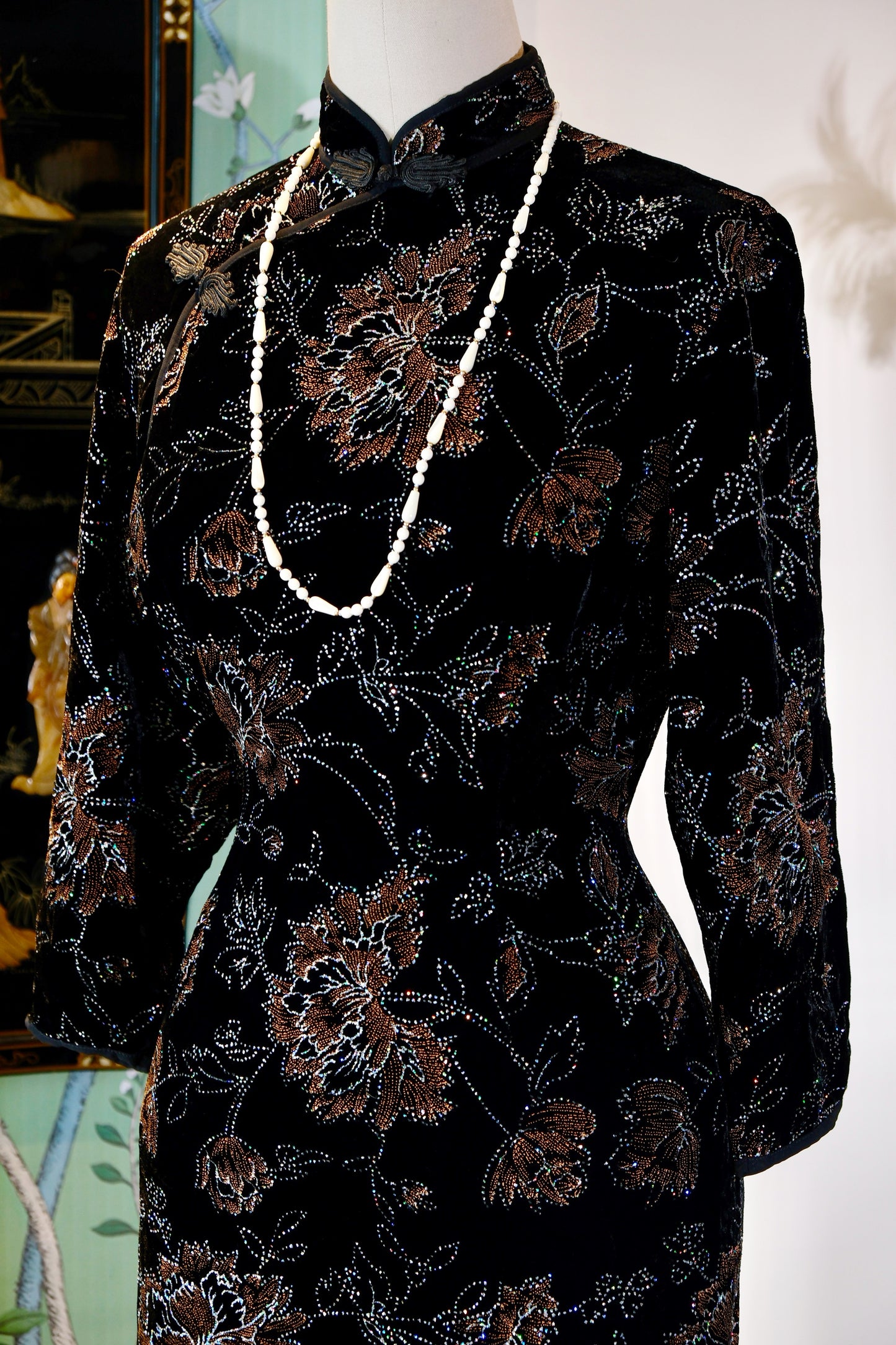
一、图案考据:墨色里的鎏金叙事
这件旗袍以黑色丝绒为底,如深夜般沉静,其上的烫金手绘纹样却似从《诗经》“蒹葭苍苍”的意境中走出——并非直白的写实,而是以抽象化的藤蔓与花卉为笔触,勾勒出“疏影横斜水清浅”的东方美学。烫金工艺并非简单的平面施金,而是通过“点金”“晕金”技法,让金色在丝绒的肌理中若隐若现,如月光洒在墨池,泛起粼粼波光。
细观纹样布局,花卉以“缠枝莲”为原型,却融入了60年代香港流行的现代几何感:藤蔓呈螺旋状向上延伸,花朵以“三叠式”绽放(外层花瓣舒展,中层半合,内层含苞),既保留了传统“缠枝纹”的连绵不绝之意,又暗合了当时香港“中西合璧”的时尚语境——正如张爱玲在《更衣记》中所写:“香港人有一种本领,能把最传统的东西穿出现代感,像把古董花瓶插上塑料花,竟也不觉得突兀。”
二、工艺溯源:指尖上的时光密码
这件旗袍的稀缺性,首先在于其“三重工艺叠加”:丝绒底料、烫金手绘、闪片点缀。丝绒在60年代的香港属于“高级面料”,多用于晚宴装或婚嫁礼服,因其垂坠感强、光泽内敛,能完美贴合旗袍的修身剪裁。而“烫金手绘”更是濒临失传的技艺——需先在丝绒上用特制胶水勾勒图案,再撒上金粉,待干后用软刷扫去浮粉,最后以手绘补色,每一片花瓣的金色浓淡都需手工控制,一件旗袍往往耗时半月。
闪片的运用则体现了60年代香港“夜上海”的遗风。彼时香港夜总会文化兴盛,旗袍作为“战袍”,需在灯光下闪耀,但设计师并未采用大面积亮片,而是将闪片缝于花瓣中心或藤蔓节点,如“星垂平野阔”般克制——这种“低调的华丽”,恰是香港旗袍区别于上海旗袍的标志性风格:上海旗袍重“柔”,香港旗袍重“飒”,前者如林徽因的温婉,后者如林青霞的英气。
三、时代叙事:一件旗袍的“迁徙史”
这件旗袍诞生于1960年代的香港,彼时正是香港旗袍的“黄金十年”。上海裁缝南迁香港,带来了海派旗袍的剪裁精髓,又融入本地实用主义:领口略低(方便活动)、袖长缩短(适应亚热带气候)、腰身收紧(凸显女性曲线)。这件旗袍的立领高度约4厘米,既保留了传统旗袍的端庄,又避免了“束缚感”;袖口呈“喇叭状”微张,暗合60年代全球流行的“嬉皮士”风格,却又以丝绒材质消解了嬉皮的叛逆,多了份东方的含蓄。
它的“故事”或许与一位香港名媛有关:1965年,她穿着这件旗袍参加慈善晚宴,在九龙香格里拉酒店的旋转楼梯上,金色纹样在灯光下流转,成为当晚的焦点;1970年代,她移居海外,将旗袍锁进樟木箱,直到2020年,其后人整理遗物时,才发现这件“时光胶囊”——丝绒依旧柔软,金粉未褪,闪片在暗处仍能折射微光,仿佛能听见半个世纪前的笑语晏晏。
四、艺术风格:传统与现代的“对话”
从艺术风格看,这件旗袍是“新古典主义”与“装饰艺术”的融合。传统元素如立领、盘扣、缠枝纹,是“根”;现代元素如几何化纹样、闪片点缀、修身剪裁,是“翼”。正如艺术史家贡布里希所说:“艺术的进步,不在于抛弃传统,而在于用传统语言表达当代情感。”这件旗袍正是如此:它没有刻意复古,却因工艺的稀缺性和时代的独特性,成为“活的历史”。
其稀缺性更体现在“不可复制性”:60年代的香港旗袍多为“定制款”,裁缝会根据客人的身形、气质、场合设计图案,这件旗袍的纹样独一无二,如同“指纹”般无法复刻。如今,能掌握烫金手绘技艺的老裁缝已不足十人,丝绒面料也因环保工艺限制,难以再生产出当年的质感——这件旗袍,是真正的“孤品”。
五、结语:穿在身上的“文化符号”
这件旗袍,不仅是一件衣服,更是一部“穿在身上的历史”。它见证了香港从渔村到国际都市的蜕变,承载了南迁裁缝的手艺与乡愁,也记录了60年代女性的独立与优雅。当你穿上它,仿佛能听见老香港的电车声、闻到夜总会的香水味、感受到那个时代“一半传统,一半现代”的张力。
正如《红楼梦》中“软烟罗”的珍贵,不在于面料本身,而在于其背后的工艺与故事。这件旗袍亦然:它的价值,在于每一针每一线都缝着时光,每一片金粉都闪着记忆,是真正的“古董级”艺术珍品。
Measurements / Size Guide:
Bust / Waist / Hips: 88/74/94 cm
Total Length: 120 cm
Detailed Description:
[I. Iconographic Analysis: A Gilded Chronicle Traced Across the Midnight Ground] The structural foundation of this Qipao utilizes a deep, enigmatic midnight-black silk velvet, functioning as a quiescent cosmic backdrop. Yet, the gilded hand-painted motifs geometricized across its canvas seem to emerge straight from the poetic melancholia of Jianjia (The Reeds) in the ancestral Classic of Poetry (Shijing). Rejecting literal, superficial representation, the textile leverages abstract vines and stylized flora to compose a visual manifesto echoing the classical ideal: "Sparse shadows slant across clear, shallow waters." The gilding bypasses flat, industrial hot-stamping; instead, it deploys elite artisanal techniques of Dianjin (stippling gilding) and Yunjin (gradient wash gilding). This ensures the gold light behaves dynamically across the physical pile of the velvet—mimicking moonlight fracturing across an ink pool, casting shimmering, horizontal ripples with every movement of the wearer.
An interrogation of the pattern layout reveals that while the blossoms are prototyped from the ancestral Chanzhilier (interlocking lotus motif), they successfully absorb the sharp geometric modernism dominating 1960s Hong Kong. The vines spiral upward in a disciplined, kinetic helix, while the blossoms unfold in a strict "tri-layered architectural sequence": the outermost petals are fully unfurled, the mid-layer is semi-closed, and the innermost core remains a tightly guarded bud. This configuration simultaneously preserves the ancestral concept of continuous generation (Lianmian Bu Jue) while negotiating the hybrid modernism of mid-century Hong Kong. It perfectly mirrors Eileen Chang’s sharp observation in Chronicle of Changing Clothes: "Hong Kong stylists harbor a distinct genius for imparting absolute modernity to the most ancestral forms—it resembles plugging plastic blossoms into an ancient vascular vase, achieving a strange, triumphant harmony."
[II. Technological Provenance: Artisanal Ciphers Sealed Within the Pile] The asset rarity of this Qipao rests primarily upon its "Tri-Layered Craftsmanship Matrix": the premium silk-velvet medium, the master-level gilded hand-painting, and the calculated deployment of micro-sequined punctures. In 1960s Hong Kong, silk velvet occupied the highest tier of haute couture textiles, reserved strictly for high-society galas or matrimonial ceremonies; its heavy architectural drape and introverted luster sculpted a flawless, body-conscious silhouette. Concurrently, the Tangjin Shouhui (gilded hand-painting) represents a vanishing material lineage. An artisan must first trace the iconography onto the velvet using a proprietary adhesive resin, cast premium gold dust across the surface, meticulously brush away the unstable excess once desiccated, and finally execute hand-painted tonal corrections. Controlling the density and graduation of gold on a high-pile textile demands decades of muscle memory; a single commission routinely devoured half a month of intensive manual labor.
The punctuation of sequins registers a profound material echo of the pre-war "Night Shanghai" diaspora. As Hong Kong's nightlife and cabaret culture surged mid-century, the Qipao functioned as an elite sartorial armor that required high performance under artificial club lighting. Crucially, the couturier rejected loud, vulgar over-embellishment, choosing instead to conceal micro-sequins exclusively within the innermost pistils of the blossoms and the nodal junctures of the helix vines. This creates a restrained visual cadence—resembling "stars hanging low across vast, open plains." This exact philosophical calibration of "governing complexity through absolute restraint" defines the ideological boundary between Hong Kong and Shanghai Qipaos: where Shanghai prioritized fluid softness (Rou), Hong Kong demanded a sharp, tailored crispness (Sa). The former evokes the gentle intellectualism of Lin Huiyin; the latter projects the striking, majestic autonomy of Brigitte Lin.
[III. Sociological Archiving: The Material Migration of a Textile Relic] Birth-dated to the 1960s, this garment archives the definitive "Golden Decade" of Hong Kong Qipao history. Following political shifts, a master vanguard of tailors migrated from Shanghai to Hong Kong, transplanting the absolute marrow of Haipai (Shanghainese-style) pattern-making while modifying it to negotiate local utilitarian realism: the mandarin collar was lowered to liberate movement, sleeve lengths were truncated to adjust for sub-tropical microclimates, and the waist cinch was aggressively tightened to sculpt an unapologetic modern silhouette. The collar of this specific specimen measures exactly 4 centimeters—balancing ancestral decorum with physical autonomy. The cuffs flare outward in a subtle bell configuration, nodding directly to the international "Hippie" silhouettes dominating global 1960s counter-culture, yet using the structural gravity of silk velvet to neutralize any rebellious anarchy, grounding the piece in Eastern poise.
The material provenance of this asset likely traces back to a prominent mid-century Hong Kong matriarch. One can visualize her in 1965, ascending the grand staircase of a luxury Kowloon hotel for a philanthropic gala; under the chandeliers, the gilded geometry across her silhouette would have catch the light in rhythmic, golden waves. By the 1970s, during the grand migration waves to Western metropolises, the garment was locked away inside a protective camphor trunk—preserved as a pure "time capsule" until its contemporary rediscovery. The velvet retains its fluid structural suppleness, the gold dust shows zero chemical oxidation, and the hidden sequins continue to catch low light in the dark, archiving the faint echo of laughter from half a century ago.
[IV. Aesthetic Paradigms: The Synthesis of Neo-Classicism and Art Deco] Sartorially, this Qipao represents a virtuoso synthesis of Eastern Neo-Classicism and Western Art Deco design languages. Traditional markers—the standing collar, the hand-fashioned frogs (Pankou), and the interlocking vines—act as the structural root; modern inputs—the geometricized floral layout, sequined punctures, and three-dimensional tailoring—act as the soaring wings. As the legendary art historian Ernst Gombrich brilliantly articulated: "Artistic progression does not reside in the absolute abandonment of tradition, but rather in the deployment of traditional languages to articulate contemporary emotional realities." This Qipao stands as the living embodiment of that truth: it entirely bypasses superficial retro-pastiche, leveraging its technical rarity and epochal specificity to operate as a piece of living material history.
This asset's rarity is further reinforced by its complete structural unrepeatability. The 1960s Hong Kong Qipao ecosystem operated on a strict, bespoke commission-only model; master tailors engineered patterns intuitively to match the specific physical architecture, posture, and social station of a single living body. Consequently, this iconography functions as a textile "fingerprint"—impossible to replicate. Today, active masters possessive of the generational knowledge required to execute gradient gilded hand-painting on velvet number fewer than ten globally. Furthermore, contemporary environmental regulations on textile manufacturing mean that mid-century velvet of this specific weight, density, and tactile depth can no longer be legally reproduced. This garment is, in the most rigorous definition of the term, a non-reproducible archetype.
Epilogue: A Totem of Wearable Cultural Memory Ultimately, this Qipao transcends the utility of apparel to operate as a profound piece of wearable historical documentation. It archives Hong Kong's epic structural metamorphosis from a colonial maritime port into a premier global megalopolis; it holds the displacement, homesickness, and stubborn pride of a migrated artisan vanguard; and it indexes the fierce awakening of modern female autonomy in the 1960s. To encounter this garment is to hear the distant clatter of double-decker trams down old Hong Kong streets, to catch the phantom drift of vintage perfume across mid-century salons, and to feel the magnificent tension of an era suspended perfectly between ancestral lineage and modern daring.
Just as the legendary value of the mythical Ruanyanluo (Gauze of Soft Smoke) in Dream of the Red Chamber rested not upon the base yarn but upon the vanished civilization of its creation, the worth of this Qipao resides in its reality as a repository of time. Every seam holds the breath of history; every micro-grain of gold dust archives a collective memory. It stands as a supreme, museum-grade monument of wearable art.