深圳溯源
无法加载取货服务可用情况
衣服尺寸:
胸围/腰围/臀围/衣长:100/94/110/106 厘米
细节描述:
一、 纹样赏析:繁花似锦的抽象诗意
这件旗袍的面料并非传统意义上的具象印花,而是一场关于“花”的视觉交响。
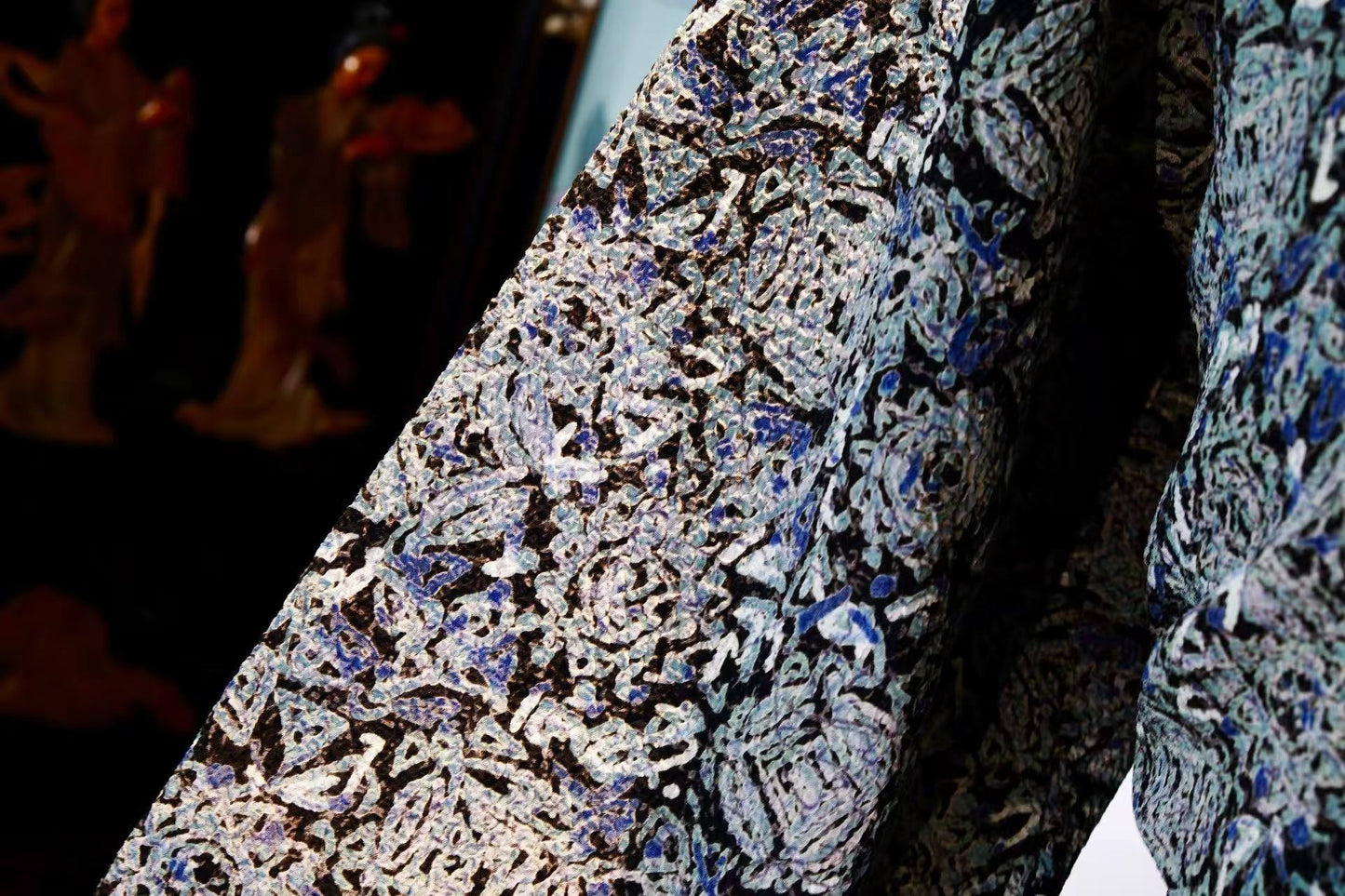
- 图案解构: 乍看之下,它是繁复密集的巴洛克式缠枝纹,但若细读(如最后一张微距图所示),你会发现这是抽象化的玫瑰与牡丹的变体。设计师摒弃了写实的花瓣轮廓,转而用破碎、重组的线条来表现花朵盛开的张力。
- 色彩美学: 底色为深邃的墨黑,其上交织着银灰、靛蓝与隐约的紫调。这种冷色调的运用,极具六十年代现代主义艺术的特征——既保留了东方花卉的富贵意象,又通过类似“点彩派”的笔触,赋予了画面一种迷离的都市感。它像是一幅未干的水墨画被定格在了织物上,远看是斑驳的光影,近看则是盛放的灵魂。
二、 面料考据:来自亚平宁半岛的奢华肌理
此衣最珍贵之处,在于其面料的来源与质感。
- 意大利进口肌理绉: 上世纪五六十年代,香港作为“远东好莱坞”,其顶级裁缝店(如培罗蒙、造寸等)常使用欧洲进口的奢华面料。这款面料具有明显的浮雕感,这是一种高难度的提花或压皱工艺。
- 触感与光影: 这种“肌理绉”不仅仅是视觉上的凹凸,更能在行走间捕捉光线。随着身体的转动,银蓝色的丝线会在黑色底布上流转,产生如同“流动的液体金属”般的视觉效果。这种面料挺括而不失垂坠感,能完美支撑起旗袍的立体剪裁,是当时名媛阶层身份的象征。
三、 历史回响:张爱玲笔下的“世俗传奇”
“衣服是一种言语,随身带着的一种袖珍戏剧。” ——张爱玲《更衣记》
这件旗袍诞生于1960年代的香港,那是一个中西文化剧烈碰撞、摩登与传统并存的黄金时代。
- 剪裁的时代印记: 请注意其领口的高度与袖长的比例。不同于清末的宽大,也不同于三四十年代的极度修身,六十年代的港产旗袍开始追求一种“建筑感”。立领依然挺拔,象征着东方的矜持;但腰身的收省更加利落,甚至带有一点西式连衣裙的结构感,这是为了适应当时女性日益频繁的社交活动与快节奏生活。
- 稀缺性叙事: 在那个年代,拥有一件意大利进口面料的定制旗袍,等同于今日拥有一件高级定制礼服。它见证了那个时代香港女性的觉醒与自信——她们不再仅仅是深闺中的看客,而是穿梭于中环写字楼与夜总会的独立个体。这件衣服,就是那段流金岁月的实物证词。
四、 艺术风格总结:东西方美学的完美联姻
这件作品是“海派文化”在香江的延续与升华。
它将西方的纺织工业奇迹(意大利肌理面料)与东方的服饰哲学(平面裁剪向立体裁剪过渡的旗袍)完美结合。那满身的抽象玫瑰,既是西方浪漫主义的余晖,也是东方“花开富贵”的现代表达。
收藏建议:
这不仅是一件衣物,更是一段被封存的历史。鉴于其面料的特殊工艺(肌理绉极易随时间老化,保存如此完好实属罕见)以及纯正的六十年代港工血统,它具有极高的博物馆级收藏价值。穿上它,你穿的不是衣服,而是六十年来未曾褪色的风华。
Measurements / Size Guide:
Bust / Waist / Hips / Total Length: 100/94/110/106 cm
Detailed Description:
The primary visual weight of this garment relies not on conventional, illustrative surface printing, but on a complex graphic symphony arranged around the conceptual theme of the flower.
Pattern Deconstruction: At a macro-glance, the textile layout mimics the dense, scrolling complexity of Baroque foliated tendrils. However, close iconographic inspection—as demonstrated in the macro-photography—reveals an abstracted variant of intertwined roses and peonies. The designer has radically rejected the literal contours of organic petals, deploying instead fragmented, reconfigured lines to capture the kinetic tension of blossoms at full maturity.
Chromatic Articulation: The field is anchored by a deep ink-black ground, shot through with an interlocking weave of silver-grey, deep indigo, and faint, fugitive violet tones. This cool palette aligns perfectly with mid-century modernist fine art aesthetics. It preserves the traditional Eastern association of dense flora with material prosperity while utilizing a Pointillist-like execution to grant the surface a shifting, cinematic urban quality. It functions like an wet ink-wash canvas permanently arrested on cloth—appearing as mottled light and shadow from a distance, and as a localized display of raw floral form upon close inspection.
The definitive archival value of this specimen is rooted in the geopolitical derivation and material science of its substrate.
Imported Italian Textured Crepe: During the mid-century peak of Hong Kong's cultural expansion, elite custom tailoring salons (such as Baramon and Zaocun) routinely premiumized their offerings by sourcing exceptional European fashion yardage. This particular textile exhibits a pronounced high-relief, sculptural texture, realized through an advanced, labor-intensive jacquard or heat-set mechanical shrinkage (crêpe) process.
Tactile Kinetics and Optical Dynamics: This "textured crepe" transcends superficial visual dimension; it is engineered to dynamically manipulate light during physical locomotion. As the biological form rotates, the silver-blue filaments shift across the matte black ground, creating an optical refraction closely resembling liquid metallic fluid. The fabric provides structural stiffness (tingkuo) while maintaining an elegant fluid drape, perfectly stabilizing the three-dimensional silhouette demanded by upper-class mid-century dress codes.
"Clothing is a language, a pocket theater carried upon the body." — Eileen Chang, Reflections on Clothing (Geng Yi Ji)
Birthed in 1960s Hong Kong, this qipao acts as a material archive of a golden era characterized by intense cross-cultural friction, where urban modernism and deep-seated tradition operated simultaneously.
The Chronological Stamp of the Cut: The structural relationship between the collar elevation and the sleeve configuration is deeply telling. Moving far away from the expansive volume of late Imperial cuts and the hyper-fitted lines of the 1930s, the 1960s Hong Kong qipao aggressively pursued architectural volume. The Mandarin collar remains tall and unyielding, validating traditional Eastern decorum, yet the waist darts are executed with a clean severity that borrows directly from Western mid-century shift dresses. This structural evolution directly accommodated the rapid civic mobilization and professionalized lifestyles of the era's women.
Scarcity Narrative: During this historical window, commissioning a bespoke qipao utilizing imported Italian yardage was economically equivalent to acquiring contemporary Haute Couture. It chronicles the rising confidence and economic agency of mid-century Hong Kong women, who were transitioning from domestic observers into independent actors within the corporate corridors of Central and the cosmopolitan nightlife of elite salons. The garment stands as primary physical evidence of that fluid socio-economic landscape.
This artifact represents the definitive historical continuation and refinement of the Haipai (Shanghai) lineage within the post-war Hong Kong ecosystem. It seamlessly bridges a Western industrial miracle (the Italian textured crepe matrix) with Eastern garment philosophy (the precise transition point where two-dimensional cutting absorbed three-dimensional Western tailoring). Its field of abstract roses functions simultaneously as the twilight reflection of Western Romanticism and the modernized material expression of the classical Chinese ideal of Hua Kai Fu Gui—the blossoming of wealth and status.
This specimen transcends the functional boundaries of apparel to exist as an institutional-grade material document. Given the volatile nature of mid-century textured crepes—which are highly susceptible to structural relaxation, fiber embrittlement, and atmospheric degradation over a sixty-year timeline—the pristine preservation state of this textile is an absolute anomaly. Exhibiting flawless regional Hong Kong assembly alongside European material provenance, this unique specimen possesses exceptional museum-level collection value.