溯源
无法加载取货服务可用情况
衣服尺寸:
胸围/腰围/臀围/衣长:86/66/86/88 厘米
细节描述:
【面料与纹样:无声的诗篇】
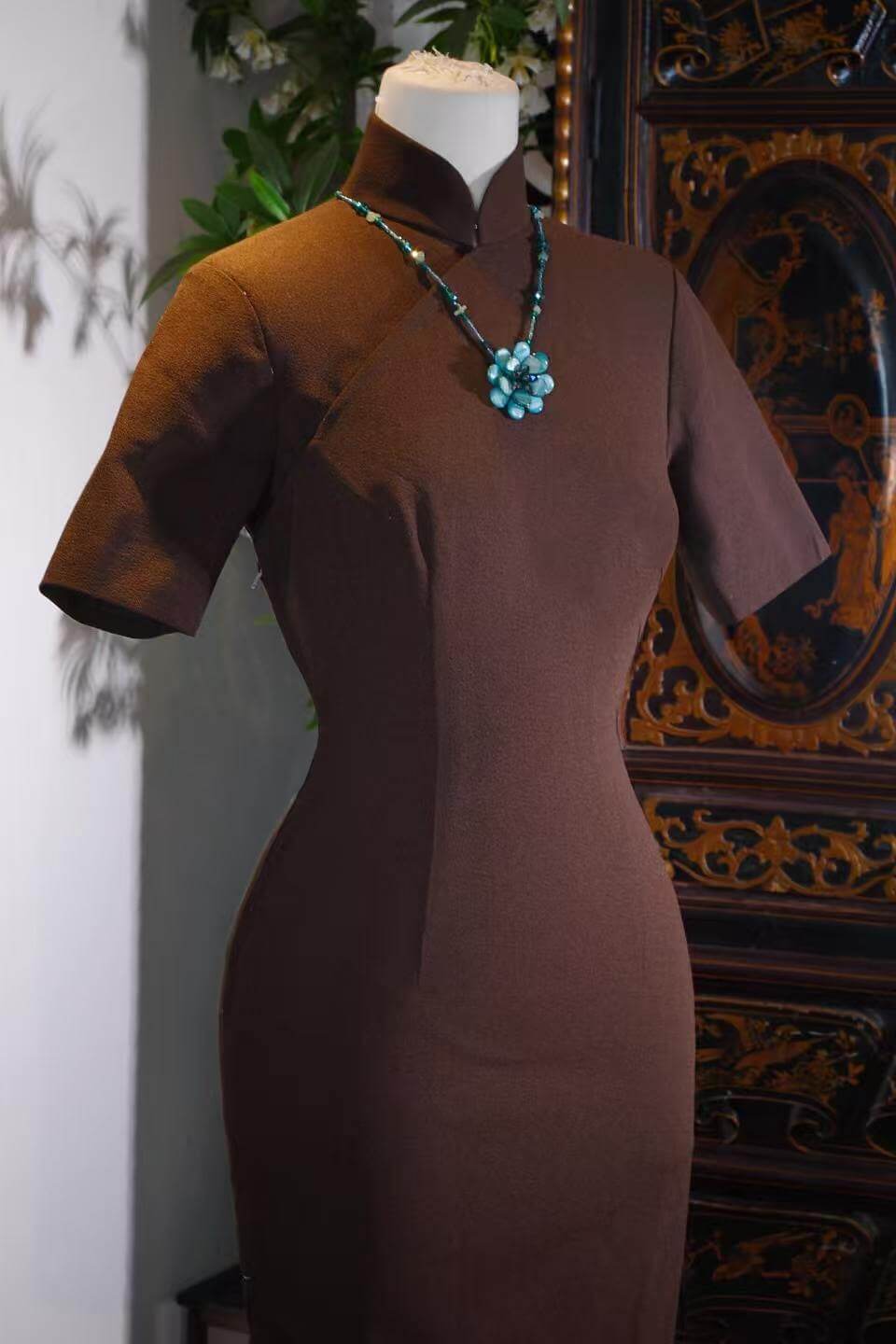
展现在我们面前的,并非仅仅是一件衣裳,而是一段被封存的时光。这件旗袍的面料,源自上世纪五十年代欧洲进口的精纺毛呢(Worsted Wool)。彼时,台湾作为东西方文化交汇的枢纽,汇聚了来自伦敦萨维尔街的顶级呢绒与上海滩精湛的剪裁技艺。
关于图案,这是一首“此时无声胜有声”的极简主义诗篇。不同于清代旗装繁复的镶滚刺绣,亦区别于同时期好莱坞式的艳丽印花,这件旗袍通体呈现出一种深沉而温暖的栗棕色。这种色彩在服装史学中被称为“大地色系”的回归,它摒弃了喧哗,追求的是质感本身的叙事。
若你凑近细看,会发现面料表面有着极为细腻的人字纹肌理。这种纹理如同秋叶的脉络,又似老唱片上的沟槽,在光线的抚摸下,会泛出如丝绸般低调的光泽。它没有具象的花鸟鱼虫,却将“质朴”与“高贵”这两种看似矛盾的特质完美融合。这种“无图案之图案”,正是五十年代现代主义美学在东方式样上的投射——大音希声,大象无形。
【形制与工艺:海派遗韵与台式改良】
从形制上看,这件旗袍是典型的五十年代“海派”风格在台湾的延续与演变。
- 立领: 领口高度适中,既保留了传统中式立领的端庄,又不过分拘束颈部,体现了当时女性追求解放与舒适并存的审美意识。
- 省道: 请注意其胸腰部的立体剪裁。这是西式立体裁剪技术(Draping)引入中式服装的铁证。通过精准的收省,勾勒出女性自然的S型曲线,而非传统平面剪裁下的直筒状。
- 袖型: 短袖设计利落干练,袖口微微外撇,不仅修饰手臂线条,更增添了一份夏末初秋的清爽感。
【历史回响:衣香鬓影后的故事】
张爱玲曾在《更衣记》中写道:“对于不会说话的人,衣服是一种语言,随身带着的是袖珍戏剧。”这件旗袍,便是一出静默的戏剧。
上世纪五十年代的台湾,正处于一种微妙的“过渡期”。大量迁徙至此的大陆移民带来了旧日的繁华记忆与精湛手艺,而欧美文化的涌入又带来了新的生活方式。这件旗袍的主人,或许是一位在台北某所女子中学任教的国文老师,或许是一位在外交场合从容应对的官太太。
她穿着这件欧洲进口呢料制成的旗袍,行走在台北湿润的街道上。栗棕色的沉稳,压住了那个动荡年代的浮躁;挺括的面料,支撑起一个女性在乱世中维持体面的尊严。它见证了从老式留声机到现代收音机的更迭,见证了从煤油灯到白炽灯的转变。它是那个时代“中西合璧”最生动的注脚——既有东方的含蓄内敛,又有西方的理性结构。
【稀缺性与艺术价值:不可复制的孤品】
在服装收藏界,五十年代的毛呢旗袍之所以珍贵,在于其“不可再生性”。
1. 面料的绝版: 当年欧洲进口的精纺毛呢,经过七十年的岁月洗礼,存世量极少。那种特有的厚重感与细腻度,是现代工业化化纤混纺面料无法模仿的。
2. 审美的断层: 如今的旗袍多偏向舞台化或过度性感化,而五十年代的旗袍,讲究的是一种“书卷气”与“日常感”的平衡。这种不张扬的高级感,在当今浮躁的时尚圈已成绝响。
【结语】
这不仅是一件衣服,它是穿在身上的历史,是触摸得到的文学。它静静地立在那里,用栗棕色的沉默,讲述着那个关于优雅、关于融合、关于岁月的永恒故事。拥有它,便是拥有了一段永不褪色的风华。
Measurements / Size Guide:
Bust / Waist / Hips / Total Length: 86/66/86/88 cm
Detailed Description:
[Fabric and Motifs: A Silent Poem]
Displayed before us is far more than a mere piece of clothing; it is a slice of preserved time. The fabric of this cheongsam originates from worsted wool imported from Europe in the 1950s. At that time, Taiwan, as a crossroads of Eastern and Western cultures, brought together top-tier woolens from London's Savile Row and exquisite tailoring craftsmanship from the Shanghai Bund.
Regarding the pattern, this is a minimalist poem where "silence speaks louder than words." Departing from the complex trimmed pipings and embroideries of Qing Dynasty banner gowns, and equally distinct from the flamboyant Hollywood-style prints of the same era, this cheongsam presents a deep yet warm chestnut brown throughout. This shade is known in costume history as a return to the "earth tone" palette—it rejects clamor, pursuing narrative through texture itself.
If you lean in for a closer look, you will discover an extraordinarily delicate herringbone texture across the fabric surface. This texture resembles the veins of autumn leaves, or the grooves on a vintage vinyl record, casting a subtle, understated luster akin to silk under the touch of light. Lacking concrete depictions of flowers, birds, fish, or insects, it nevertheless achieves a flawless fusion of two seemingly contradictory qualities: "simplicity" and "nobility." This "patternless pattern" is the exact projection of 1950s modernist aesthetics onto Eastern silhouettes—where great music is faint in sound, and great form is subtle in shape.
[Silhouette and Craftsmanship: Shanghainese Legacy and Taiwanese Modifications]
Structurally speaking, this cheongsam is a classic continuation and evolution of the 1950s "Shanghai-style" in Taiwan.
Mandarin Collar: Sitting at a moderate height, the collar preserves the dignity of a traditional Chinese standing collar without excessively constricting the neck, embodying the aesthetic awareness of women at that time who pursued liberation alongside comfort.
Darts: Notice the three-dimensional tailoring across the bust and waist. This serves as ironclad proof of Western three-dimensional draping techniques being integrated into traditional Chinese garments. Through precise darting, it contours a woman's natural S-curve rather than the straight, boxy silhouette of traditional flat-pattern cutting.
Sleeve Silhouette: The short-sleeve design appears crisp and capable, with cuffs flaring outward ever so slightly—not only flattering the arm lines, but adding a refreshing touch suited for late summer and early autumn.
[Historical Echoes: Stories Behind Fragrant Attire and Shimmering Hairpins]
Eileen Chang once wrote in A Record of Changing Clothes: "To those who cannot speak, clothes are a language, carrying with them a pocket-sized drama wherever they go." This cheongsam is precisely a silent drama.
Taiwan in the 1950s sat in a delicate "transitional period." A massive wave of mainland immigrants who migrated here brought memories of past prosperity and exquisite handcrafts, while the influx of European and American culture introduced new ways of living. The owner of this cheongsam was perhaps a teacher of Chinese literature at a girls' high school in Taipei, or perhaps a official's wife who navigated diplomatic occasions with composed poise.
Dressed in this cheongsam made of imported European woolen fabric, she walked through the humid streets of Taipei. The composure of the chestnut brown grounded the restlessness of a tumultuous era; the crisp, structured fabric supported a woman's dignity to maintain propriety amid chaotic times. It bore witness to the transition from old-fashioned gramophones to modern radios, and from kerosene lamps to incandescent bulbs. It stands as the most vivid footnote to the era's "East-meets-West" ethos—possessing both Eastern subtlety and restraint alongside Western structural rationality.
[Rarity and Artistic Value: An Irreplaceable One-of-a-Kind Specimen]
In the world of vintage apparel collecting, a 1950s woolen cheongsam is particularly precious due to its "non-renewable nature."
Obsolete Fabric: Imported European worsted wool from those years is extraordinarily rare in surviving quantities after seventy years of history. That unique weight, structure, and fineness cannot be replicated by modern industrial chemical-blend fabrics.
Aesthetic Gap: Modern cheongsams lean heavily toward stage performance or over-the-top sensationalism, whereas 1950s cheongsams prized a balance between "scholarly poise" and "everyday elegance." This unostentatious sense of refinement has become a lost art in today's restless fashion industry.
[Epilogue]
This is not merely a garment; it is history worn on the body and literature you can touch. It stands quietly, using the silence of chestnut brown to tell an eternal story of elegance, fusion, and time. To possess it is to own a timeless piece of grace.