深圳溯源
无法加载取货服务可用情况
衣服尺寸:
胸围/腰围/臀围:96/80/98 厘米
衣长:101 厘米
细节描述:
一、衣上纹章:经纬间的无声诗篇
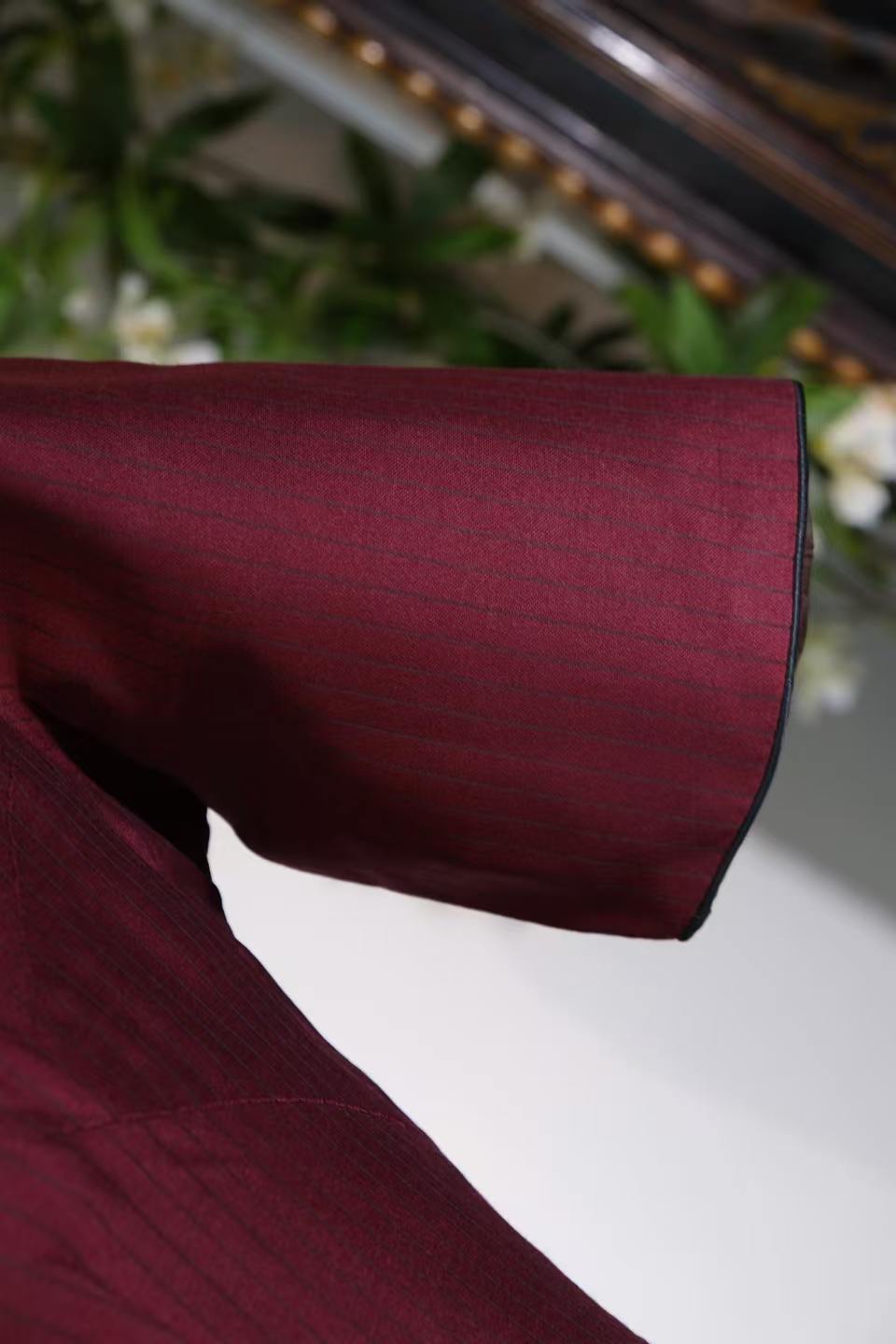
此件旗袍之面料,乃上世纪六十年代远渡重洋而来的意大利进口时装级羊毛。细观其表,并非俗艳的印花堆砌,而是一种极具建筑感的“隐纹竖条”肌理。这种纹理在服装史学中被称为“Shadow Stripe”(阴影条纹),它利用羊毛纤维对光线的漫反射差异,在深勃艮第红(Burgundy)的底色上,织造出若隐若现的纵向线条。
这不仅是视觉上的延伸,更是触觉上的奢华。面料表面呈现出一种类似丝绸的哑光光泽,却又保留了羊毛特有的挺括与温润。这种“似丝非丝,胜似丝”的质感,正是六十年代高级定制面料追求的极致——既要东方的柔媚,又要西方的立体剪裁支撑力。那一道道细密的竖纹,宛如古琴上紧绷的弦,随着穿着者的呼吸与步态,流淌出静穆而高贵的韵律。
二、工艺绝唱:一线定乾坤的“线香绲”
此衣最摄人心魄之处,在于其领口、襟边及袖口处那一抹极细的黑色滚边——这便是濒临失传的“线香绲”工艺。
在《天工开物》中有云:“凡织帛,罗纱用排蠡,绫绢用排梳。”而旗袍之难,在于“绲”。所谓线香绲,即是将布料折叠成极细的圆管状,内嵌铜丝或特制硬衬,使其圆润如线香,挺立而不塌陷。请看图中领口与斜襟的交接处,那条黑色的细边如同书法中的“铁画银钩”,不仅勾勒出女性颈部的修长线条,更以一种近乎冷酷的理性,平衡了红色的热烈。
这种工艺极度考验工匠的手眼配合,稍有不慎便会导致边缘起皱或断裂。在六十年代的香港,能掌握此等技艺的裁缝已是凤毛麟角,它是那个“东方巴黎”黄金时代留给我们的最后背影。
三、古衣叙事:香江夜雨中的摩登回响
这件旗袍,不仅仅是一件衣物,它是1960年代香港的一段切片历史。
彼时的香港,正处于东西方文化剧烈碰撞与融合的熔炉之中。张爱玲曾在《更衣记》中写道:“各人住在各人的衣服里。”而这件衣服的主人,或许是一位穿梭于中环写字楼与半山豪宅之间的职业女性,又或许是一位在邵氏片场等待上妆的银幕明星。
那时的香港裁缝店(Tailor Shop),是世界上最繁忙也最精致的作坊之一。来自意大利比耶拉(Biella)地区的顶级羊毛面料,经由海运抵达维多利亚港,再落入经验丰富的老裁缝手中。他们摒弃了传统满清旗装的宽大平直,大胆引入了西方的省道(Darts)剪裁。你看那腰身收得极紧,胸省与腰省的转移天衣无缝,完美地塑造出符合现代人体工学的S型曲线。这不仅是对身体的解放,更是女性意识觉醒的宣言。
四、学术考证与稀缺性综述
从服装社会学的角度审视,这件藏品具有极高的文献价值:
1. 断代依据:其袖长介于传统的长袖与后来的无袖之间,为典型的六十年代“七分袖”改良款,既保留了端庄,又便于行动,符合当时女性参与社会工作的需求。
2. 材质孤品:六十年代的意大利羊毛混纺技术处于巅峰期,这种特定的酒红色调与竖纹织法,在现代工业流水线中已难以复刻。现代面料往往过于轻薄或化纤感过重,唯有当年的老料,经过半个多世纪的氧化,才沉淀出如此醇厚的色泽。
3. 文化标本:它见证了旗袍从“传统服饰”向“现代时装”转型的关键节点。它不再仅仅是民族的符号,而是成为了世界时尚语境下的一种通用语言。
结语:
这件旗袍,如同一位沉默的贵妇,静静地伫立在时光深处。它身上的每一道褶皱,都藏着香江的旧梦;每一寸针脚,都缝进了匠人的心血。拥有它,不仅是收藏一件华服,更是珍藏了一段不可复制的、关于美与尊严的黄金岁月。
Measurements / Size Guide:
Bust / Waist / Hips: 96/80/98 cm
Total Length: 101 cm
Detailed Description:
The fabric of this qipao is fashioned from premium fashion-grade Italian wool that crossed the ocean during the 1960s. A close inspection reveals that instead of relying on a chaotic overlay of flamboyant prints, it embraces an architectural, subtly textured "hidden vertical stripe" design. Known in fashion history as a Shadow Stripe, this technique utilizes the varying light-reflective properties of wool fibers to weave faint, longitudinal lines across a deep burgundy background.
This texture offers not only visual elongation but also a tactile form of luxury. The surface of the fabric exhibits a matte luster closely resembling silk, yet it firmly retains the characteristic structure and warmth of wool. This exquisite, silk-like quality was the pinnacle of haute couture textiles in the 1960s—demanding both Eastern softness and the structural support needed for Western three-dimensional tailoring. Those dense vertical lines resemble the taut strings of an ancient zither, flowing with a serene and noble rhythm alongside the wearer's breath and stride.
The most arresting feature of this garment is the incredibly fine black piping adorning the collar, structural edges, and cuffs—a manifestation of the near-lost technique known as Xianxiang绲 (Xianxiang piping).
As stated in Tiangong Kaiwu (The Exploitation of the Works of Nature): "In weaving silks, different combs and reeds are used for distinct textures." Yet, the ultimate challenge of a qipao always lies in its piping (gun). The Xianxiang technique requires the tailor to fold fabric into an exceptionally narrow, cylindrical tube, embedding copper wire or a specialized stiff interlining within it so that it remains as perfectly rounded and rigid as an incense stick (xianxiang), never collapsing.
Looking at the intersection of the mandarin collar and the diagonal closure (pajin), that fine black line mirrors the crisp, forceful strokes of master calligraphy. It not only outlines the elegant length of the female neck but balances the fiery passion of the burgundy wool with a cool, near-clinical sense of rationality. This process demands flawless hand-eye coordination from the artisan; the slightest misstep results in puckering or breakage. In 1960s Hong Kong, tailors who mastered this technique were already few and far between, making this detail a beautiful parting glance from the golden age of the "Paris of the East."
This qipao is more than an article of clothing; it is a historical slice of 1960s Hong Kong.
At that time, Hong Kong was a fierce cultural melting pot where East and West collided and integrated. Eileen Chang once noted in A Chronicle of Changing Clothes, "Everyone lives in their own clothes." The original owner of this dress might have been a professional woman navigating the corporate offices of Central and the luxury residences of Mid-Levels, or perhaps a silver-screen starlet awaiting her makeup at the Shaw Brothers studio.
During this era, Hong Kong's tailor shops were among the busiest and most sophisticated ateliers in the world. Top-tier wool textiles from the Biella region of Italy arrived at Victoria Harbour via maritime trade routes before falling into the hands of experienced master tailors. These craftsmen abandoned the loose, flat, and straight lines of traditional Manchu robes, boldly introducing Western darting concepts. The waist of this piece is cinched to the absolute limit, and the transition between the bust and waist darts is seamless, beautifully sculpting an S-curve silhouette that adheres to modern ergonomics. This represents not only a liberation of the physical form but a declaration of awakening female consciousness.
Examining this piece through the lens of fashion sociology reveals its profound documentary value:
Chronological Evidence: The sleeve length sits precisely between a traditional long sleeve and the later sleeveless variants. This constitutes a textbook example of the three-quarter sleeve modified qipao characteristic of the 1960s, which maintained traditional dignity while offering freedom of movement to accommodate women entering the workforce.
A Material One-of-a-Kind: Italian wool-blending technologies reached a pinnacle in the 1960s. This specific shade of burgundy and its delicate shadow-stripe weave are nearly impossible to replicate on modern industrial assembly lines. Contemporary textiles are frequently either too thin or over-reliant on synthetic finishes; only vintage yardage of this caliber, having undergone over half a century of natural oxidation, can settle into such a mellow, rich depth of color.
A Cultural Specimen: It stands as physical evidence of the critical moment when the qipao transitioned from a traditional ethnic garment into a item of modern fashion. It ceased to be merely a national symbol and successfully became a universal language within the global fashion lexicon.
Like a silent noblewoman, this qipao stands quietly in the deep recesses of time. Within its folds lie the old dreams of Hong Kong, and within every inch of its stitching is woven the soul of a master artisan. To possess it is not merely to collect a magnificent garment, but to preserve an irreplicable, golden era of beauty and human dignity.