A Sweep of Spring Mint Green: 1960s Qipao Elegance and Woven Silver Dreams
-
Era Context & Stylistic Positioning: This Qipao dates back to the 1960s. By this period, the Qipao had evolved from the wider cuts of the Republican era through the introduction of Western structural tailoring (such as darts and zippers) in the 1930s and 1940s, and the "hourglass" peak of the 1950s, settling into a cleaner, more streamlined, ready-to-wear-oriented H-line silhouette (H-Line Silhouette) in the 1960s. Rather than obsessively emphasizing an exaggerated cinched waist and full hips, it adopted a poised, intellectual stance that matched the era's rising independent woman stepping into public life. This perfectly mirrors the historical trajectory of mid-century Qipaos toward practical minimalism and East-West synthesis.
-
Fabric & Color: The bodice is crafted from a pale mint-green wool (Wool Fabric). The adoption of wool in Qipao construction represented a major stylistic trend of the period. Compared to delicate, high-maintenance silk, wool offered greater structural crispness and warmth, rendering it versatile for diverse urban settings while imparting a quiet, tactile warmth. Mint green, associated with the element of wood (Wood) in classical elemental color theory, evokes the fresh green shoots of early spring—crisp yet gentle, radiating a soft backbone. As the classical verse observes: "The spring breeze turns the southern bank green once more." This shade operates as a wearable veil of misty southern rain: gentle and fresh, yet touched by an imperceptible, aloof detachment that captures the introverted beauty of Eastern womanhood.
-
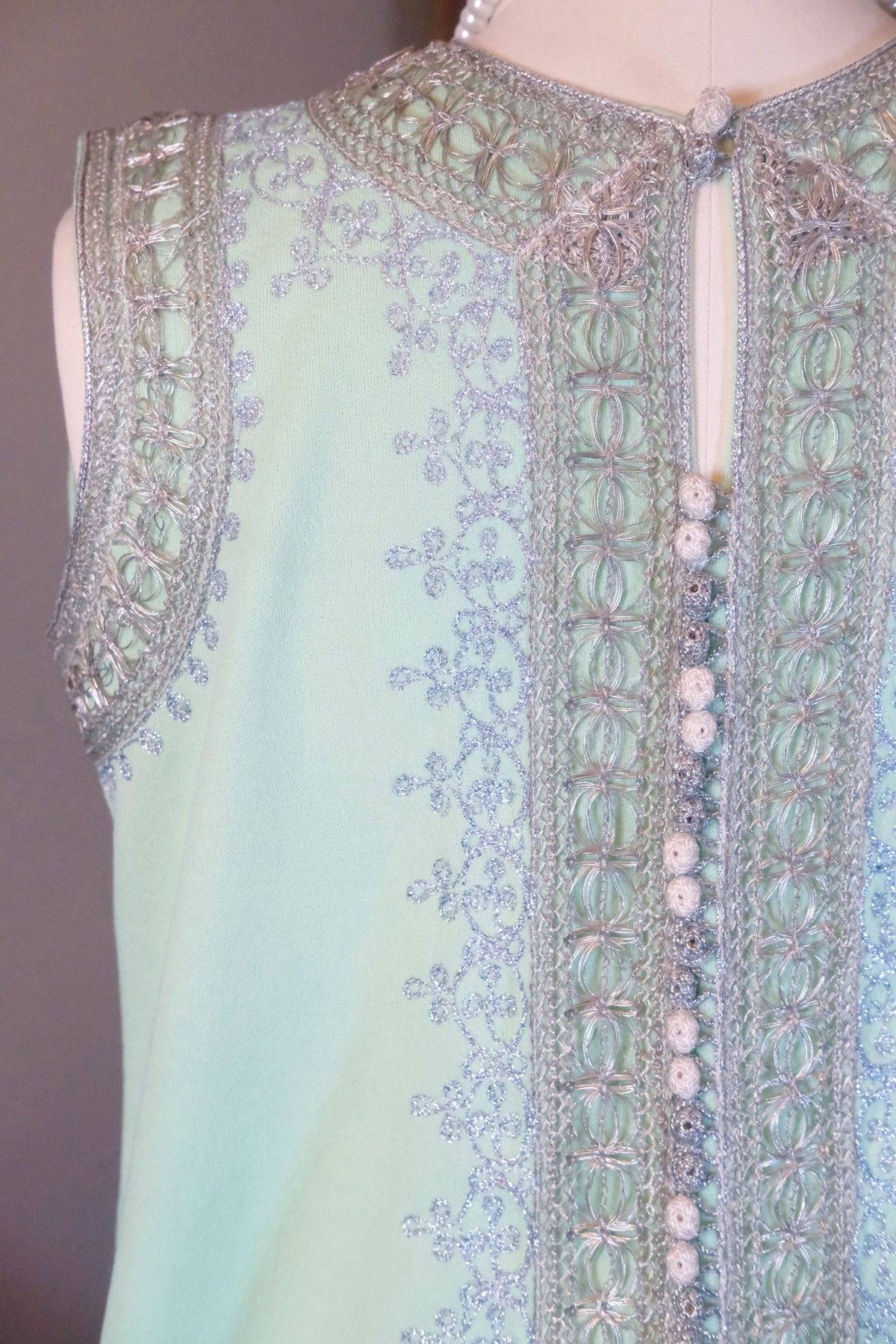
Craftsmanship & Embellishment: The most breathtaking dimension of this Qipao resides in the heavy artisanal embellishments tracing the neckline, shoulders, side slits, and central back axis. Eschewing traditional flat embroidery, it deploys a composite technique marrying woven silver braid (Woven Silver Braid) with glittering metallic silver thread (Silver Lurex).
-
Neckline & Shoulders: Features openwork woven ribboning, echoing a geometricized evolution of traditional Ruyi cloud collars or antique knotting. It balances echoes of classical auspicious motifs with Art Deco (Art Deco) geometric sensibilities, serving as a prime example of East-West aesthetic fusion.
-
Back & Sides: A decorative vertical band running down the center back unites the visual axis with a row of dainty cloth-covered buttons. Functioning like structural pillars in classical architecture, these elements provide functional closure while establishing solemn, symmetrical adornment. Silver-threaded scrolling vines and floral motifs shimmer with subtle, fragmented radiance under the light—resembling distant stars twinkling against a quiet night sky, unassuming yet impossible to ignore. This high-end approach of leveraging tone-on-tone or complementary embellishment atop a solid ground is a hallmark of haute couture (Haute Couture), embodying an understated, luxurious aesthetic of quiet power.
-
Tailoring & Silhouette: The Qipao retains a classic high mandarin collar (Mandarin Collar) and a sleeveless cut (Sleeveless), while integrating slits along the sides and back. In particular, the adoption of a concealed back zipper or center-back closure stands as a defining hallmark of 1960s Western tailoring influence on the Qipao. By breaking away from the structural limitation of side-only entry, this design preserves the complete, unbroken flow of the side seams while enhancing ease of movement for the modern wearer.
Epilogue
Ultimately, this mint-green Qipao stands as a work of art uniting the spirit of its era, superlative craftsmanship, and Eastern aesthetics. It belongs not to any single individual, but to a brilliant epoch. Resting quietly upon its hanger, it grants us a direct glimpse into the poise, refinement, and inner backbone of mid-century women.