深圳溯源
无法加载取货服务可用情况
衣服尺寸:
胸围/腰围/臀围:78/66/84 厘米
衣长:134 厘米
细节描述:
一、 引言:时光的针脚
张爱玲曾言:“对于不会说话的人,衣服是一种语言,随身带着的是袖珍戏剧。”眼前这件粉色旗袍,便是一出无声却华丽的独角戏。它诞生于20世纪60年代的台湾——那个被誉为“旗袍黄金时代”的尾声与转型期。彼时,台北的裁缝店汇聚了来自上海的老师傅与本土的新锐匠人,而面料与辅料的来源则深受国际贸易影响。这件旗袍正是那段特殊历史的见证者,它融合了东洋的精密工艺与中华的传统剪裁,是海派文化与岛屿风情交织的绝唱。
二、 纹样考据:佩斯利的东方转译
观其衣身,最引人注目的莫过于那满铺的佩斯利纹。
这种起源于波斯、盛行于克什米尔的腰果花图案,在西方被称为“Paisley”,而在中国传统纹样中,我们更愿称之为“勾连云纹”或“如意纹”的变体。
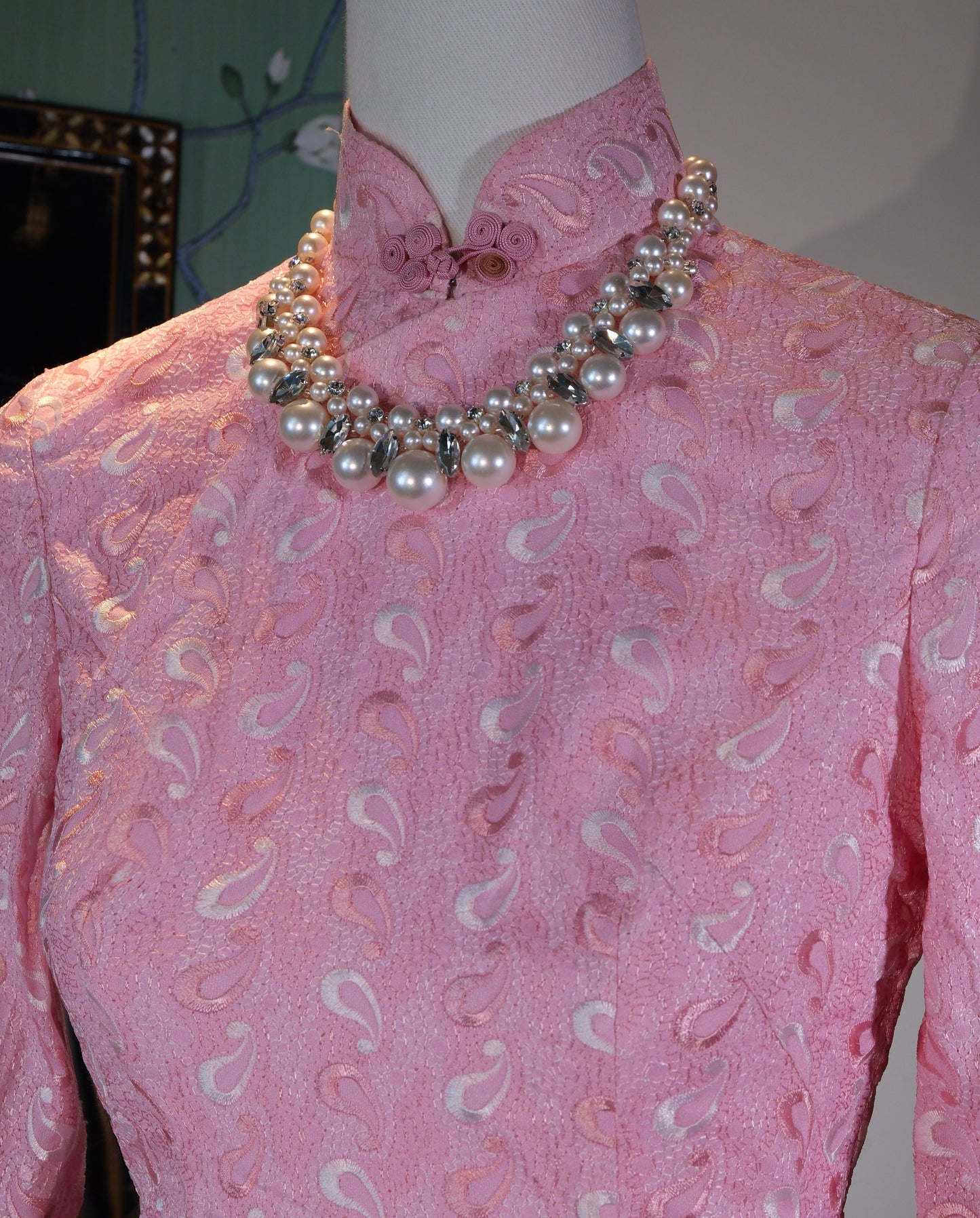
- 图案描述: 这件旗袍上的纹样并非简单的平面印染,而是采用了高难度的提花与刺绣结合工艺。底色为娇嫩欲滴的樱花粉,其上以银白色丝线勾勒出无数旋转、卷曲的泪滴状花纹。这些纹样如同流水般垂直排列,既保留了佩斯利纹原本的繁复与神秘,又通过竖向的线条感,在视觉上极大地拉长了身形,契合了旗袍“修长挺拔”的审美追求。
- 文化隐喻: 《诗经·小雅》有云:“君子万年,介尔景福。”这种连绵不断的卷草纹样,在中国文化中象征着生生不息、富贵延绵。而在60年代的语境下,这种略带异域风情的纹样,恰恰折射出当时台湾社会渴望走向国际、拥抱现代文明的开放心态。它既有东方的含蓄,又有西方的浪漫。
三、 工艺溯源:日本进口机绣的工业美学
此衣最大的技术亮点,在于其标注的“日本进口机器绣花”。
在20世纪60年代,日本的纺织机械制造业正处于世界领先地位(如Brother、Janome等品牌的崛起)。台湾当时的纺织业虽已起步,但高端的精密刺绣仍依赖进口设备。
- 技法分析: 请细看领口与衣身的纹理,这并非手工刺绣的灵动随意,而是机器特有的严谨与秩序。这种“机绣”并非廉价的代名词,相反,它是那个时代“高科技”的象征。它利用精密的电脑模版前身技术,将丝线的张力控制得恰到好处,使得花纹具有浮雕般的立体感(Relief Effect)。
- 稀缺性: 随着70年代成衣工业化浪潮的彻底席卷,这种专门用于高级定制面料的精密老式绣花机逐渐被淘汰。如今,这种带有明显60年代光泽感、且保存如此完好的机绣面料,已是凤毛麟角。它代表了手工向机械过渡时期的最高水准——既有工业的精准,又不失织物的温情。
四、 剪裁与形制:海派余韵的坚守
从形制上看,这件旗袍严格遵循了50年代末至60年代初的经典海派剪裁:
- 立领与盘扣: 领口高耸而贴合,展现了东方女性颈部的优美线条。领口的盘扣制作精细,与衣身纹样浑然一体。
- 归拔工艺: 尽管是机器绣花面料,但裁缝依然运用了传统的“归拔”熨烫工艺,使平面的布料在胸部、腰部和臀部呈现出符合人体工学的立体弧度。这种“S”型的曲线美,正是旗袍区别于其他连衣裙的灵魂所在。
- 色彩心理学: 这种粉色,不是艳俗的桃红,也不是沉闷的暗粉,而是一种带有灰调的“藕荷粉”或“胭脂水粉”。这种颜色在当时极为挑人,只有肤色白皙、气质温婉的女性方能驾驭,它象征着那个年代女性内心深处的柔情与对美好生活的向往。
五、 结语:穿在身上的历史文献
这件旗袍,不仅是一件衣物,更是一份纺织考古的实物样本。它记录了60年代东亚纺织贸易的流向,见证了台湾时装业的辉煌一刻。
当我们抚摸那些微微凸起的佩斯利花纹,仿佛能听到当年缝纫机哒哒作响的声音,看到那位穿着它的女士,或许是在台北圆山大饭店参加晚宴,或许是在某条充满梧桐树的街道上漫步。她留下的不仅是背影,更是一个时代的优雅与从容。
收藏建议: 鉴于其面料的特殊性与年代的久远,此衣具有极高的博物馆级收藏价值。它不仅适合高端复古舞会、艺术展览陈列,更是研究战后东亚服饰变迁不可多得的实物教材。
Measurements / Size Guide:
Bust / Waist / Hips: 78/66/84 cm
Total Length: 134 cm
Detailed Description:
The celebrated author Eileen Chang once immortalized the concept: "To those who cannot speak, clothes are a language; what one carries with them is a pocket drama." The pink qipao before us performs exactly such a silent yet magnificent monologue. It was materialized during the 1960s of the twentieth century in Taiwan—marking both the twilight and the critical transformational inflection node of the qipao's "Golden Age." During this timeline, the tailoring ateliers of Taipei acted as a high-density crucible, gathering veteran master artisans from Shanghai alongside avant-garde native craftsmen, while the supply lines of luxury textiles and notions were profoundly conditioned by global trade routes. This piece stands as a primary physical witness to that unique historic window, seamlessly reconciling Japanese precision engineering with heritage Chinese sartorial cutting—a swan song born from the intersection of Shanghai style (Haipai) and island culture.
Appraising the garment chassis, the most captivating visual attribute is the continuous, all-over deployment of the Paisley motif. This teardrop icon, which originated in ancient Persia and flourished across Kashmir, is known as "Paisley" in Western terminology; however, within the lexicon of traditional Chinese ornamentation, it is more properly decoded as a structural variant of the interlocking cloud motif (Goulian Yunwen) or the scepter-head motif (Ruyiwen).
Pattern Typography: The motifs across this qipao reject basic, flat surface printing, choosing instead to implement an intensely complex synthesis of mechanical jacquard weaving and structural embroidery. Against a delicate cherry-blossom pink grounding chassis, countless rotating, curling teardrop profiles are precisely outlined in silvery-white silk threads. These motifs are organized in a rhythmic, vertical alignment resembling fluid, moving water; while safeguarding the dense complexity and exotic mystery intrinsic to classical Paisley, this vertical linear cadence introduces an optical elongation of the silhouette, perfectly satisfying the traditional qipao aesthetic of a "slender and upright" stature.
Cultural Metaphor: The ancient Classic of Poetry · Minor Odes (Shijing) reads: "May the sovereign live for ten thousand years, safeguarding great and lasting blessings." This uninterrupted, undulating vine layout symbolizes unbroken vitality and perpetual prosperity within Chinese semiotics. In the specific socio-cultural context of the 1960s, the introduction of this slightly exotic pattern accurately mirrors the open, globalized mindset of Taiwanese society as it actively embraced mid-century modernity. It beautifully anchors Eastern understatement and Western romanticism in a single medium.
The supreme technical triumph of this garment resides in its documented pedigree: "Embroidered via Machinery Imported from Japan." During the 1960s, Japan's textile machinery engineering apparatus held an undisputed global leadership position, catalyzed by the meteoric rise of precise mechanical brands like Brother and Janome. While Taiwan's domestic textile industry was entering its formative growth stage, high-tier, precision-engineered embroidery remained heavily dependent on imported Japanese hardware matrices.
Technical Analysis: Close inspection of the collar bindings and surface textures reveals an absolute structural rigor and geometric order native to machinery, distinct from the fluid, organic variation of manual hand-stitching. Within this historical window, "machine embroidery" (Jixiu) was never a pejorative moniker for cheap mass-production; conversely, it operated as the ultimate semiotic marker of period "high technology." Utilizing early precise computerized or mechanical punched-card pattern templates, these machines governed thread tension with absolute uniformity, coaxing the silk fibers into a high-relief, embossed dimensionality (Relief Effect).
Absolute Scarcity: With the sweeping onset of wholesale garment industrialization in the 1970s, these specialized, vintage mechanical embroidery looms dedicated to haute couture fabrics were permanently decommissioned. Encountering a physical specimen today that preserves such a definitive 1960s lustrous sheen in a pristine state of conservation is an extreme rarity—a true phoenix feather. It captures the absolute zenith of the historical transition from manual craft to automation, balancing industrial precision with the innate warmth of textiles.
Structurally, this qipao maintains strict fidelity to the definitive Shanghai cutting metrics of the late 1950s and early 1960s:
The Standing Collar and Pankou: The standing collar rises high and contours flawlessly around the throat, articulating the elegant, elongated anatomical lines of the neck. The hand-wound frog closures (Pankou) at the neckline are meticulously executed, achieving complete stylistic unity with the overarching surface pattern.
The Guiba Engineering: Despite the structural rigidity inherent to machine-embroidered fabric matrices, the tailor aggressively applied traditional Guiba ("shaping through ironing and stretching") iron-work methodologies. This forced the flat, two-dimensional textile plane into an ergonomic, three-dimensional curve across the bust, waist, and hip contours. This resulting "S-curve" profile operates as the very sovereign soul that distinguishes the authentic qipao from standard Western dresses.
Color Psychology: This specific pink palette completely avoids loud, vulgar magentas or heavy, muddy tones, opting instead for a disciplined, desaturated rose-water or cosmetic-powder pink laced with subtle gray undertones. This colorway was exceptionally demanding of its historical wearer, requiring a fair skin tone and a gentle, poised disposition to properly unlock its aesthetic depth. It symbolizes the interiorized tenderness and structural aspiration for refined living held by women of that era.
This qipao transcends its utility as an article of clothing to operate as an indispensable primary physical artifact for textile archaeology. It permanently archives the logistical flows of the post-war East Asian textile trade and stands as a material witness to the crowning moment of Taiwan’s mid-century fashion apparatus.
When handling the raised topography of these Paisley embroideries, one can almost capture the rhythmic, mechanical hum of vintage sewing machines, visualizing the historical lady who once commanded this silhouette—perhaps attending an elite gala at Taipei’s Grand Hotel, or taking a leisurely promenade down an avenue shaded by plane trees. She left behind not merely a striking profile, but the definitive elegance and composure of an entire epoch.
Curatorial Recommendation: Given the profound material specificity of its fabric matrix and its chronological distance, this garment commands an absolute, museum-grade collectible value. It is flawlessly suited for high-tier historical costumed galas, curated fine-art exhibitions, and serves as an irreplaceable primary teaching text for researching the post-war evolution of East Asian apparel culture.