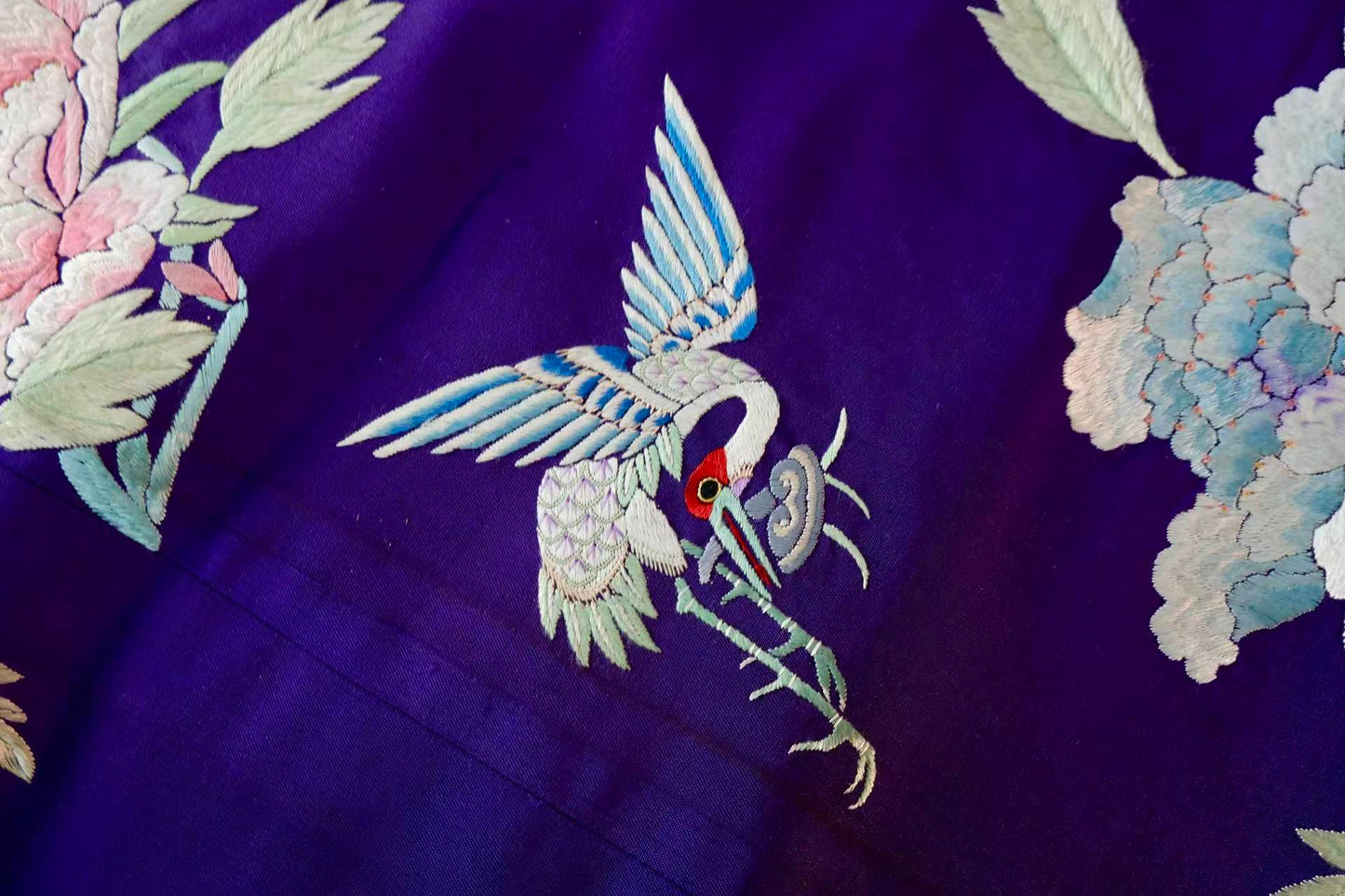
晚清刺绣仙鹤牡丹纹马甲:一种古典美学的延续
这件晚清刺绣仙鹤牡丹纹古董马甲,以深紫缎为底,配宝蓝滚边与湖绿衬里,刺绣工艺精湛,纹样布局疏密有致,是清末民初贵族女性服饰的典型代表。仙鹤展翅衔灵芝,牡丹层叠绽放,寓意“鹤寿延年、富贵荣华”,既显吉祥,亦见身份。其形制为立领右衽,缀盘扣,下摆圆弧,内衬湖绿暗纹绸,工艺考究,是当时上层社会女性日常或节庆所穿的“坎肩”或“背心”,兼具装饰与礼仪功能。
从历史语境看,此马甲的形制与纹样,正与末代皇后婉容、格格韫颖等清室女性在1920年代所穿服饰高度契合。婉容作为末代皇后,其服饰多承袭宫廷规制,但又融入民国新风,这件马甲的“仙鹤牡丹”纹样,正是宫廷“吉服”元素的世俗化表达——仙鹤象征“一品”,牡丹象征“富贵”,合为“一品富贵”,是清代命妇服饰中常见的等级符号。而其湖绿衬里与宝蓝滚边的配色,亦见清宫“石青、湖绿、宝蓝”等传统用色体系的延续。
从艺术风格看,此马甲的刺绣技法细腻,仙鹤羽毛以“套针”“施针”层层晕染,牡丹花瓣则用“滚针”“打籽”勾勒轮廓,叶脉以“缠针”表现筋络,整体立体感强,色彩过渡自然,是苏绣或京绣的典型风格。其纹样布局“疏可走马,密不透风”,仙鹤与牡丹错落分布,既避免呆板,又不失庄重,体现了清末民初“雅俗共赏”的审美趣味——既保留宫廷的华贵,又迎合新兴市民阶层对“吉祥寓意”的追求。
从稀缺性看,此类刺绣马甲存世极少。清末民初正值服饰变革期,传统马甲逐渐被西式外套取代,而能完整保留刺绣纹样、衬里、盘扣等细节的实物,多为宫廷或贵族旧藏。婉容、韫颖等清室女性的服饰,因历史动荡多已散佚,此件马甲若能追溯至清室旧藏或民国贵族家族,其历史价值与艺术价值将更为凸显。
Elegance of the Late Qing: An Embroidered Vest with Crane and Peony Motifs
This antique vest (Majia/Kanjian) from the late Qing to early Republican period features deep purple satin enriched with royal blue piping and a lake-green lining. It stands as a quintessential representative of aristocratic female attire from that era. The pattern—cranes soaring with lingzhi mushrooms in their beaks amidst cascading peonies—symbolizes "Longevity and Prosperity" (Heshou Yannian, Fugui Ronghua), reflecting both auspicious wishes and high social status. Designed with a standing collar, right-side closure (Yoren), and curved hem, it served as a decorative and ceremonial garment for the upper-class elite.
I. Historical Context: Echoes of the Forbidden City
From a historical perspective, the form and motifs of this vest align closely with the attire worn by the Last Empress Wanrong and Princesses like Yunying in the 1920s. As the Last Empress, Wanrong’s wardrobe inherited rigid palace protocols while embracing the burgeoning Republican style. The "Crane and Peony" pattern is a secular expression of palace "Festive Robes" (Jifu) elements—the crane symbolizes the "First Rank" (Yipin), and the peony represents "Wealth" (Fugui), combining into the heraldic symbol of "First-Rank Prosperity." The color palette of lake-green, royal blue, and deep purple continues the traditional aesthetic system of the Qing court.
II. Artistic Style: Mastery of the Needle
The embroidery exhibits exquisite artistry. The crane’s feathers are rendered with "Overlap Stitches" (Taozhen) and "Application Stitches" (Shizhen) for a layered, shaded effect. The peony petals are defined by "Stem Stitches" (Gunzhen) and "Knot Stitches" (Dazi), while the leaf veins are brought to life through "Twining Stitches" (Chanzhen). This creates a strong sense of three-dimensionality and natural color transitions typical of Suzhou or Beijing Embroidery. The layout masterfully balances density and space, embodying the "refined yet popular" aesthetic of the time—retaining regal opulence while appealing to the modern era's desire for symbolic blessings.
III. Rarity and Value: A Living Fragment of History
Such embroidered vests are exceedingly rare. The late Qing and early Republican periods were times of radical fashion transformation, where traditional vests were gradually replaced by Western-style coats. Items that retain their original embroidery, lining, and frog buttons are often from the private collections of the imperial family or high nobility. Given that most garments belonging to figures like Wanrong were lost during historical upheavals, a piece that preserves these details serves as a historical fossil of a vanishing world.