深圳溯源
无法加载取货服务可用情况
一、衣上暗夜:真丝缎的“沉静之光”
这件民国二十年代的真丝缎古董裙,以“暗夜流光”之姿,
领口的银丝蕾丝,以“藤蔓缠枝”的图案覆盖,每一针都需匠人以“
二、裙间繁花:机器刺绣的“暗夜蔷薇”
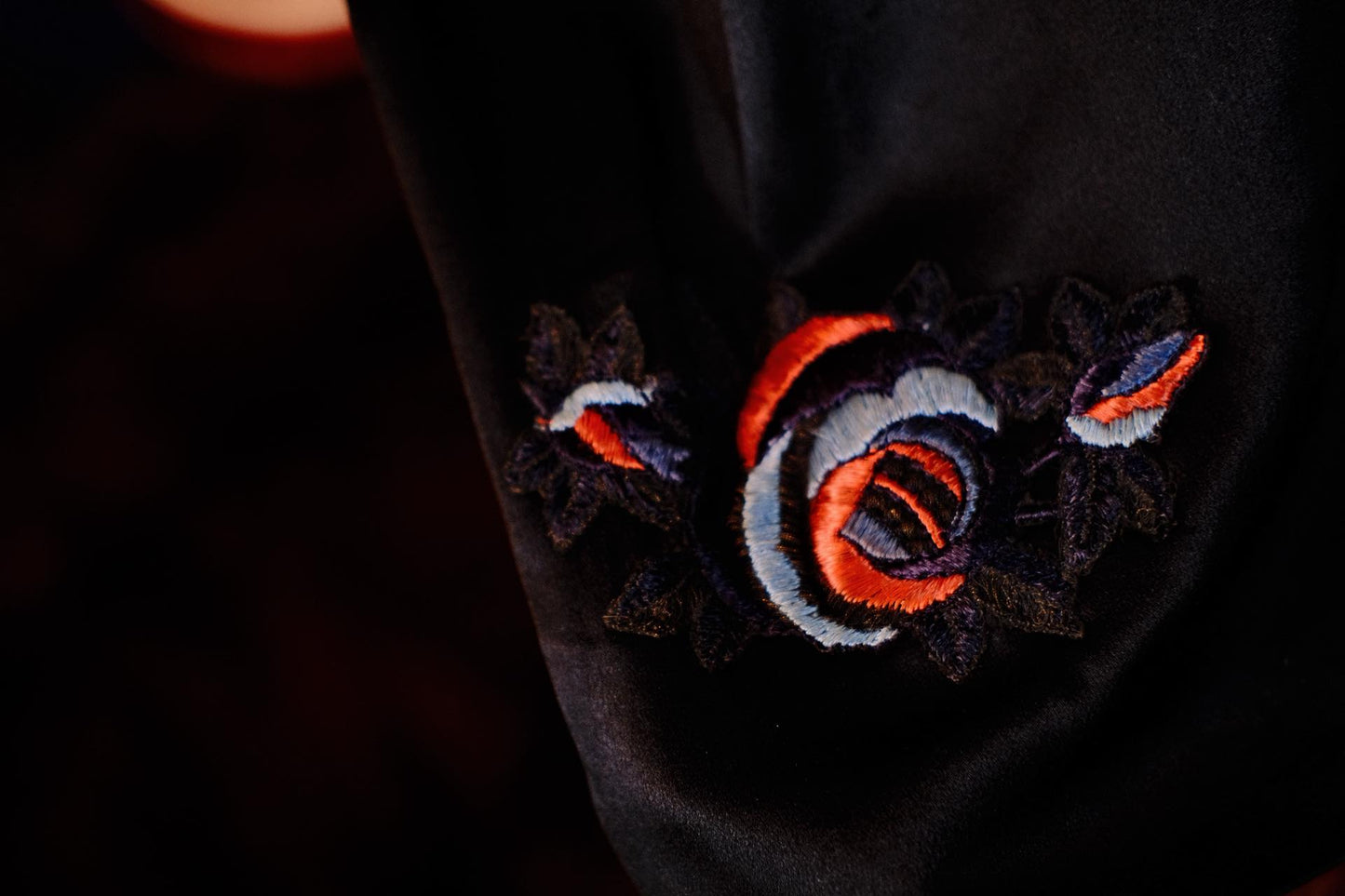
裙摆的机器刺绣蔷薇,以橙、蓝、浅蓝三色丝线绣成,
三、百年旧梦:从温哥华唐人街到蒙特利尔“暗夜舞会”
此裙的主人,正是前文所述加拿大“老钱”家族的闺秀。二十年代,
四、艺术孤品:跨文化的“衣冠孤本”
此裙的珍稀,在于它是“跨文化时尚”的活化石。
五、结语:穿在身上的“暗夜流光”
当指尖拂过裙摆的机器刺绣蔷薇,仿佛能触摸到百年前蒙特利尔的“
This silk satin antique dress from the 1920s and 1930s takes the posture of "shimmering light in the dark night," condensing the warm softness of Eastern silk and the refinement of Western machine embroidery within its warp and weft. The main body of the dress utilizes an ink-black silk satin, with a dim glow of "sunken gold in the dark night" flowing through its threads. Distinct from the bright gloss of ordinary satin, this silk satin must undergo a specialized process of "heavy creping and slow weaving" to weave a texture that is "thick but not stiff, soft but not collapsing." This perfectly aligns with the design philosophy from The Treatise on Superfluous Things (Chang Wu Zhi): "Rather thick than thin; rather deep than superficial."
The silver thread lace at the neckline is covered with a "trailing vine and intertwined branch" motif. Each stitch requires the artisan's immense patience through "thousands of stitches and lines" to flawlessly merge the cold light of the silver thread with the warm softness of the silk, forming a visual tension of "one cold and one warm, one abstract and one concrete." The edge of the lace is finished in a "wavy" contour, subtly channeling the "curvilinear aesthetics" of Art Deco, yet retaining the elegance of traditional lace through "Eastern-style implicitness," precisely as The Book of Songs (Shi Jing) describes: "There is a beautiful lady, graceful and clear-eyed."
The machine-embroidered roses on the skirt hem are crafted with orange, blue, and light blue silk threads. Each single blossom requires the artisan's supreme mastery of splitting silk threads into sixteenths to achieve a delicacy where "petals appear like congealed fat, and leaves resemble jade." The embroidery needlework draws inspiration from the combination of Suzhou embroidery's "satin stitch" and "seed stitch," yet reconstructs the form of traditional roses through "Western-style realism"—the gradient of the petals resembling "morning dew dampening the clothes," and the curling of the leaves evoking "a spring breeze brushing the face," precisely as The Book of Songs (Shi Jing) describes: "The peach tree is young and elegant, brilliant are its flowers."
The owner of this dress was precisely a lady from the aforementioned Canadian "old money" family. In the 1920s and 1930s, she might have stunned the crowd at a "Dark Night Gala" in Montreal, pairing this dress with the previously mentioned pure silver woven dress: the dim luster of the ink-black silk satin making her skin appear as fair as snow, the cold light of the silver thread lace appearing like a "galaxy draping down," and the warm light of the machine-embroidered roses shining like a "beacon in the dark night."
The rarity of this dress lies in its status as a living fossil of "cross-cultural fashion." Fewer than ten machine-embroidered silk satin dresses from the Republic of China era survive worldwide, and the combination of "ink-black silk satin + silver thread lace + machine-embroidered roses" makes this a unique piece among unique pieces. The silk satin required the craftsmanship of the Jiangnan Weaving Bureau "using silk as the bone and ink as the soul"; the silver thread lace required the weaving skills of Western artisans "using silver as ink and the needle as a pen"; and the machine-embroidered roses required the creative inspiration of "cross-cultural romance." The fusion of these three elements achieves a cross-cultural masterpiece where "the garment carries the culture."
When fingertips brush across the machine-embroidered roses of the hem, it feels as though one can touch the "Dark Night Gala" of Montreal from a century ago—reflecting the warm softness of Eastern silk, the refinement of Western lace, and the glory and forbearance of a Canadian "old money" family in a foreign land. This ensemble is the ultimate expression of "diaspora aesthetics": it represents both the "geometric cold glamour" of Western Art Deco and the romance of Eastern "blossoms blooming in the dark night"—and moreover, serves as the silent declaration of a woman a century ago using garments as armor and beauty as a shield in the crevices of cross-cultural collision.