溯源
无法加载取货服务可用情况
衣服尺寸:
胸围/腰围/臀围/衣长:104/94/112/106 厘米
细节描述:
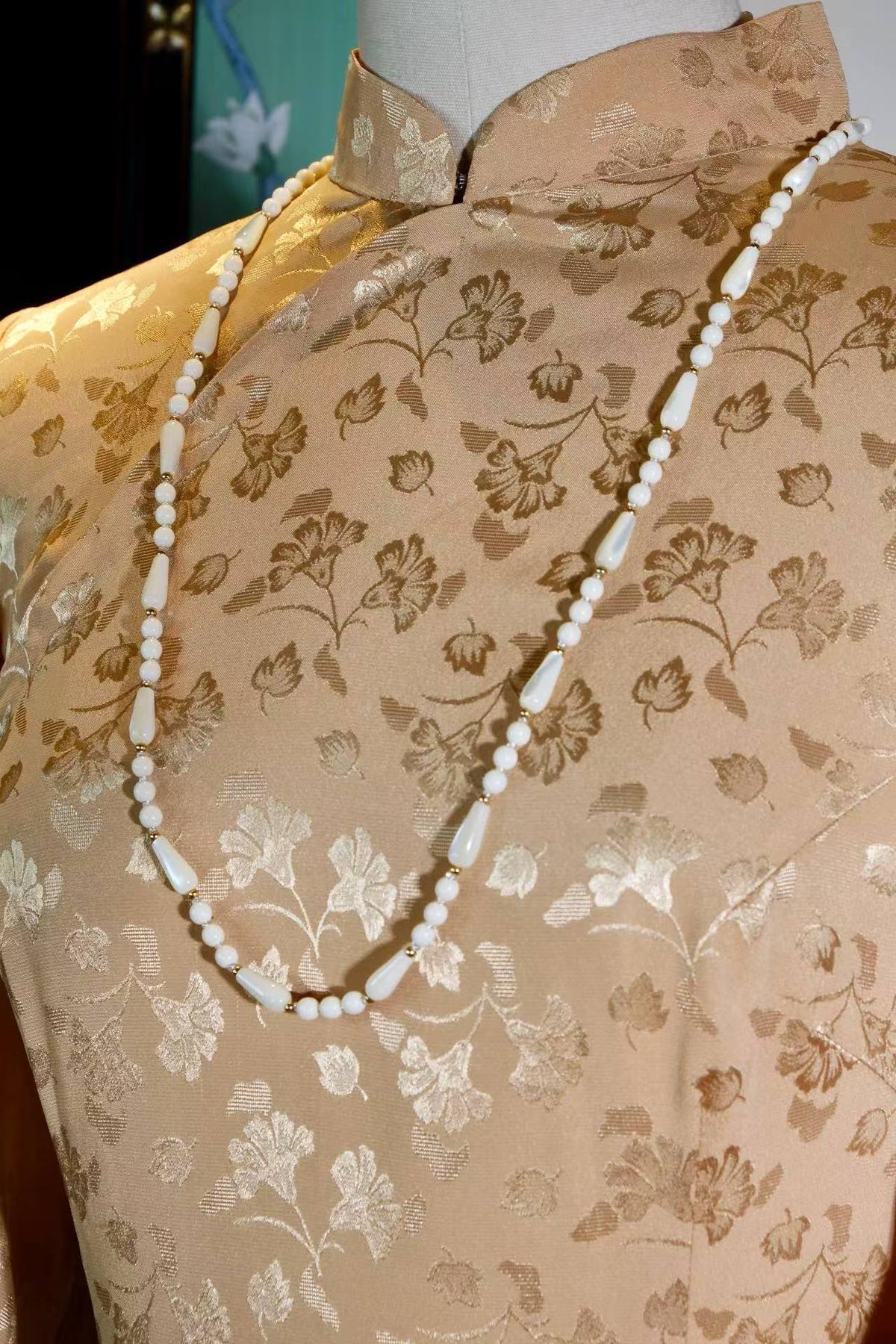
图案描述:暗香浮动的东方写意
这件旗袍最引人驻足的,无疑是其面料的图案工艺。在服装史中,我们称之为“提花”。
* 色彩与光影:面料基底是温润的香槟金(或杏黄色),这种色彩在清代《雍正十二美人图》中常被用于室内陈设,自带一种低调的皇家贵气。其上通过经纬线交织出的暗纹花卉,呈现出银白与深褐交织的色泽。在自然光线下,这些花卉仿佛会呼吸一般,随着衣袂的摆动折射出微妙的光影变化,宛如“暗香浮动”。
* 花型解析:细观其提花图案,这是一种抽象化的缠枝花卉纹。这种纹样自唐宋以来便盛行于织锦,但在这件旗袍上,它被现代工艺简化,去掉了繁复的枝叶,仅保留花头与卷曲的藤蔓,极具二十世纪中叶的现代装饰艺术风格。这种“似有还无”的暗纹设计,完美诠释了中式美学中的含蓄——不招摇,却极尽奢华。
故事与匠心:六十年代的“海派”余韵与“港工”革新
上世纪六十年代,旗袍艺术在香港迎来了最后的黄金时代。上海裁缝南迁,将海派旗袍的立体剪裁与香港本地更趋实用、现代的审美相结合,催生了无数经典。
这件旗袍无疑是那个时代的缩影。想象一下,它的主人或许是香港太平山上一位名门的阔太,又或是中环办公室里一位独立干练的职业女性。她穿着这件旗袍,搭配着那串典雅的玉石项链,在港岛的电车上望着维多利亚港的波光粼粼。
从工艺细节来看,这件作品凝聚了极高的技艺:
1. 改良的袖型设计:它采用了微喇的七分袖。这不同于三四十年代紧贴手臂的紧身袖,六十年代的袖口微微张开,露出了手腕,既保留了端庄,又增添了几分潇洒与透气感,是当时女性走向职场、追求解放的着装体现。
2. 珠玉相映的配饰:模特颈间搭配的长款项链,采用白色玉石与圆珠相间,这在当时极为流行。玉石在中国文化中象征君子之德,它的温润质感恰好中和了提花丝绸的奢华光泽,达到了“雅”的极致。
艺术风格与稀缺性:引经据典的传世之作
这件旗袍的艺术价值,在于它将传统织造工艺与现代剪裁达到了完美的统一。
* “低调的奢华”:《道德经》有云:“大音希声,大象无形”。这件旗袍没有大面积的彩色刺绣,也没有张扬的滚边,而是通过提花织物的纹理来彰显其高贵。这种“藏”的艺术,正是中国文人审美的核心——奢华在骨子里,而非浮于表面。
* 《诗经》的温婉:面料上的缠枝花卉,让人联想到《诗经·唐风·绸缪》中那句“绸缪束薪,三星在天”。这种缠绵不断的花纹,象征着连绵不绝的生命力与美好祝愿。将它穿在身上,不仅是一件华服,更是一份对岁月静好的期许。
* 不可复制的稀缺性:这种六十年代的提花丝绸,随着时代的变迁和纺织工艺的机械化,如今已极为罕见。那时的织造工艺复杂,成本极高。而且,这件古董衣保存品相极佳,面料没有明显的脆化,颜色依然温润如初,这在近七十年的历史长河中,堪称奇迹。
总而言之,这件旗袍是一首凝固的诗。它记录了那个时代女性在传统与现代之间的优雅平衡,是纺织工艺、剪裁技艺与东方美学集大成者的孤品。
Measurements / Size Guide:
Bust / Waist / Hips / Total Length: 104/94/112/106 cm
Detailed Description:
Pattern Description: Oriental Expressionism of Floating Secret Fragrance
The most captivating aspect of this cheongsam is undoubtedly the pattern craft of its fabric. In fashion history, we call this "jacquard."
Color and Light/Shadow: The fabric base is a warm champagne gold (or apricot-yellow)—a color often used for indoor furnishings in the Qing Dynasty's Twelve Beauties of Yongzheng, carrying an innate sense of understated royal nobility. Upon it, dark floral motifs woven through the interplay of warp and weft threads display an interwoven color of silver-white and deep brown. Under natural light, these flowers seem almost to breathe, refracting subtle shifts of light and shadow with every sway of the garment's hem, reminiscent of "floating secret fragrance."
Motif Analysis: Examining the jacquard pattern closely, it reveals an abstracted interlocking floral vine motif (Chanzhi). This pattern has flourished in brocades since the Tang and Song dynasties; however, on this cheongsam, it has been simplified through modern craft. Stripped of dense leaves, it retains only the flower heads and curling vines, thoroughly exemplifying the mid-twentieth-century Modern Art Deco style. This "there yet seemingly absent" dark-woven design flawlessly interprets subtlety in Eastern aesthetics—unostentatious, yet extraordinarily luxurious.
Narrative and Craftsmanship: The Shanghai-Style Reverberations and Hong Kong Tailoring Innovations of the 1960s
During the 1960s, the art of the cheongsam reached its final golden age in Hong Kong. Master Shanghai tailors migrated south, combining the three-dimensional tailoring of Shanghai-style cheongsams with Hong Kong's more pragmatic, modern local aesthetics to give birth to countless classics.
This cheongsam is undoubtedly a microcosm of that era. Imagine its owner: perhaps a wealthy matron of a prominent family on Hong Kong's Victoria Peak, or an independent, capable career woman in a Central office building. Wearing this cheongsam paired with an elegant jade necklace, she looked out at the shimmering waves of Victoria Harbour from a Hong Kong Island tram.
From the perspective of craftsmanship details, this work encapsulates supreme technical mastery:
Modified Sleeve Design: It adopts slightly flared three-quarter sleeves. Distinct from the tight sleeves fitted close to the arms in the 1930s and 40s, the cuffs in the 1960s open slightly to expose the wrists. This preserves dignified elegance while adding a touch of dashing ease and breathability—a sartorial reflection of women entering the workplace and pursuing liberation at that time.
Harmonious Pearl and Jade Accessories: The long necklace styled on the model alternates between white jade and round beads, a look that was immensely popular back then. In Chinese culture, jade symbolizes the virtues of a noble gentleman; its warm, gentle texture perfectly tempers the opulent luster of the jacquard silk, achieving the pinnacle of "refinement."
Artistic Style and Rarity: A Legacy Specimen Drawing from Classics
The artistic value of this cheongsam rests in its seamless integration of traditional weaving craftsmanship and modern tailoring.
"Understated Luxury": The Tao Te Ching states: "Great music has faint sound; great form has no contour." This cheongsam features no large-scale colorful embroidery nor bold piping, choosing instead to showcase its nobility through the texture of the jacquard weave. This art of "concealment" sits at the core of Chinese literary aesthetics—luxury rooted deep in character, rather than floating on the surface.
The Subdued Grace of the Book of Songs: The interlocking floral vines on the fabric evoke the line "Bound tightly is the firewood, three stars shine in the sky" from "Bound Firewood" (Chou Miu) in the Book of Songs: Odes of Tang. Such endlessly swirling floral patterns symbolize unceasing vitality and beautiful blessings. Wearing it upon one's body is not merely wearing a fine gown, but carrying a wish for serene and peaceful years.
Irreplicable Rarity: This type of 1960s jacquard silk has become extremely rare today due to the passage of time and the mechanization of textile crafts. Weaving techniques back then were complex and astronomically expensive. Furthermore, this vintage garment is preserved in superb condition; the fabric exhibits no noticeable brittleness, and the color remains as warm and gentle as ever—a true miracle across nearly seventy years of history.
In summary, this cheongsam is a poem frozen in time. It records the graceful balance achieved by women of that era between tradition and modernity, serving as a unique, masterwork piece integrating textile craft, tailoring mastery, and Eastern aesthetics.