Twilight Garden: The "Lingering Warmth of an Old Dream" in a 1930s French Lace and Silk Spliced Dress
I. Twilight Upon the Garment: The "Dance of the Real and Unreal" Between Lace and Silk
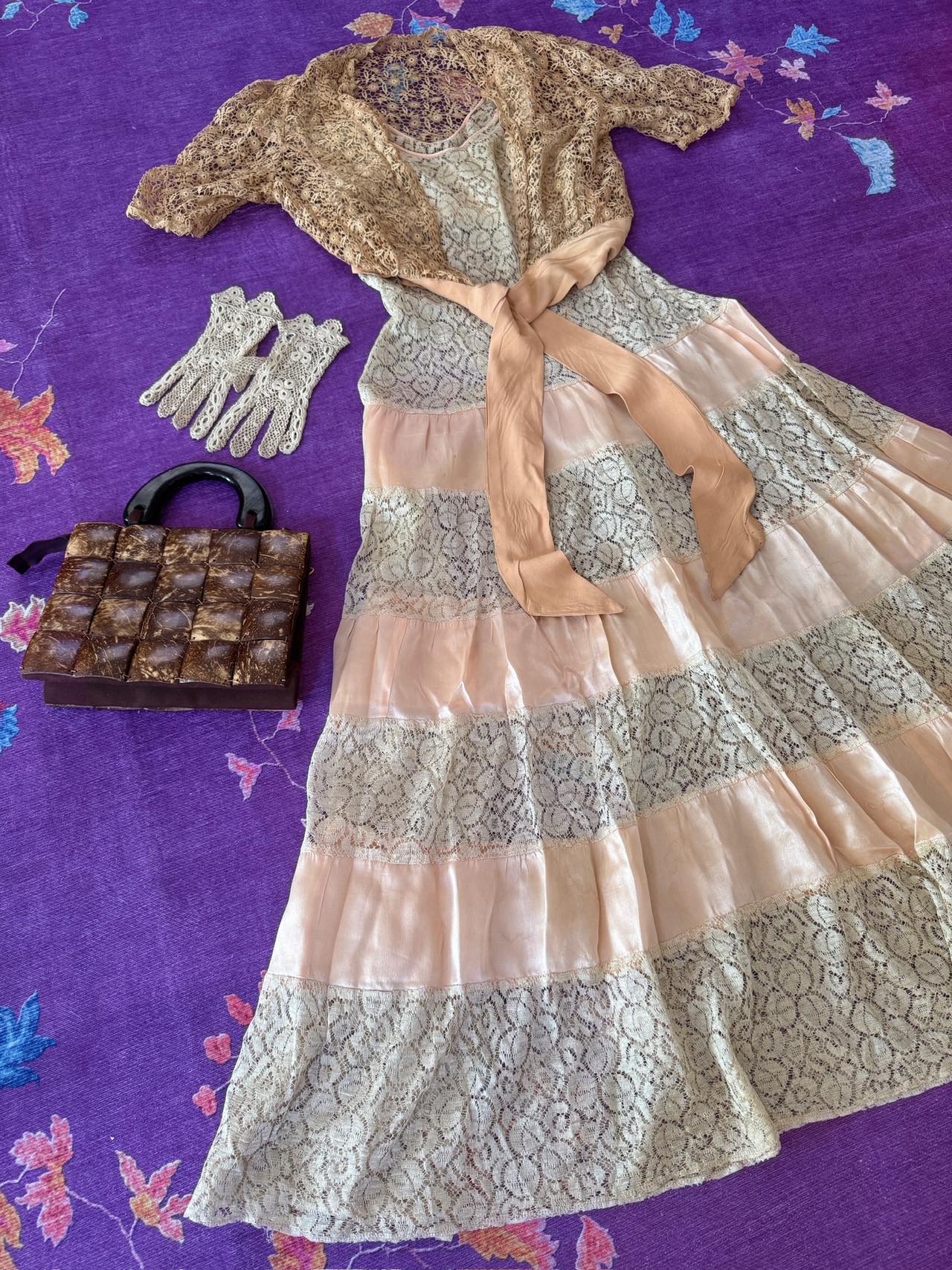
This 1930s antique ensemble takes the posture of a "twilight garden," condensing the refinement of French lace and the warm softness of silk within its warp and weft. The coat utilizes light brown handcrafted French lace, interwoven with a "trailing vine and intertwined branch" motif. Each single stitch requires the artisan's immense patience through "thousands of stitches and lines" to weave a texture that is "revealing but not exposed, concealing but not suffocating." This perfectly aligns with the design philosophy from The Treatise on Superfluous Things (Chang Wu Zhi): "Rather translucent than suffocating; rather concealed than exposed."
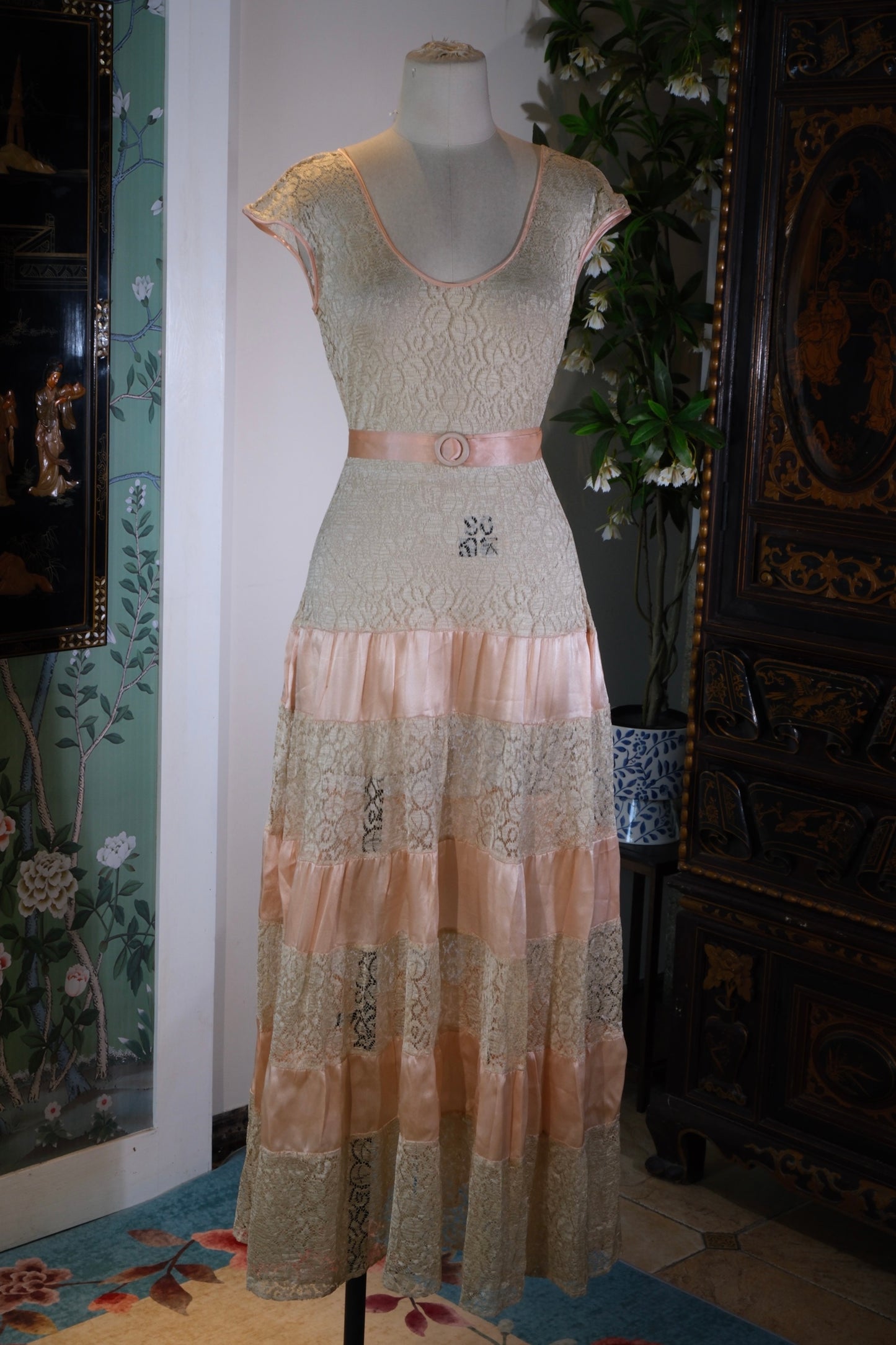
The inner silk dress is pieced together with alternating "pink and white" stripes. Each single panel of silk must undergo a specialized process of "light-creping and slow-weaving" to weave a texture that is "sheer but not exposed, soft but not collapsing." The lace splicing along the hem echoes the lace patterns of the coat, subtly channeling the Eastern poetic ideal of "twin blossoms on a single stalk," yet reconstructs the flat, two-dimensional nature of traditional patchwork through "Western-style three-dimensional tailoring," forming a visual tension of "one soft and one rigid, one Eastern and one Western."
II. The Ribbon Around the Waist: The "Private Romance" of Silk
The light brown silk belt around the waist is the crowning touch of this ensemble. Tied at the waist in the form of a "bow knot," each single pleat requires the artisan's immense patience through "thousands of stitches and lines" to fix it in place, shaping a lifelike, three-dimensional form that subtly echoes a private romance of "flying wing to wing." The edge of the belt is finished in a "wavy" contour, echoing the lace splicing of the hem, yet retaining the elegance of a traditional belt through "Eastern-style implicitness," precisely as The Book of Songs (Shi Jing) describes: "There is a beautiful lady, graceful and clear-eyed."
III. Century-Old Dreams: From Vancouver's Chinatown to Montreal's "Twilight Gala"
The owner of this ensemble was precisely a lady from the aforementioned Canadian "old money" family. In the 1930s, she might have stunned the crowd at a "Twilight Gala" in Montreal wearing this attire: the translucency of the light brown lace making her skin appear as fair as snow, the soft luster of the pink and white silk feeling like "springtime blossoms in full bloom," and the bow knot at her waist evoking a "sprite of the dark night."
IV. Artistic Masterpiece: A Cross-Cultural "Unique Fashion Chronicle"
The rarity of this ensemble lies in its status as a living fossil of "cross-cultural fashion." Fewer than ten French lace and silk spliced dresses from the 1930s survive worldwide, and the combination of "light brown lace + pink and white silk + three-dimensional bow belt" makes this a unique piece among unique pieces. The French lace required the weaving skills of French artisans "using thread as ink and the needle as a pen"; the silk splicing required the craftsmanship of the Jiangnan Weaving Bureau "using silk as the bone and pink as the soul"; and the three-dimensional bow belt required the creative inspiration of "cross-cultural romance." The fusion of these three elements achieves a cross-cultural masterpiece where "the garment carries the culture."
V. Conclusion: "Twilight Garden" Worn on the Body
When fingertips brush across the lace patterns of the coat, it feels as though one can touch the "Twilight Gala" of Montreal from a century ago—reflecting the refinement of French lace, the warm softness of Eastern silk, and the glory and forbearance of a Canadian "old money" family in a foreign land. This ensemble represents "perseverance amidst diaspora" and a "reconciliation between tradition and modernity"; moreover, it stands as a "twilight garden" written with attire by a lady from that turbulent era a century ago.