溯源
无法加载取货服务可用情况
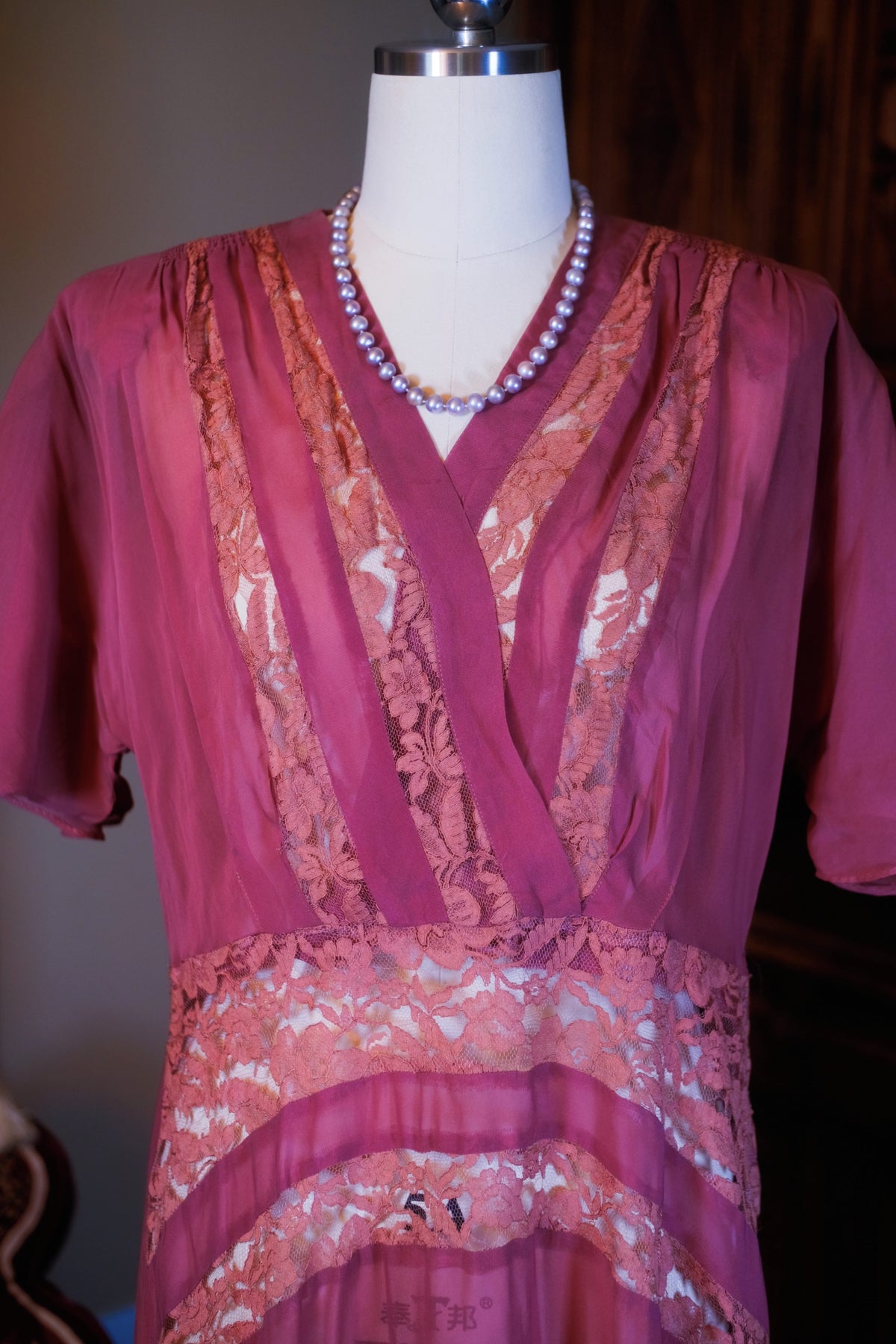
【材质与工艺】:主体为轻盈通透的梅子色真丝薄纱(Silk Chiffon),辅以法国手工蕾丝(French Handmade Lace)拼接镶嵌,辅以细腻的真丝斜纹缎面作为V领与腰线处的结构过渡。
一、 历史语境:风雨欲来前的绝代风华
在服装史的宏观视野中,20世纪30年代末是一个极具张力的时期。彼时的东方,正值民国晚期与孤岛时期的交汇,西方时尚与中国传统服饰正处于深度融合的“黄金时代”。
这件连衣裙,便是那个特殊时空下的缩影。它脱胎于西方20世纪30年代由玛德琳·维奥内(Madeleine Vionnet)等人引领的“斜裁”与“流动性”审美风潮,却又深深烙下了东方海派名媛追求“西体中用”的审美趣味。在1937年至1939年间,由于时局动荡,面料与高级蕾丝成为极度稀缺的资源,能拥有这样一件用料考究、工艺繁复的裙装,其主人绝非寻常之辈,定是当时身处风云变幻中心的大家闺秀或社交名媛。
二、 色彩美学:梅子色的诗意与隐喻
此裙的色彩,并非俗艳的粉紫,而是一抹极为高级且沉静的“梅子色”(Plum/Prune)。
在色彩心理学与中国传统色卡中,梅子色介于深紫与暗红之间,它褪去了少女的甜腻,沉淀出成熟女性的从容与神秘。李清照词云:“红藕香残玉簟秋,轻解罗裳,独上兰舟”,这种颜色恰如秋日将尽、初冬将至的晚霞,带着一种凄美、孤高与坚韧的隐喻。在战火纷飞的30年代末,这抹梅子色既是对动荡时局的一种静默抵抗,也是女性内在温婉力量的视觉化表达。
三、 工艺考究:法式蕾丝与东方剪裁的对话
1. 法式手工蕾丝(French Handmade Lace):
在20世纪30年代,随着西风东渐,蕾丝(当时称为“花边”)在中国掀起了一场席卷上流社会的“花边运动”(Lace Movement)。但这件裙装上的蕾丝,与当时大量普及的机器蕾丝截然不同。其花卉纹样繁复,针法细腻,网地轻盈,边缘呈现出不规则的自然起伏,明显采用了昂贵的法式尚蒂伊蕾丝(Chantilly Lace)或阿朗松蕾丝(Alençon Lace)工艺。这种全手工的技艺在战时已近绝响,每一片蕾丝都是时光的绝唱。
2. 拼接与结构:
整件连衣裙采用了极其高超的“多层拼接”工艺。
* 胸前的交叠V领设计:借鉴了30年代好莱坞女星如玛琳·黛德丽(Marlene Dietrich)穿着的流线型晚礼服剪裁,既保留了西式服装对女性颈部线条的展示,又隐约透出中式服饰的含蓄。
* 腰腹部的波浪纹样拼接:这是此裙最绝妙的设计。设计师利用梅子色薄纱与法式蕾丝的明暗、虚实对比,在腰腹部拼接出三道波浪形的弧形纹样。这不仅打破了平面的单调,更利用视错觉完美地勾勒出女性的S型曼妙曲线,同时巧妙地修饰了体型,展现了极高明的立体裁剪(3D Draping)功力。
3. 薄纱的朦胧质感:
裙身主体采用极轻的薄纱,具有极高的透光性。30年代末的时尚界流行“朦胧美”,要求面料能随着穿着者的呼吸和步伐轻盈摆动。这种薄纱在灯光下会折射出如月光般的柔和光泽,与蕾丝的哑光质感形成绝佳的对比。
四、 穿搭情境:岁月静好的绝版记忆
想象一下,在1938年的上海霞飞路某座幽深的法租界小洋楼里,一位风华绝代的佳人,在去参加私人沙龙前,缓缓穿上这件连衣裙。
她不需要繁琐的衬裙,因为裙身的薄纱已足够轻盈。颈间佩戴的或许是温润的珍珠项链,手中拿的是一柄象牙扇或是一朵新鲜的白玉兰。当她在留声机《夜来香》的旋律中翩然起舞时,裙摆上的波浪纹样仿佛也随之流动,梅子色在摇曳的灯光下泛着岁月的光泽。
这件连衣裙,不只是一块布料,它是一段凝固的历史,是那个时代女性在最艰难的岁月里,依然坚持优雅、追求美、不屈服于命运的生命宣言。
【档案注记】
此件文物完好度极高,梅子色薄纱未出现严重的抽丝或褪色,法式手工蕾丝保存完整,是研究20世纪30年代末中外服饰文化交流与高级定制工艺不可多得的珍贵实物标本。
The foundation of the garment is crafted from a light and translucent plum-colored silk chiffon (Silk Chiffon), masterfully pieced and inlaid with French handmade lace (French Handmade Lace), and accentuated by delicate silk twill satin (Silk Twill Satin) structural transitions along the V-neckline and waist.
Within the grand panorama of fashion history, the late 1930s represents an epoch charged with intense structural tension. In the East, this era intersected the late Republican period and the wartime "Isolated Island" phase of Shanghai, forming a golden age of deep synthesis between Western fashion and traditional Chinese attire.
This dress stands as a micro-cosm of that exceptional space-time. Descending from the "bias-cut" and "fluidity" aesthetics pioneered by Madeleine Vionnet (Madeleine Vionnet) and others in the West during the 1930s, it simultaneously carries the indelible aesthetic imprint of Chinese Shanghainese socialites pursuing the philosophy of "Western body, Chinese soul." Spanning the years 1937 to 1939, when escalating geopolitical turbulence rendered fine fabrics and high-grade lace exceptionally scarce commodities, the owner of such a meticulously engineered and intricately crafted gown could not have been ordinary—assuredly a daughter of a prominent family or a celebrated socialite at the epicenter of a changing world.
The coloration of this dress avoids the common vulgarity of bright pink-purples, settling instead upon an elevated, tranquil "plum" (Plum/Prune).
Within color psychology and traditional Chinese palettes, plum resides between deep purple and dark crimson, stripping away girlish sweetness to precipitate the composure and mystery of mature womanhood. As Li Qingzhao’s classical lyric verse recounts: "Red lotus blossoms fade, the jade mat grows autumn-cool; lightly untying my silk gauze robe, I board the orchid boat alone." This hue mirrors the dusk of a late autumn sky merging into early winter—carrying an undertone of poignant beauty, lofty isolation, and resilience. Amidst the war-torn twilight of the late 1930s, this plum shade functioned simultaneously as a silent resistance against a volatile era and as a visual articulation of an inner feminine fortitude.
French Handmade Lace: As Western influences swept eastward during the 1930s, lace sparked a sweeping "Lace Movement" (Lace Movement) among upper-class society. Yet the lace gracing this gown diverges starkly from the mass-produced machine lace of its day. Featuring complex floral motifs, refined needlework, a lightweight mesh ground, and irregular, organic scalloped edges, it clearly utilizes the costly techniques of French Chantilly lace (Chantilly Lace) or Alençon lace (Alençon Lace). Such entirely hand-executed craftsmanship was already nearing obsolescence amidst wartime disruptions, rendering every panel of lace an isolated echo of a bygone era.
Piecing and Structural Architecture: The dress executes a superlative "multi-tiered piecing" (Multi-Layered Piecing) technique.
The Crossover V-Neckline: Drawing inspiration from the streamlined evening gowns worn by 1930s Hollywood icons such as Marlene Dietrich (Marlene Dietrich), it preserves the Western silhouette's exposure of the neck and collarbone while retaining an undercurrent of Eastern restraint.
The Wavy Abdominal Panel: Perhaps the most ingenious design element of the gown, the designer deploys the light-dark, positive-negative interplay between plum chiffon and French lace to construct three undulating, curved wave motifs across the waist and abdomen. This not only shatters flat monotony, but harnesses optical illusion to sculpt an exquisite S-curve female silhouette while subtly flattering the form through advanced three-dimensional draping (3D Draping).
The Ethereal Texture of Chiffon: The main body utilizes an ultra-light chiffon possessing exceptional translucency. Late-1930s fashion championed a "misty aesthetic" (Misty Aesthetic), demanding that textiles ripple lightly in tandem with the wearer's breath and stride. Under illumination, this chiffon refracts a soft, moonlight-like radiance, establishing a magnificent textural contrast against the matte finish of the lace.
Picture a legendary beauty within a secluded French Concession garden villa along Avenue Joffre in Shanghai, circa 1938. As she prepares to attend a private salon, she slowly slips into this dress.
She requires no cumbersome petticoat, for the chiffon body is already featherlight. Adorning her neck might be a lustrous strand of pearls, while her hand clasps an ivory folding fan or a fresh magnolia blossom. When she waltzes gracefully across the floor to the strains of Night Jasmine playing on a vintage gramophone, the wave motifs along her hem seem to flow in rhythm, casting a mellow, time-honored luster across the plum silk within the shifting candlelight.
This dress transcends mere cloth; it is solidified history, a manifesto of a generation of women who—even in the bleakest of times—unwaveringly upheld their elegance, pursued beauty, and refused to bow to fate.
This artifact exhibits an exceptionally high degree of preservation: the plum chiffon shows no severe thread pulls or fading, and the French handmade lace remains intact, rendering it a precious and irreplaceable physical specimen for researching Sino-Western sartorial exchange and haute couture craftsmanship of the late 1930s.