深圳溯源
无法加载取货服务可用情况
纹样与色彩:樱花粉下的金属幻梦
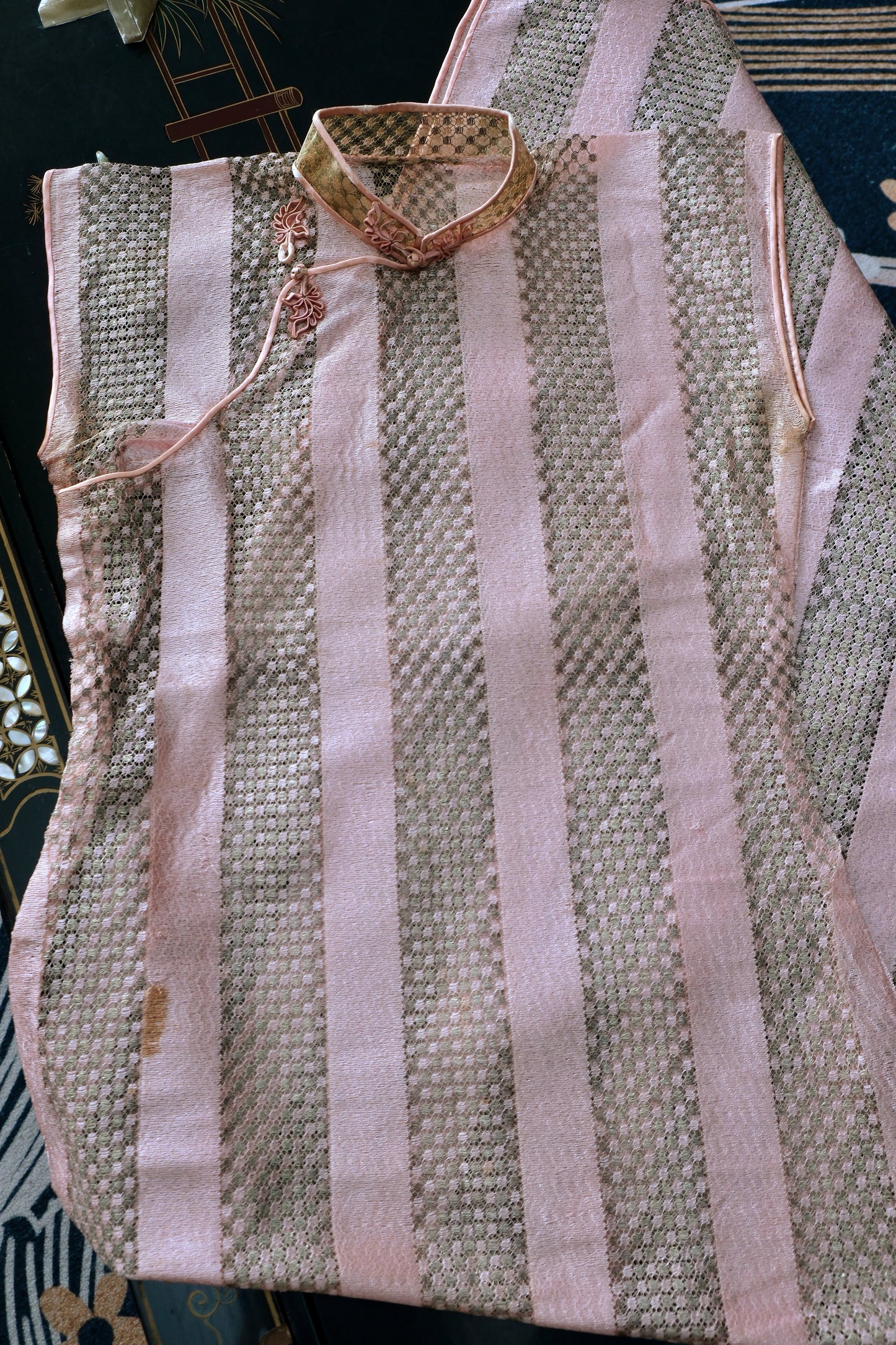
这件旗袍最摄人心魄之处,在于其面料的独特性——植入金属蕾丝。这并非普通的印花或刺绣,而是一种极高难度的织造工艺。
● 视觉韵律: 衣身采用了经典的竖条纹布局,但打破了传统丝绸的单一质感。宽条部分是温润如玉的樱花粉真丝缎面,象征着东方女性的柔美与温婉;而间隔其中的窄条,则是植入金属丝的镂空蕾丝。这种金属光泽在光线下呈现出一种冷艳的银灰色调,与暖粉色形成微妙的冷暖对比。
● 光影流动: 当穿着者走动时,金属蕾丝部分会随着身体的起伏折射出细碎的光芒,如同波光粼粼的水面。这种“虚实相生”的视觉效果,极大地修饰了身形,营造出一种如梦似幻的朦胧美,正应了那句“云想衣裳花想容”。
工艺考证:胶片领与立体花扣的绝唱
这件旗袍的领口设计,是断代其年份与等级的关键证据。
● 罕见的胶片领: 请注意领口的挺括度与光泽感。这是三十年代极为流行但如今已近乎失传的“胶片领”(也称假领、硬领)。当时的工匠会在领衬中夹入一层特制的赛璐珞(Celluloid)薄片或浆硬的衬布,外覆织锦缎。这种工艺能让领子始终保持直立、圆润,即便在炎热的夏季也不会软塌,展现了当时对“精气神”的极致追求。领面采用的金色织锦缎,暗纹繁复,尽显奢华。
● 精致的盘扣: 领口下方的立体花型盘扣,采用了与衣身同色系的粉色丝线缠绕而成,造型如同一朵含苞待放的兰花或梅花。这种盘扣不仅起到了固定的功能性作用,更是一件微型的雕塑艺术品,体现了“苏工”细腻的针法。
历史回响:张爱玲笔下的“乱世摩登”
若这件旗袍有灵,它定会讲述一段关于上海滩“黄金十年”的故事。
“对于不会说话的人,衣服是一种语言,随身带着的是袖珍戏剧。” ——张爱玲《更衣记》
这件旗袍正是那出“袖珍戏剧”的主角。它诞生于1930年代,那是中国女性意识觉醒的年代。她们开始走出闺阁,走进学堂、职场甚至舞厅。她们渴望展现身体的曲线,渴望像西方电影明星一样耀眼,但骨子里依然保留着东方的含蓄。
于是,设计师们大胆地将西方的金属蕾丝(象征工业文明与摩登)植入传统的丝绸旗袍中,用胶片领(象征秩序与端庄)来约束颈项。这是一种矛盾的和谐,正如那个时代本身——在战火与繁华的夹缝中,绽放出令人窒息的美丽。
稀缺性与艺术价值
在当今的古董衣市场上,保存如此完好的三十年代金属蕾丝旗袍凤毛麟角。
1. 材质的脆弱性: 金属丝线随着时间推移极易氧化断裂,而这件衣服的金属光泽依然清晰,说明其当年的用料极为考究(可能含有真银丝或高品质人造丝),且保存环境极佳。
2. 工艺的失传: “胶片领”工艺因舒适度和成本问题,在四十年代后逐渐被淘汰,如今只能在博物馆级的藏品中得见。
3. 色彩的永恒: 这种低饱和度的“樱花粉”极其难以染色,且容易褪色。能历经近百年岁月仍保持如此温柔的色泽,实属奇迹。
— Decoding the Supreme Craftsmanship of a 1930s Antique Qipao Featuring Inlaid Metallic Lace and a Celluloid Collar
The most mesmerizing attribute of this qipao resides in its hyper-unique structural composition: the strategic inlay of metallic wire lace (Zhiru Jinshu Leisi). This is fundamentally distinct from standard surface printing or surface embroidery; it represents an exceptionally advanced tier of mid-century textile engineering.
Visual Rhythm: The garment chassis implements a classic vertical pinstripe configuration, yet completely shatters the predictable, flat sensory limitations of heritage silk. The expansive vertical bands are executed in a warm, jade-like Cherry-Blossom Pink silk satin, semiotically mapping the interiorized tenderness and grace native to Eastern womanhood. Interspersed between these satin ribbons are narrower bands composed of openwork mesh lace into which genuine metallic wire has been structurally interwoven. Under shifting illumination, this metallic component yields a crisp, cool argent-gray luster, establishing a highly sophisticated, high-contrast dialogue between warm and cool color values.
Kinetic Light and Shadow: As the wearer moves, the inlaid metallic lace sections refract fractured glints of light along the organic undulations of the body, mimicking the natural play of sunlight across rippling water. This calculated aesthetic interplay between physical transparency and dense structural boundaries (Xushi Xiangsheng) masterfully re-proportions the silhouette, engendering a hazy, romantic atmosphere that flawlessly captures the classical sentiment: "Clouds bring to mind her vestments, and blossoms her countenance."
The structural design of this neckline assembly serves as the definitive primary physical evidence for calibrating both the precise chronological provenance and the haute-couture tier of this specimen.
The Rare Celluloid Collar: Particular attention must be paid to the absolute structural rigidity and surface finish of the high collar assembly. This represents a immaculate execution of the "Celluloid Collar" (Jiaopianling, alternatively classified as the rigid faux-collar or stiffened neck-band)—a structural methodology that reached its zenith in the 1930s but has since vanished from the contemporary apparel apparatus. To achieve this, master artisans encapsulated a custom-cut strip of genuine celluloid (Celluloid) or a heavily starched, bone-dry canvas core within an outer casing of premium jacquard brocade. This intervention compels the collar to permanently maintain an unyielding, pristine cylindrical geometry, strictly resisting collapsing or wrinkling even under the duress of humid summer climates—the ultimate materialization of the era's obsession with refined personal dignity and posture (Jingqishen). The face of the collar utilizes a golden jacquard brocade densely populated by complex, low-relief structural motifs, radiating a sovereign luxury.
Exquisite Artisan Frog Closures: Localized immediately beneath the collar band, the three-dimensional floral frog closures (Pankou) are meticulously wrapped with roseate silk threads perfectly matched to the primary grounding chassis. The geometry mimics an awakening orchid or winter plum blossom bud. These closures transcend their basic mechanical utility as fasteners to operate as miniature sculptural masterpieces, indexing the peerless needle precision and fine tension control characteristic of the elite Suzhou craft lineage (Sugong).
If this antique specimen possessed a conscious voice, it would narrate a definitive material history of the "Golden Decade" of old Shanghai.
"To those who cannot speak, clothes are a language; what one carries with them is a pocket drama." — Eileen Chang, The Record of Changing Clothes
This specific qipao performs precisely as the leading protagonist of that silent material drama. Birthed in the 1930s, it documents the historical window marking the awakening of Chinese female autonomy. Women were stepping decisively beyond the cloistered domestic sphere, entering academic institutions, professional workforces, and metropolitan dance halls. They actively desired the articulation of their anatomical curves and aspired to mirror the luminous presence of Western cinematic icons, yet remained fundamentally anchored by an interiorized Eastern modesty.
Consequently, the designers of this epoch boldly executed a structural synthesis: inlaying Western metallic lace—the literal symbol of industrial civilization and cosmopolitan modernity—directly into the chassis of a traditional silk qipao, while simultaneously deploying the unyielding celluloid collar to discipline and elongate the neck. This represents a highly complex, harmonious paradox, mimicking the exact spirit of the epoch itself: a breathtaking blossom of absolute elegance cultivated within the narrow fractures between impending wartime devastation and supreme urban opulence.
Within the contemporary international antique apparel market, a 1930s metallic-inlay lace qipao preserved in such an unblemished conservation state represents an extreme statistical anomaly.
Structural Volatility of the Material: Metallic wire filaments are highly prone to chemical oxidation, atmospheric embrittlement, and mechanical fracturing over long timelines. That this garment's metallic components retain such high-clarity reflective power indicates an exceptionally elevated grade of raw materials (likely incorporating genuine fine-silver wire or specialized high-purity artificial filaments), coupled with an immaculate, climate-controlled preservation lineage.
Lineage Discontinuity of Craftsmanship: The specialized engineering governing the "Celluloid Collar" was systematically abandoned after the 1940s due to shifts in ergonomic comfort priorities and industrial production costs; today, this technology can be examined exclusively within museum-grade permanent collections.
Chromatographic Permanence: This highly specific, low-saturation "Cherry-Blossom Pink" is notoriously volatile to stabilize during the dye-vat stage and is historically susceptible to photo-degradation. For this textile matrix to retain such a tender, uniform roseate saturation after traversing nearly a century of existence is a literal curatorial miracle.
This cherry-blossom pink metallic filigree qipao stands as a wearable masterpiece of fine art. It simultaneously documents the absolute peak of 1930s sartorial engineering and serves as a fluid, physical archive of cross-cultural reconciliation. For the textile archivist, it represents an irreplaceable, non-reproducible holotype within the history of pre-war Asian fashion; for its contemporary custodian, it remains a sovereign, cross-temporal testament to unyielding grace.